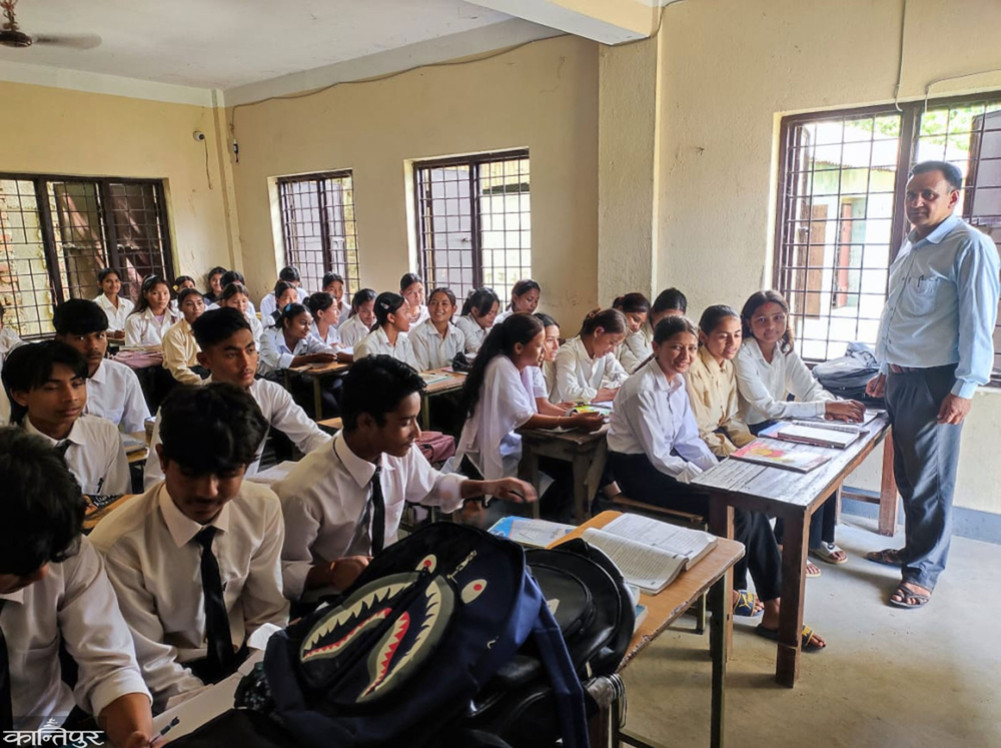
If public education becomes the 'exclusive domain of the poor', the higher income groups of society feel no political or social responsibility towards public schools.
We use Google Cloud Translation Services. Google requires we provide the following disclaimer relating to use of this service:
This service may contain translations powered by Google. Google disclaims all warranties related to the translations, expressed or implied, including any warranties of accuracy, reliability, and any implied warranties of merchantability, fitness for a particular purpose, and noninfringement.
Strong public education with equal participation of all children in the country is the cornerstone of democracy, shared prosperity, progress, peace, unity, social solidarity, equality and inclusiveness. Therefore, all the countries of the world have accepted public education as a human right.
Since education is a matter of public or common 'good' or 'interest', it has been established internationally that investment in education is the responsibility of the state. Therefore, the main objective of the public policy on education is to build a quality, inclusive and equitable public education system for all.
Recently, a public statement given by the education minister of Nepal, Raghuji Pant, has raised a great debate. He said, "Public education is only for the poor, the helpless, the poor." Why do we need public education for the children of the able-bodied, wealthy and wealthy? Why do they need government or public schools?'
At first glance, this idea may seem like an argument with the state that 'given priority to the poor due to limited resources', but if we look deeply, this approach is directly opposed to the essence of the education policy and the clear purpose of our constitution.
This approach is a way to make the public education system a 'low-quality alternative for the poor', which not only encourages the expansion of private schools and fee hikes, but also institutionalizes class divisions in the education system. This weakens the vision of building an inclusive, socialist and democratic society embraced by Nepal through its constitution and international declaration.
Education is a right, not a facility
Article 31 (1) of the Constitution of Nepal clearly mentions - "Every citizen shall have the right to basic education and it shall be free." Therefore, it is inconsistent with the language of our Constitution to say that public education is only for the poor.
This point of view is also confirmed by Article 26 of the Universal Declaration of Human Rights of the United Nations of 1948, "Education - at least at the basic and elementary level - shall be free to all." Here too, there is no mention of the provision of separate education according to income or social status.
Sustainable Development Goal 4 – which has been adopted globally, including in Nepal, includes ensuring free and equitable primary and secondary education for all, quality early childhood development and expanding access to vocational and higher education, and achieving youth and adult literacy globally.
It is a common belief around the world that education is the responsibility of the state and that the education provided by the state to all citizens with equal opportunities is a fundamental right of citizens, which cannot be limited by the logic of individual property or the market.
Public education: the backbone of social cohesion
What if public education is restricted to the underprivileged? In such a situation, government schools get the tag of 'poor people's schools' and only children from rich families study in private schools. The society is thus divided into two distinct educational and cultural poles—the 'privileged' class on one pole and the 'limited opportunity' class on the other. When education becomes the basis of class division, social cohesion, tolerance and democratic values gradually weaken.
Only when public education is open to all do schools remain a common public space in society, where children from different backgrounds can have common experiences in the same classroom and playground. Such experiences create a sense of mutual understanding and equality among citizens in the future. Fragmented or weak public education is the bane of democracy.
Benefits for the private, loss for the public
Minister Pant's statement that 'people with the ability and resources do not need public schools' is not limited to this. This leads to three major consequences: First, the private school market expands: By pushing affluent families out of public schools, they become consumers of the private sector, giving private schools more freedom to raise fees.
Second, lack of resources in public schools: If children from families with limited income only attend public schools, school resources and public support will decrease. Without the voice and pressure of the affluent community, the pressure on the state to improve quality is reduced. The universal experience is that elites do not leave public service alone, they inspire others to leave that service as well.
The exodus of the affluent weakens public schools politically. Being politically weak means not having access to policy and resource distribution levels. For this reason, the education system of many countries that have adopted a policy of building strong public education for the poor without organizing and regulating the private level, have become more and more in crisis.
Thirdly, the class division of quality in education: private schools are transformed into the paradigm of 'quality' and public schools 'inferior'. It is a stain on the public character of education to elevate it to the policy level that those who can afford it and get higher education.
This article does not mean that families should not be given the right to choose schools for their children and that schools should be prohibited in non-public areas. Any policy has two meanings – the explicit one, which is directly visible in its purpose and language, and the indirect one, which is hidden in its inner aims, presuppositions or unintended consequences. To show 'compassion' that the state should only care for the very poor and helpless is to openly encourage the private sector operating commercially and profitably. Education is not a favor, it is a right and public policy must protect that right.
Lack of coordination among policy makers
In recent years, many municipalities have been working hard to improve public schools. In some places, it is heard that public sector employees are encouraged to enroll their children in public schools. Some media have mentioned that thousands or hundreds of students have returned from private to public schools in some municipalities.
The reason why Minister Pant's statement and the municipality's campaign to return students from private schools are contradictory to each other is that different levels of government have different priorities or perspectives. While the minister's statement indicates that private education can be supported or accepted in one way or another, when the municipality is insisting or pressuring students to return to public schools, it creates confusion among the public and shows a lack of coordination between different levels of government or policy makers about the role of private and public education.
The municipality does not seem to have an in-depth study of educational work but they are on the right track with their mandate as they aim to create equal opportunities and space for all. As mentioned earlier, if public education becomes the 'exclusive domain of the poor', the higher income groups of society feel no political or social responsibility towards public schools.
This begins a long-term cycle of declining public school quality and ultimately weakening the public education system. Thus, divisions in education increase political polarization and social distance. Public education should remain a common institution serving all classes of citizens, for the quality of which all sections of the society should have equal pressure and interest.
The constitution of Nepal has also defined the education system as a means of socialist orientation. This means that education is not just for personal financial gain, but for equality, social justice and collective progress.
The correct answer to the education minister's question, 'Why do the able and well-off need public schools?' is this - because public schools are the common property of all citizens. It strengthens democracy, unites society and instills a sense of equal opportunity in future generations. Public education being 'public' means that it is for all, not just the economically disadvantaged.
Nepal's constitution, international recognition and democratic ideals compel the state to provide quality and equal opportunity education to all citizens. So don't let the public education system become a tool of class division. Let's invest in building high-quality public schools that cover all classes. Let's treat education as a 'right', not as a 'gift' or a 'privilege'. This is the only way, which can move Nepal towards building an inclusive, equal and united society.