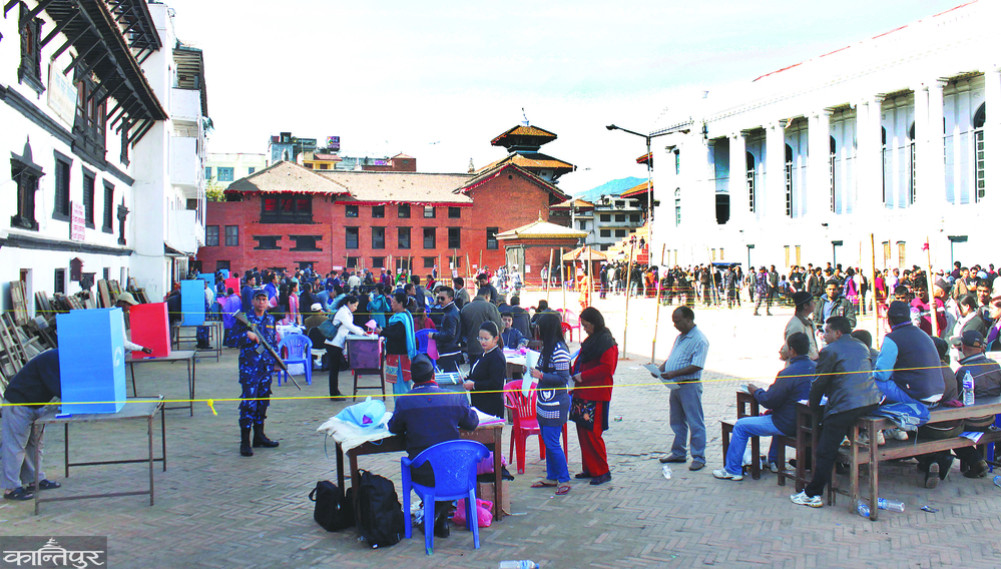
If the Constituent Assembly election had been held around 2010, Nepal would have become a federal republic right away and we would not have had to wait for several decades between us.
We use Google Cloud Translation Services. Google requires we provide the following disclaimer relating to use of this service:
This service may contain translations powered by Google. Google disclaims all warranties related to the translations, expressed or implied, including any warranties of accuracy, reliability, and any implied warranties of merchantability, fitness for a particular purpose, and noninfringement.
First, the constitution could not be created by the Constituent Assembly. The constitution was made in the year 2072 through the second election. Accordingly, federal parliament, state assembly and local level elections were held in the elections of 2074 and 2079. Govt. Meanwhile, secularism and federal democratic republics have become more institutionalized.
Some questions arise regarding the Constituent Assembly. For example, can the governance system of the country not function without the constitution? Why and how did the idea of the Constituent Assembly come to us? Why did we hold the election of the Constituent Assembly? If the election of the Constituent Assembly had been held 6/7 decades ago, what could have happened?
In a democratic country, the tradition of making a constitution has started with the aim of making the various organs and bodies of the state run smoothly. Britain is an old democratic country with no written constitution. Perhaps because the development of democracy there was gradual (it took time to take away power from the king and transfer it to the people), there was no need for a written constitution. The United States is the oldest democratic country in the world. Which is governed by a written constitution. However, the democratic system is a completely new concept in the political history of mankind, which has gradually developed. Its development process seems to be accelerating after the Second World War.
For the first time in Nepal, the word constitution is used in the 2015 constitution. Before that, Rana Prime Minister Padma Shamsher issued the 'Constitutional Law of Nepal' on 12th January 2004. Similarly, in 2007, the concept of state management was made public through the 'Internal Government Act'. The first constitution of Nepal is the 'Constitution of the Dominion of Nepal', which was issued by King Mahendra. Mahendra implemented a non-partisan constitution in 2019 after 'coup' the government of the first elected Prime Minister Vishweshwar Prasad Koirala on January 1, 2017. Along with that, the 2015 constitution was repealed. The Constitution of 2019 was also repealed along with the Constitution of the Dominion of Nepal, 2047, which was made after the people's movement of 2046. According to the 2047 constitution, general elections were held in 2048, 2051 and 2056.
Meanwhile, the armed rebellion started by the CPN-Maoist in 2052 lasted for almost a decade. In 2058, the dynasty of the then king Birendra was destroyed. Raja Gyanendra Shah became the gaddinsin. Soon after, a 12-point agreement was reached between the Maoists and seven political parties. It was on this basis that the second mass movement took place in 2062/63. It resurrected the dissolved parliament in 2059 and brought the Maoists into the political mainstream. An interim constitution, an interim parliament and an interim government were formed. Accordingly, the first election of the Constituent Assembly was held in 2064. In this context, there is a remarkable issue, the main demand of the Maoists was that the election of the Constituent Assembly should be held through adult suffrage. Therefore, the people should consider that constitution as their own.
The question before us is why the Maoists demanded a Constituent Assembly. Two words are attached to the name of the then Maoist – Communist and Maoist. The Communist Party has an affinity for the former Soviet Russia, where a communist government was established after the Bolshevik Revolution. Was there a constitution made by the Constituent Assembly? The name Maoist is inspired by the ideology of China's Mao Zedong. Is the constitution made by the Constituent Assembly in China? In both these countries, these countries are running on the political philosophy of the dictatorship of the proletariat, which has turned into a one-party dictatorship. However, there has been some change in the fragmented Russia. In such a background, why did they include the conditions of the Constituent Assembly in the 12-point agreement in Delhi? How did the idea of Constituent Assembly come to the then top leader of Maoist?
Because the Maoist leaders understand the importance of public opinion, they gave more importance to the issue of Constituent Assembly elections based on adult suffrage compared to the other seven parties. Among the seven parties, Nepal Sadbhavna Party must have accepted the issue of the Constituent Assembly because this issue was raised by the late leader Gajendra Narayan Singh, the founder of that party. Congress had abandoned the issue before 2015. Why would he have participated in the 2015 parliamentary elections if he had not left it? What if he had boycotted that election? However, the then Chairman of the Congress and former Prime Minister Girija Prasad Koirala certainly did not raise the issue of the Constituent Assembly during the 12-point agreement. His only aim was to gain power. In which he was successful.
Is the issue of the Constituent Assembly raised by the Maoists for the first time?
After the Second World War, a party named Praja Parishad was established in Kathmandu in opposition to the Rana regime. The common people were also active against the Rana regime. The execution of four people raised political interest. At that time, the Nepali youths participating in the freedom movement in India, including the students studying there, united and established the Congress. who started an armed movement against the Rana rule. At that time, the then King Tribhuvan had taken refuge in the Indian embassy after being defeated by the Rana regime. Later he reached Delhi.
Against this backdrop, a three-point agreement was reached in Delhi, mediated by India. It is understood that Congress had no direct involvement in reaching this agreement. His words were put through Indian Ambassador Chandrashwar Prasad Narayan Singh. In three points, the new constitution was to be created by the elected Constituent Assembly, the formation of a joint government with the participation of the Congress, and the recognition of the king as king. The question arises, who raised the issue of the Constituent Assembly in this agreement and kept it?
The issue of the Constituent Assembly cannot have been raised by the king in the Delhi talks. Because the first main desire of the king, who had lived like a prisoner in the Narayanahiti court all his life, was to bring back the right of the king from the Rana rulers. This issue may not have been raised by the king because his knowledge about the role of the Constituent Assembly in the creation of the constitution may be limited.
It is unlikely that this issue could have been raised by Nepali Congress leaders who indirectly participated in the Delhi talks. Because Vishweshwar Prasad Koirala in his autobiography has called the Delhi Agreement a 'fantasy'. It cannot be imagined that this issue was raised even by the Rana Prime Minister's representatives. Because Prime Minister Mohanshamsher did not allow the statutory laws issued by Padmashamsher to be implemented. It was impossible for him to come up with the idea of a new constitution and the idea and proposal to make a constitution from the elected Constituent Assembly. So Delhi, which is mediating the talks, should definitely have raised this issue. The credit goes to Jawaharlal Nehru, the Prime Minister of India. Because, the Constitution of India is also made by the Constituent Assembly itself. Similarly, this point should be kept with the thought that a democratic constitution cannot come from a committee formed by the king and adoption by the people can only be possible in a constitution formed by the Constituent Assembly.
According to the Delhi Agreement, a government of Rana and Congress representatives was formed under the continuation of Rana Prime Minister Mohan Shamsher. But this government disintegrated within a few months and a new government was formed under the leadership of Congress leader and hero of the armed movement Matrikaprasad Koirala. Regarding the Constituent Assembly, Nehru wrote to Prime Minister Matrikaprasad Koirala in a letter dated 6 June 1952 - We hoped that the Constituent Assembly would be formed within a year and a little more and that the state would be run according to the advice of the Advisory Council during that period. But neither anything has happened regarding the Constituent Assembly nor the Consultative Assembly has become active. Even with such measures, the issue of the Constituent Assembly did not progress and the government did not get stability. And, in the meantime King Tribhuvan passed away and his successor King Mahendra made KI Singh, Tank Prasad Acharya as Prime Minister. But the issue of the Constituent Assembly did not go forward.
The king decided to hold parliamentary elections instead of the Constituent Assembly and the Nepali Congress also chose parliamentary elections for power. In the constitution issued by the king, the king was given the right to dissolve the parliament. Accepting this provision, the Congress participated in the elections. obtained a two-thirds majority. A government was formed under the leadership of Visveshwar Prasad Koirala. King Mahendra dismissed him on 1st December 2017 and took over the government.
King Mahendra wrote a letter to Pandit Nehru the very next day. However, the information was not made public and the response to that letter was also not made public. About 58 years later, the details were made public. Now I have typed copies of letters written by both Raja and Nehru. Nehru wrote his reply more than a month after receiving Raja's letter. He writes in his letter apologizing for the delay in replying to the letter – First, as in the letter you sought to give notice of the royal action which you yourself have been pleased to take, I was quite confused as to whether or not you were looking for any particular kind of reply in that case, and also unclear as to what to write to you under the present circumstances.
The letter from the king is short and two paragraphs long. Nehru's letter is long, which is natural. He writes - Later I found out that the newly appointed minister Dr. As Tulsi Giri was coming to meet me, I waited to have a conversation with her. Talked to him for two hours. In the letter, Nehru has also included the Delhi Agreement of 2007 while referring to his political history and socialist character. Nehru advises the King regarding the allegations of corruption etc. imposed by the King on the Congress - I would like to seriously request the King not to look at the present situation but also to consider the realities related to the future when they reveal themselves.
If I dare to give my advice to the Maharajadhiraj, the current crisis should not be allowed to remain in this state and some steps should be taken as soon as possible to give the citizens of Nepal the right to express their views. If the existing parliament cannot be reconvened, fresh elections can be held.
Mentioning that he was deeply saddened by the steps taken by the king, Nehru, reiterating his old advice to the king, writes – I have told you several times that there were only two main stable elements in Nepal. First, the King and secondly, the Congress which was the only organized political party with the popular support of the people....Therefore it seemed to me absolutely necessary that the two stable powers should fully co-operate with each other. If not, the alternative would be lack of monitoring and continuation of stability and... I am afraid that the 'tussle' between these two will prove harmful for Nepal.
Jawaharlal Nehru's prediction was definitely disastrous for the monarchy, but what happened to the country? It can also be evaluated. If the Constituent Assembly elections had been held around 2010, as Nehru thought, Nepal would have become a federal republic right away and we would not have had to wait for several decades.
If the constitution was made at that time, would there have been more than seven provinces and fewer than 77 districts? Did Sihdarbar's power reach villages through provinces instead of Baluwatar? The political leadership did not follow the bureaucracy, but did the bureaucracy follow them? Would it be easy to appoint employees to the provincial and local levels so that it would be easy to implement federalism? Did local people's representatives pay more attention to their rights and duties? Would maturity come to leaders?
Therefore, the honorable members of the federal parliament and the provincial assemblies did not have the habit of going out after declaring their presence in the meeting? Wasn't there a situation where the quorum was not reached due to lack of presence of members of parliament? Didn't the Prime Minister and former Prime Ministers consider it disrespectful to attend the meeting of the Parliament? The leaders of the party did not make their place of residence the headquarters of the party? Today, the beautiful scenery of Terai Madhesh-Mountains would not be lost and Charkose Jhari would not turn into Madhesh desert after drying up? The population of the mountains did not leave the mountains and moved to the plains? The land of the mountains was not barren?
At that time, if a democratic republic had been established by making this constitution, the monarchy would not have wasted 6 decades to preserve its existence. Sometimes there was no such thing as dismissing the elected government, sometimes bringing independent panchayat system, sometimes taking the government in their own hands. In order to preserve its power, sometimes it was not necessary to please China and sometimes to please India. This tendency reached the politicians and the leaders also spent their time in preserving power. As a result, thousands of people died in the Maoist armed conflict. Thousands of activists ended up in prisons and in exile in India.
Millions of young people have migrated abroad today. There are no men to go to Malami in the mountains, and there are no young men to plant rice in Madhesh. If the attention of our leaders was towards the people and not towards power, dozens of hydropower plants would be running. Instead of importing petroleum products from India, we used to export electricity. We used to export rice instead of importing it. India and China would try to please us.