The money earned in Arabia, Malaysia, Korea is also flying there, and our preparation for the future crisis is zero. Just as we are engrossed in sitting on a pointed stick, in the same way our state and politics are blindly sailing the ship to reach the destination.
We use Google Cloud Translation Services. Google requires we provide the following disclaimer relating to use of this service:
This service may contain translations powered by Google. Google disclaims all warranties related to the translations, expressed or implied, including any warranties of accuracy, reliability, and any implied warranties of merchantability, fitness for a particular purpose, and noninfringement.
projectionLet's start with a hypothesis. Supposedly, the global crisis will send at least 3 million Nepalis back to Nepal within the next ten years. 90 percent of them will be Nepalis of active age earning remittances and working abroad on employment visas.
Let's assume that fifty percent of them will not have paid off the loan they took to go to work abroad or to buy real estate or to enter Europe/America.
Now let's brainstorm based on this assumption. Will such a situation be a natural situation or a crisis situation? What kind of economic environment will be created when remittances sent by such a large workforce are suddenly stopped? What will be the effect of mass unemployment and its cyclical effects? Will there be a food crisis or not?
What will happen to trade, business and the banking system when the source of remittances dries up in large numbers? What will be the impact on the government budget? Can the government spend on social security, education, health, etc.? What will be the salaries and pensions of the army, police, employees, teachers, health workers etc.? Does daily life remain natural? What will be the status of social security and peace?
Many such questions can be thought of. Because the effects of such phenomena are multidimensional and the situation cannot be assessed without creating questions from all dimensions. Supposedly, year after year, an increasing number of people turned back. In such a situation, the national crisis also becomes more complicated and dangerous year by year like the scale of an earthquake. When you take another step to see if you are submerged up to your waist, you suddenly sink up to your toes without moving. Are we ready to face such a bigger challenge?
some
of reality Can this assumption not be true? This columnist has repeatedly tried to discuss the possibility of such a terrible situation happening any day through various media, movements and elections. After Donald Trump's American administration began to "deport" thousands of people in the style of kidnapping, the Nepali society has also been shaken.
The American administration also loaded many Nepalese people into a military plane with handguns like Chordankulai and brought them to Tribhuvan Airport and released them. That scene points not only to national shame, but also to a doomed national future.
This is the time of massive changes in the world order. The world order, which revolves around American economic and strategic power, is about to collapse. In the words of American political scientist John Mearsheimer, with the rise of a multipolar world, history has also determined the collapse of the US-led 'liberal international order'.
Whether it is Trump's tariff war or the campaign to chase immigrants, these are some of the emotional explosions seen in the collapse of the world order. The turmoil in the international system has also created an unnatural vibration in the national life of the developed European and American worlds. This is the result of the fierce debate going on in the Western world (Global North) about the crisis in liberalism, democracy and capitalist system.
The countries where our young people are eager to jump by selling houses, taking loans on metered loans are the same countries where one after the other Trumps of different faces are coming to power. While visiting the so-called developing and underdeveloped countries to teach them the evils of globalization, nationalism has been awakened in their own countries. Anti-immigrant, racist and white supremacist issues are winning elections.
The liberal philosophical system born and raised by Europe and operated under the American monopoly for eighty years is in crisis from the navel. Events such as political crisis or strategic war tend to end at a point, but the breakdown of a philosophical system leads to a series of multiple crises.
Be it the Russia-Ukraine war or the Israel-Iran war, the US-China trade war or Israel's Gaza massacre, these and similar tragedies are just a few glimpses of the collapsing world order. The supremacy of the US dollar is being challenged by the emerging powers of the Global South such as China, India, Brazil, and Russia.
The financial crisis of 2008 intensified global distrust and revulsion at the American (and, by extension, European) financial system. The continent of Africa is gradually rebelling against American and European domination. The Arab world, which built an oil economy as part of the existing world system, is no longer safe in terms of economic and strategic systems. The Japanese and South Korean economies, which flourished under the American umbrella, are also under great pressure.
What are we doing when the world order is on the verge of explosion? How are we assessing the future as a country, as a society, as a family or on an individual level? Nepal is not the dream country of our youth and the land that is considered as a dream country is also considered as a hateful immigrant. Stories are being made public in America that many Nepalis are in a situation where they have to hide and collect donations. In other words, the signs that we are speeding towards a crash are everywhere. But is there any light on in the brain of our state and society?
Blind country
The budget of 19 trillion 64 billion recently brought by the government gives any direction to the country? Does the budget that spends 80 percent on running the government and paying the debt try to move the economy on any campaign? Does society give any assessment and vision of the future? Budget is just an example, our national life is blindly and stubbornly based on tradition. Our principle is 'what goes is what goes'.
Anthropologist Dor Bahadur Bista theorized the similar character of the Nepali state and society in a different context and called it 'fatalism'. Bista's conclusion is that the influence of fatalism is pushing towards the opposite results in matters such as the concept of planning, future-oriented thinking, awareness of cause-cause relationship, human dignity and punctuality (Fatalism and Development). Even if it is a
, the principle of political parties does not seem to rise above winning elections by paying toll. The character of the country is blindly understood just by looking at the rush of parliamentarians to budget for development plans, budget programs and retail projects in their area.
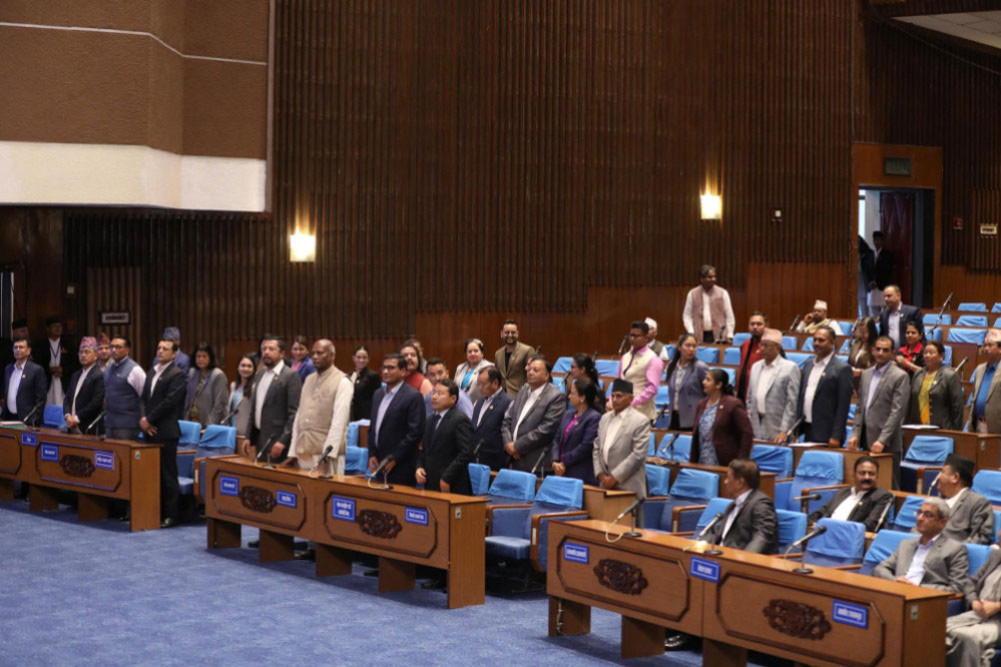
Listen to the Parliament debate. Apart from holding the tail of the news published in the media and making speeches, it is not seen that the parliamentarians put forward any original thought and conduct the debate. Amidst the rumors that the media has been eaten by social media, at least they are reading newspapers! And looking at the compatibility between being in the government and not, there is a situation to be satisfied that they are raising something or the other.
They don't realize that the bill that has already been made into a law by itself is not only 'total' but the 'cooling period' is already gone. There is a parade of colorful scandals, pointless debates about monarchy, shouting and sloganeering, but nothing meaningful about the border and crisis of the country. There are MPs all over the country, but the country does not meet in parliament.
Andhra Nationalism has become a permanent disease. A vivid example of this was presented in the context of the cancellation of USAID. While Elon Musk was running a chainsaw on USAID, Trump also called Akkalzhukkal Nepal's name. Naturally, since 2008, USAID has been providing 'aid' to many political and economic projects in Nepal.
It was called American 'soft power'. Trump didn't think it was necessary, closed it. In this indiscriminate country, the state and political parties remained unresponsive when the anti-nationalists made an opportunity to attack some artists and writers. In fact, this is a topic that should be deeply debated. Not just an event, but a sign that the 'tectonic plates' of the world order have shifted.
The current budget promises to raise around Rs 3 trillion from foreign loans and grants. It is estimated that the revenue will not cover the current expenditure. The account of the money coming through the INGOs of countries that want to practice soft power has been separated. After Trump's pressure policy, European countries including Japan are increasing their defense budget to a large number.
Just as the United States canceled the USAD, the European countries have also said that they will cut the amount of aid given to the "underdeveloped" countries. What kind of crises can it cause in our budget and economic life? How does a state that is drowning in dependency face this challenge?
Andhra Nationalism can divert the topic, but it does not escape from the truth. Will the government now put up a hole-in-the-wall or cover up the crisis with colorful paintings? A cancellation of USAID has left many people unemployed, various government and non-government projects have been cancelled. Other projects are almost certain to close or shrink. Jobs or programs available through government or NGOs in the fields of health, education, technology, drinking water, infrastructure, etc., from small shops to large hotels, were directly flowing foreign grant money into the economy. Hasn't there been any pressure on the economy due to the changes that have come now? Trying to walk blindly now?
Ular framework
Theoretically, development projects, whether USAID or any other, are colonial instruments. Finally, it is necessary to be freed from their occupation and become a self-sufficient country. Without self-reliance, self-esteem does not develop. However, the truth is that we are drowning in the historical quagmire of dependency. Getting out of there requires a realistic assessment of reality as well as future-oriented plans and dreams.
Congress, Communist, Madhesh government all the people felt the same why? Its root cause is also hidden in this dependency. This dependence has an ideological dimension greater than the economic one. A person who invests billions of money and jumps to America is not doing so by setting up a profit and loss account, he is investing in an abstract dream called America. This is an ideological cobweb which our government, education system and social system are entangling every day. The money earned in Arabia, Malaysia, Korea is also flying there. And, our preparation for future dire crisis is zero.
Nepali state's tail has been shaken, society's cart has also been shaken. We haven't got it yet or even if we do, we are afraid to go into public discussion. Just as we are engrossed in sitting on a pointed stick, in the same way our state and politics are blindly sailing the ship to reach the destination. The essence of politics is to recognize the challenges rooted in the present and to give ideological and organizational leadership to the society to face the crises that may develop in the future. Can our politics handle this magnificent Ular of the blind country? This is the topic of discussion.