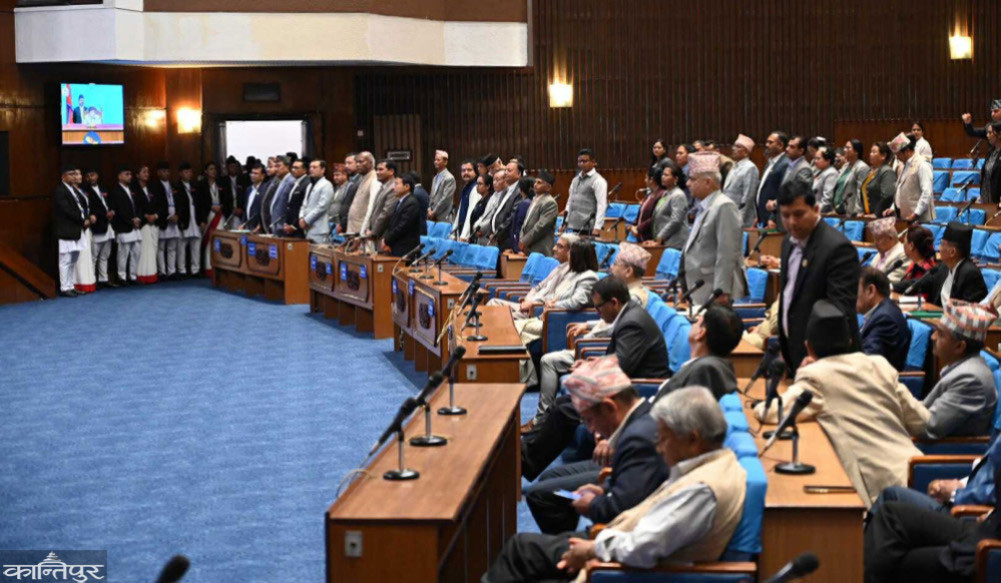
In order to make the legislature effective, the representation and entry of vested interest groups should be prohibited. In the context of Nepal, the influence of interest groups is seen in various bills and laws including School Education Bill, Civil Service Bill, Cooperative Law, Land Bill, Financial and Banking Bill.
We use Google Cloud Translation Services. Google requires we provide the following disclaimer relating to use of this service:
This service may contain translations powered by Google. Google disclaims all warranties related to the translations, expressed or implied, including any warranties of accuracy, reliability, and any implied warranties of merchantability, fitness for a particular purpose, and noninfringement.
In society there are people with vested interests and various interest groups. They look for the nearest place (venue shopping) that fulfills their desires, interests and benefits to make their favorable decisions. If it is easy for the interest groups to make decisions from the government, they will choose the executive, if the executive is not favorable to them, they will pressurize through the legislature to fulfill their interests through the law itself. Similarly, if they see that it is easy to make a decision from the judiciary, they use the court as a nearby place.
In this way, vested interest groups are looking for a place where it is easy to make decisions favorable to them. Self-interested groups try to influence the political parties to become candidates in the elections or to make their own candidates and win, to manipulate the government, and to influence the court from the moment they appoint a judge. Similarly, the Commission for Investigation of Abuse of Authority is exerting influence on the appointment of officials so that they do not take action on matters of their own interest in the abuse of authority.
Since the constitution is the basic law, the political interest groups keep the corresponding provisions in writing the constitution to protect their interests. Similarly, those who want to be appointed to a constitutional body or other public position emphasize their own qualifications. In this way, the constitution formed by vested interests cannot address the wishes of the common people.
The content of the constitution should be able to connect the rights of everyone. If this is the case, there will be adoption and acceptance of the constitution of the people. Constitutions and laws created by vested interests cannot provide strong rule of law and good governance. Similarly, in the laws made by the legislature, interest groups are active in one way or another from the initial draft of the legislation to the verification stage. In this way, the laws made under the influence of vested interest and pressure cannot serve the interests and welfare of the common people.
Law purpose and conflict of interest
Law is an important tool for governing society. Law is a collected system of principles with binding force. The purpose of which is to ensure peace and security in the society as well as the protection of civil rights and freedom and social welfare. Law is a strong force, which is the nature of good law that applies equally to all and is used equally. In order to respect and follow the law, such law should be constructed focusing on the broader interest of the nation and the people, rather than on the private benefit of vested interests and interest groups. In order for
laws to be implemented in society, such laws must cover the aspirations of the common people. In this context, jurist Joseph Raj has said that laws are a powerful tool to combine the desires and aspirations of the people, so such laws are enforced. In this way, to internalize the supremacy of the law and transform the principle of the rule of law into practice, laws should not be made for the vested interests of individuals or unfair interests of groups.
In modern times, legislators who make laws are under the influence of some interest group, and as a result, bad laws have been created, so 'conflict of interests' has developed to prevent it. Such self-interested acts are placed under the broad spectrum of corruption. In this way, the main reason for adopting the principle of conflict of interest in the legislative process is to ensure good governance, to increase public trust towards those who use state power, to bear international responsibility for the state party to the Convention against Corruption, and to exclude such persons from the process of law-making in matters of self-interest.
In various democratic countries of the world, it seems that in order to prevent conflict of interests in the making of legislation, legislators must make their and their family's assets public, must declare themselves to separate themselves from matters of vested interest, do not give donations, gifts, hospitality without the approval of the government, and must not work elsewhere in a conflict of interest as long as they remain in the position of legislator. It is necessary to implement such a system in the context of Nepal and effectively monitor it.
Legislation in Nepal
Here, the society has been governed by customs, traditions, traditions and scriptures. V.No. In 1910 the first codified 'Land Act' was promulgated. These laws were discriminatory on the basis of caste and in some cases unscientific. V.No. In 2004, the Government of Nepal issued the Statutory Law, 2004 Constitution, but it was not implemented. It was only intended to stop the movement of the people.
Construction of modern laws in Nepal It seems to have happened after the 2007 political change. Due to political instability, some of the laws made at that time could not be effective. V.No. It seems that some important laws have been made under the 2015 constitution. During the 30-year reign of the Panchayat, some laws such as the new Civil Act and the Land Act were enacted, which played an important role in improving the society and improving the land, while a control-oriented legal system was created in relation to human rights and freedom of expression. This is also the reason why public opinion remained against the Panchayati independent governance system.
vs. Although the constitution of 2047, which was issued after the historic people's movement of 2046, had some liberal provisions, the laws issued during the time of crisis and the direct rule of the king came to appear as unconstitutional and human rights and freedom-oriented laws.
Although the constitution was liberal, the constitution of 2047 ended as a result of the armed rebellion and people's movement due to the illiberal behavior. Although the interim constitution issued as a result of the people's movement of 2062/63, the constitution made by the Constituent Assembly and the laws at that time were focused on the protection of civil rights, due to the lack of development of political culture in political parties and the power-centered political thinking, the law enforcement side has become very weak.
Good governance could not be satisfactory. Corruption has increased in every sector. Although the Constitution of Nepal, issued in 2072, aims to establish a socialist-oriented state system by guaranteeing basic fundamental rights and adopting the principles of liberal democracy, the study of some bills has shown that in practice, the thinking of making laws is developing towards the control of civil rights.
Rest Period and Civil Bill
It seems that modern states have accepted the 'rest period' (cooling off period) for a certain period to prevent the conflict of interest due to the fact that the person in the regulatory body of the government service, after retirement, works as an employee or consultant of the organization to which he was responsible for regulation, has unfair relationship with the political sector for appointment to constitutional bodies or important government positions, and the fact that the condition of good governance will be weakened. Such a break period seems to be 2 years in the UK, 2 years in India, 1 year in the US, 2 years in Japan, 2 years in Canada, 18 months in Australia.
In the context of Nepal, the desire of the people's representatives to have a rest period arrangement was added to the main civil service bill in section 82, sub-section (4) so that no appointment can be made for two years. When the sub-sections of the main bill are arranged, sub-section 4 is sub-section (5) and the provision of sub-section (5) of clause (a) states that constitutional or diplomatic appointments and any other appointments made by the Government of Nepal are contrary to the accepted principle of the rest period.
Even if the bill passed by the error committee is more than a month and a day after the report, it has been seen that the issue that has not been paid attention to by the relevant stakeholders should be taken seriously. It seems that the parliamentary committee formed to investigate the lack of legal identity has concluded that the sub-committee, the committee, the assembly, the bill presenting ministry and even the ministry responsible for preparing the draft have not fulfilled their responsibilities.
It is exemplary that the House of Representatives itself constituted a parliamentary inquiry committee on the issue of this kind of 'serious error' in the bill. If the parties involved in the drafting of the bill are unable to take serious responsibility for such a serious error, they should self-examine.
People can create an understanding that legislators are not serious about making laws and are falling under the clutches of interest groups. In order to benefit the people in a democratic governance system, it is necessary to form a legislature based on the votes of the people through fair elections, a government accountable to the people, an independent and competent judiciary, an aware civil society and a conscious citizen.
Legislature must be able to prohibit the representation and entry of vested interest groups in order to be effective. Reforms in the electoral system are necessary to revive the constitution. Similarly, there is a need for improvement in the existing situation regarding the appointment of officials in important state bodies including constitutional bodies. To make the constitution dynamic based on political consensus, it is necessary to amend the constitution accordingly. Areas of
reform The act of
lawmaking itself is a subject requiring technical skill and knowledge. The words, phrases, sentences and clauses mentioned in the law should be simple and clear. The Legislature should make laws prioritizing the issues specified by the State's Directive Principles and Policies on Fundamental Rights and Human Rights, Good Governance and Sustainable Development.
It is necessary to transform from the traditional type of legal system to a modern legal system. For this, it is necessary to codify laws, transform technology systems into legal systems, provide legitimacy to scientific research, data privacy, cyber security, and online platforms. Similarly, to develop a legal system that makes public rights users more accountable, specialized laws, an equitable legal system, and a legal system that has the power to solve existing challenges, it is necessary to create laws in these areas and implement them effectively. It seems that the
law is not being implemented effectively. In that case, it has been seen that there are issues such as corruption, lack of necessary resources, lack of capacity, increasing distrust of public bodies and officials (trust deficit), indifference among law enforcers, unreasonable laws, and legal provisions that have double or ambiguous meanings.
Laws should be made according to the needs of the society. Pressure groups can influence the government, parliament, and MPs in various ways for their unfair advantage. In the context of Nepal, the influence of interest groups is seen in various bills and laws including School Education Bill, Civil Service Bill, Cooperative Law, Land Bill, Financial & Banking Bill.
Similarly, it cannot be said that interest groups have not had any influence on the issue of withdrawing the cases of those convicted of serious crimes, or denying pardons, and the bill being prepared to allow polygamy. On the one hand, due to the improper influence of interest groups on the bill and on the other hand, errors are made in the draft of the bill, the state of good governance is not satisfactory as good laws cannot be made.
Errors in the legislative process include trying to get the bill passed in a hurry for political gain, not having a comprehensive discussion at various stages of the legislative process, not having an easy system to give suggestions to the people in the legislative process, and passing the bill without evaluating the impact of the law.
The practice of passing some Nepal Acts as amendment bills by keeping many issues together can lead to the creation of bad laws because the manipulation of interest groups will get more opportunities and it will not be seriously discussed in the legislative assembly. It is necessary to pay attention to these and such aspects in the legislative process and improve them in time.