Will the Land Act under discussion in Parliament make clear provisions about the landless? Let's hope, soon, the provision of permanent residence will be ensured for the Bankaria and other similar housing and landless people and they will also be able to enjoy the constitutional right to live with dignity.
We use Google Cloud Translation Services. Google requires we provide the following disclaimer relating to use of this service:
This service may contain translations powered by Google. Google disclaims all warranties related to the translations, expressed or implied, including any warranties of accuracy, reliability, and any implied warranties of merchantability, fitness for a particular purpose, and noninfringement.
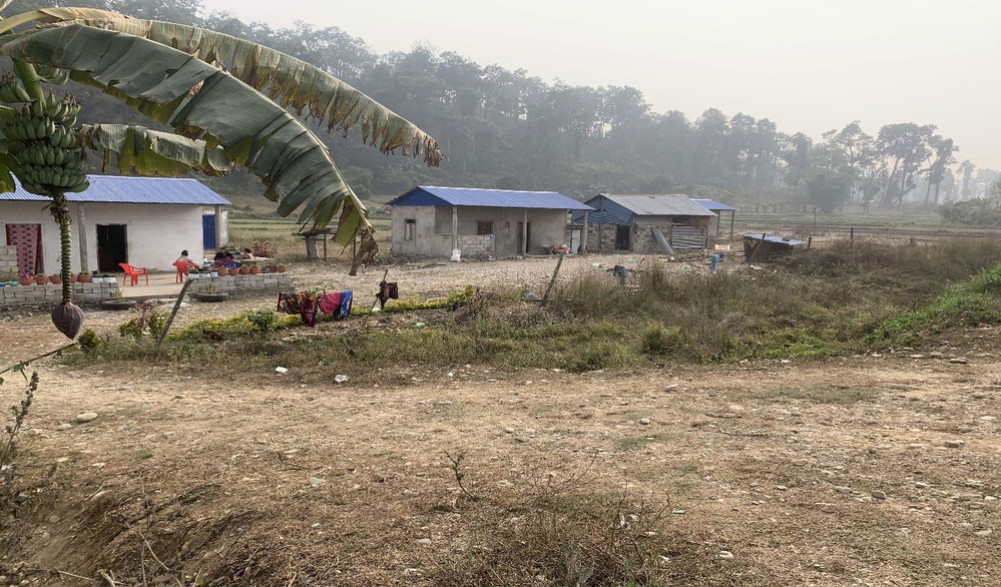
After an hour's drive from Hetaunda via Kanti Lokpath, Manohara Rural Municipality-7 comes across a settlement of identical houses with cement blocks and tin roofs on the banks of the river. In this settlement named Musedhap, there are 24 households of Bankaria.
Diss. Listed as an endangered tribal tribe in 2059, the Bankarias live here alone. Bankaria was living in Chureghaan, a central area of Parsa district, until 20 years ago. They have been moved here in accordance with the plan to bring them from wild life to human settlement in 2062.
Bankaria, who was living a wandering life in the forest, was provided 9 hectares of land by District Forest Office Makwanpur under Kabuliyati Forest Group. Even though they have been living there for almost 20 years, they are in confusion and fear that they will have to leave this place too!
because the land is not in their name. The local government has assured them that they will be provided with spare parts. With this assurance, the farmers who used to be farmers until a few years ago are now rearing chickens, goats and buffaloes. Some do farming and some work as wage labourers.
According to the 2078 census, the total population of Bankaria is 180 and the mother tongue speaking population is only 86. Santoshi, a leader of the Bankaria community, says that currently there are 93 Bankarias including 46 women and 47 men. He argues that the number of children and old people died because they could not blend in with the environment after leaving the middle region, and because there were more daughters and they got married to other castes, they also stopped writing Bankariya.
Women seem to be more active than men in Bankaria caste. Whether it is participating in skill development training or advocacy for rights, women have taken the lead. Pampha is the first among Vankaria community to pass SLC. She is currently studying Anami. After that, Santoshi Bankaria, who passed SLC, studied JTA and works in the Tribal Federation. In addition to her job, she leads many places for the rights of the Bankaria caste.
Bankaria community also runs a small soap industry and Santoshi is the president of this industry. They started their work with 14 people who received training in soap making and invested Rs 15,000. As the main raw materials for soap, they bring titepati, nimpatta and ghyukumari from the forest, while other necessary raw materials are bought from the market. They make laundry powders and soaps and bath soaps to order. The soap they make has a good market. Santoshi says that consumers have no complaints about the soap they make, but they are getting advice for better packaging.
Not only that, after the National Tribal Women's Forum provided soap making training and the necessary tools, the bankaria women's group planned to register the industry and work. But they were disappointed at the beginning when they needed a red portion of land for the registration of the industry. Later, with the help of the ward president, they said that they started the work by keeping the red parts of their land.
The crops on that land are not enough to eat for three months. The monthly allowance should be used to maintain the house and buy a pen for the child. Sometimes they think that their life after permanent settlement is more difficult than that of their parents who spent their whole lives in the forest. They say, 'Give the red portion of land, give employment and give access to education. If this is the case, bankers can also work and eat.' Will the government fulfill their demand?
The government has made policy arrangements for the orderly settlement of similar communities including Bankaria. Part three of the Constitution of Nepal mentions that under the right to housing, every citizen has the right to a suitable housing and the state will arrange housing for the homeless in accordance with the law. Similarly, in the policy related to social justice and inclusion under part four of the constitution, it is mentioned that the freed workers, kamalari, hawa, halia, landless, squatters will be identified and rehabilitated by arranging arable land or employment for housing and livelihood. In addition, the Procedure 2081 regarding providing land to landless Dalits, landless squatters and unorganized residents also states that the target groups should be processed and distributed.
According to the Order 2081 of the Establishment of the Land Problem Resolution Commission, if it is proved that the land has been inhabited for at least 10 years prior to the date of the eighth amendment of the Act, there is a provision to measure the land subject to the Act and Rules. Similarly, it is mentioned to collect data related to the identification and verification of landless Dalits, landless squatters and unorganized residents from the local level and provide land to the landless Dalits, landless squatters under the approved procedures after the assessment by the commission and to manage the unorganized settlements and unify the land for integrated housing.
Even in the current sixteenth five-year plan, it is mentioned that the development of cooperative, shared, rental housing for people who do not have land and who cannot earn a living even from their own and family resources will be arranged and gradually the cost of such housing will be based on the income earned from the employment provided to them. Similarly, in the annual policy and program of the year 2082/2083, it is mentioned that landless Dalits, squatters and unorganized residents will be managed and emergency housing and housing construction for homeless families will be continued.
If these policies and plans are implemented, it seems that the problems of the homeless and landless, including Bankaria, will be solved. But the Forest Act, 2076 seems to be an obstacle in its implementation.
In the Land Act, even if the former forest area is close to the former forest area, if a person has occupied the land for the past 10 years, even though there is a provision that such land can be given to him on the basis of usufruct, in Section 7 of the Forest Act, 2076, "No one shall register or cause the land within the national forest to be registered. If the registration is done illegally, such registration will automatically be canceled after the commencement of this Act.
Will the Land Act under discussion in Parliament make clear provisions about the landless? Let's hope, soon, the provision of permanent residence will be ensured for the Bankaria and other similar housing and landless people and they will also be able to enjoy the constitutional right to live with dignity.