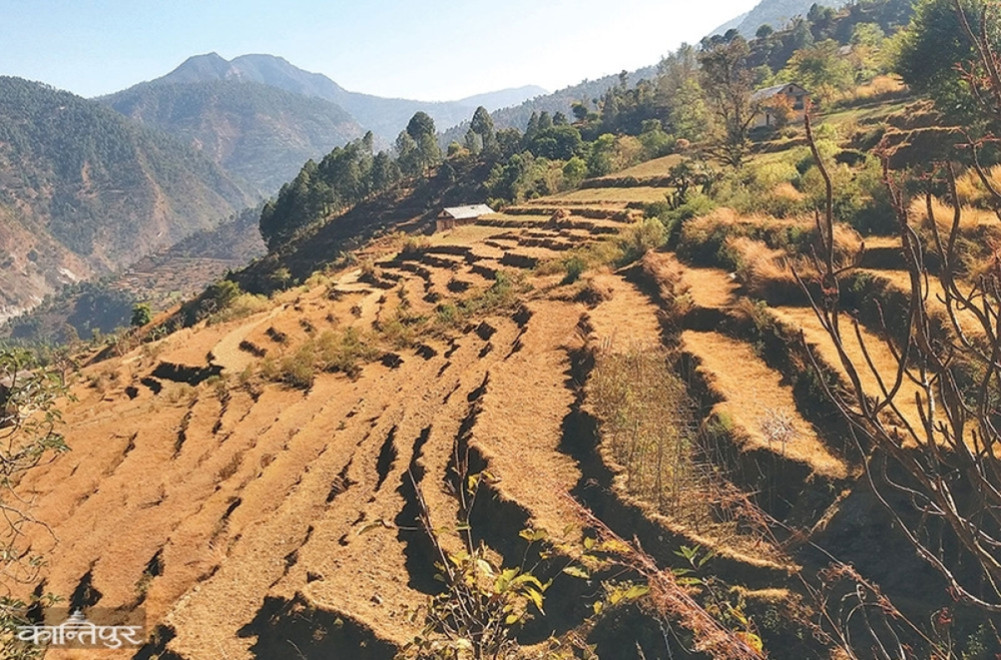
With the migration of young people abroad, even the families involved in agriculture are moving away from agriculture as they move to relatively easy market areas.
We use Google Cloud Translation Services. Google requires we provide the following disclaimer relating to use of this service:
This service may contain translations powered by Google. Google disclaims all warranties related to the translations, expressed or implied, including any warranties of accuracy, reliability, and any implied warranties of merchantability, fitness for a particular purpose, and noninfringement.
Now our geography and society are becoming more and more desolated. Due to the lack of national policy and planning, not only the agriculture of our geography, but also the entire nature and environment, which our ancestors carefully protected and maintained, are becoming sterile. It has had a serious impact on the system of integrated farming according to the nature of the local characteristics made possible by the cooperation with the surface soil and the nature in it.
This has adversely affected the livelihood, food security, employment and income of the people who depend on natural resources.
It is reported that more than one-third of the country's arable land is barren, while the nature and biological diversity of forests and protected areas are also becoming barren. Along with this, the climate change that has been happening rapidly for two decades, especially due to temperature increase, uncertainty of water, diseases and pests as well as the destruction of wild species and wild animals, the villages have become unsustainable.
The traditional integrated resource management system adopted by our ancestors is an advanced method and practice of managing the surface of our geography, the nature and environment within it. This is what has created the diverse culture of our characteristic original way of life. This originality is continuously declining instead of being advanced by making development based on external knowledge and technology spread with the wave of modernity as the only formula.
The change in the social structure is also a result of the rapid disruption of basic agriculture. With the migration of young people abroad with the dream of employment and a better future, even the families involved in agriculture are moving away from agriculture as they move to relatively easy market areas. It has a direct impact on agriculture, farming systems and food imports. It is too late to identify and address the specific cause of increasing food imports rather than discussing seasonality.
Now, the ecological and social interrelationships of mountains, hills and plains are disturbed. Due to human-made green gas emissions, there is no snow in the mountains, there is a lack of water in the mountains and rivers, and Madhesh is suffering from drought and flooding. In the last two decades, the rate of agricultural land remaining barren has increased along with the rate of migration. Likewise, the import of agricultural produce and the export of youth have increased around this time, while almost one-third of the settlements have been vacated. The local nature is deserted around that area.
If such a large part of the country's geography continues to be barren, the negative impact on the overall environment will increase in the future. The management of the country's agricultural land, which is currently around 25 percent, is the main basis of our life, livelihood and its development. According to the available rough data, Nepal's total cultivated area was less than 1/4 of 8 decades ago. With the expansion of cultivation in the dense forests of the Terai, it rose to 28 percent 6 decades ago. Now it is reduced to 22 percent.
While the plains of the world are being cleared for agriculture, not only the land for cultivation, but the entire nature has become barren in our country. There are countless internal and external causes of constipation. Human-induced climate change is occurring qualitatively. It has the greatest impact on biodiversity and productivity of nature.
Farmers are not able to maintain both the agriculture and forestry sectors due to the lack of finding and dissemination of effective solutions to address them. In the name of modernity, the choice of Samthar Plains development, education, health, transportation and other useful service facilities planned around it have forced the common people to abandon their development work.
Many natural and environmental problems and challenges have been added as the land becomes barren. Traditional dills and walls that protect soil and water, ponds, lakes, springs, streams have been destroyed. The ground water has flowed. Endangered species and wildlife have increased. The accompanying increase in temperature has increased the risk of wildfires and water uncertainty. There has also been increased concern and concern about how to stop the avalanches caused by snowmelt and ice storage explosions. As the soil surface dries out and the topsoil runs off, its biological degradation is accelerated. Fertility is continuously decreasing and Samthar Plain is turning into a barren.
The effects and impacts of barren land are not limited to social and economic dimensions. Due to the lack of regular maintenance by the farmers throughout the year and the lack of proper management to protect the soil and water nutrition, the barren fields are subject to erosion, landslides, and have turned into hollows and bhirpakhas. Their erosion has adversely affected the underground water storage especially in hills, Chure and Bhawar areas. Natural underground water flow is interrupted. Springs are drying up and water availability is reduced.
Although some natural vegetation has started to grow on the barren land, most of these are of uncultivated nature. Random changes in land use have profoundly affected local biodiversity. Some Michaha wildlife and plant species have thrived and others are rapidly disappearing. Human-wildlife conflict has increased.
With the increase in temperature, the forest and the village are struggling to save the forest and the village. As the farmers in the village have started to keep their fields barren, even the families who make a living by cultivating a single piece of land are forced to leave the land barren. All these things have changed the measurement and map of biological diversity and geological and biological condition of diverse land.
Both the causes and effects of land degradation are the product of complex and extended natural and social processes. It is not just a contemporary and local phenomenon and effect. It has long characterized our lack of vision to improve our environment and society. This is also the sad result of doing the same thing as imitation of advanced development in other society and environment.
The desolate nature had already hinted at this. Even the long-standing efforts to correct this have become more agitated by falling into the trap of cyclical development. In particular, it has fallen prey to the idea of single-pronged development as opposed to the idea of advancing an integrated system of forestry and agriculture. This condition has also been manifested in the thinking of the social and economic development of the society. With the changes brought about by cyclical development in the environment and society, the Nepali society that does not run a household is on a journey of dispersion. Migration is just going on everywhere.
Since these important questions cannot be addressed, the human society of this geography is making it desolate and is on the journey of escape. As a result, the desertification of our geography is accelerating. This is pushing the society where agriculture is the main source of income and livelihood towards a complex vicious cycle of poverty, scarcity and food insecurity.
Traditional social structures, especially the disintegration of the joint family, have led to the disappearance of social practices such as Ormaparm. With the collapse of community cooperation in society and resource management, it has become imperative to leave farming. This is a structural challenge added to land management in the future along with agriculture. Because, as these structures and practices disappear, its knowledge and skills are also disappearing.
Under the pressure of the collapsing social structure, young and capable people are migrating from rural areas to cities or abroad in search of their income and employment opportunities, education, health and other services. This has also increased labor shortage in agriculture.
Even the natural conscience of a woman who does not want to keep the land barren as much as possible seems helpless as she cannot bear this burden. Along with this, small land holdings, low productivity, high production costs, disincentives for resource services and lack of access to markets have led to further barrenness of farms. Due to the thinning of the population, the reduction of cultivation, and the lack of weeding in the nearby forests, the outbreak of monkeys, boars and wild animals have become more of a concern for the farmers living in the village and the land is becoming barren.
The problem of barren land does not fall under the purview of either forestry or agriculture. Therefore, none of the current policies have been able to address it. Let alone the initiative to address the serious problem of barren land in time, it has not even been objectively assessed so far.
The root cause of this is the inaction of the responsible leadership who should help bring the barren land back into use due to the cyclical effects of economic, social changes and climate change. Mainly, the approach, structure, strategy to improve the nature and environment of our specialty, and to help the community in every way to protect and maintain it.
Although all these facts make the problem of barren land management clear, effective efforts have not been made by anyone. Addressing the issue of wasteland requires a multi-faceted and comprehensive nature and environment restoration approach. The only way to correct this is a collective initiative in the principles and practice of nature reproduction.
In particular, we should seriously look back at our social, economic, environmental and policy dimensions, and make an integrated development based on the national vision of sustainable development through objective analysis. It only provides an opportunity to bring together the youth who are looking for their future and their entrepreneurship. Although our geography and environment seem to be becoming sterile from the outside, it is not difficult to say that this is the product of the mental sterility of the policy makers and intellectuals. Until this is accepted, there will be no decision to change this path.