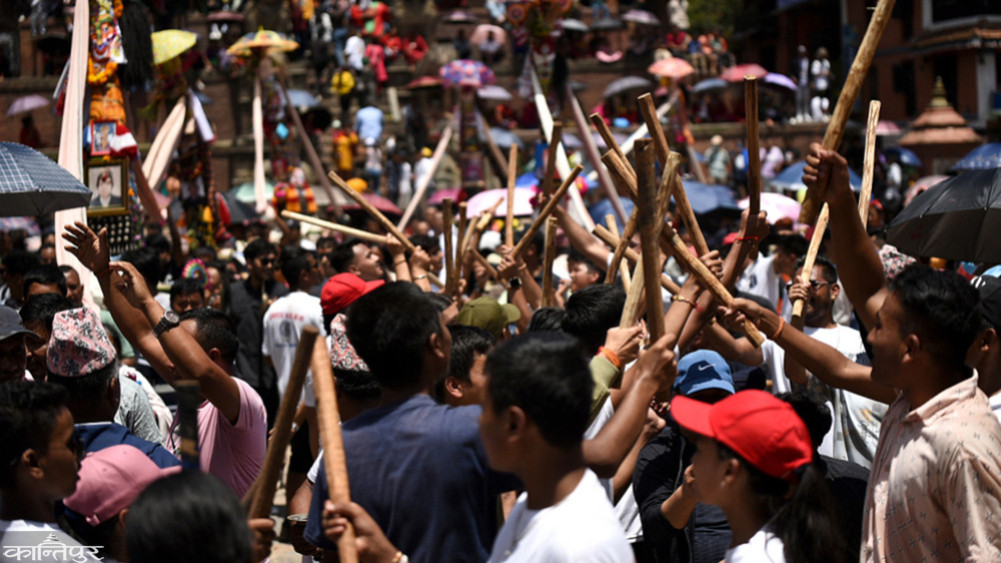
Yesterday, the role and position of the Nepal State Pragya Pratishthan was different during the period when Narayanhiti's decree was legally irrevocable. In the same environment, a wrong commentary was created to make the mourning and condolence Gaijatra a festival.
We use Google Cloud Translation Services. Google requires we provide the following disclaimer relating to use of this service:
This service may contain translations powered by Google. Google disclaims all warranties related to the translations, expressed or implied, including any warranties of accuracy, reliability, and any implied warranties of merchantability, fitness for a particular purpose, and noninfringement.
It was called Gunla from 'Gunila'. Gunla means a month from Shravan Shukla Pratipada to Shravan Krishna Paksha. This month has a special importance in the social life within the ancient Nepal Mandal. However, the Raithanes of Nepalmandal are busy in one way or another every twelve months in festivals, fairs, festivals and other cultural activities. Therefore, cultural experts consider the border of Nepal Mandal as an open museum for tangible and intangible heritage.
This period has multifaceted significance as the Raithanes are active in various cultural activities for a month as Gulla Parva . Likewise, many of their religious and customary values are also the same. Especially Buddhists also have their own original statement in Bajrayani society, among which there is a tradition of participating in special worship for the month of Buddhist Chaitya by blowing Nyeku Bajan (animal horn used as a blowing instrument) inspired by Swayambhu Purana and Shringeveri Jataka story . This will give the deceased family members a happy abode and faith will be found.
Gunila means the main festival celebrated by the Raithanes under Gunla Mass - Gupunhi (Janaipurnima). According to the Mahayani Buddhist faith and other local rituals, this festival is related to the nine numbers . Nine in the local language means Gu . Therefore, this festival that lasts for nine days from the full moon day to Krishnashtami The Raithane Buddhists of Nepal Mandal go to the major Buddhist places of worship near them such as Swayambhu Chaitya, Buddh, Sankhu Bajrayogini, Rato Machhindranath etc. for worship and darshan. The special instruments played in this festival are Gulla Baja, Dhaha Baja and Dhamokhin . Other instruments are also played. Legend has it that the identity of this month is Gunila or Gunla due to the belief that when the stupa, Chaitya and Buddha murti are seen and worshiped, quality will increase in life.
Those who are engaged in agricultural professions are also those who go to their fields to express their gratitude to the frogs for playing a supportive role in farming. Raithane Vaishnavs are also involved in the worship of Lord Krishna in this month according to their customs and traditions like other Hindus like snake worship, Rakshabandhan and Janmashtami. Some people also consider yajnopavit on the day of Rishi Tarpani . Shaivites travel to Rasuwa district on foot and visit Shiva at Gosainkunda. Some run to Kumbheshwar in Lalitpur . In the form of religious diversity and multiplicity, they are also reflected in the fairs throughout this month . In addition to this, seeing the face of the father and Buddhist Panchdan festival also fall under this month.
The main festival celebrated by the Raithanes under this gunila or gunla mass is - Gunpunhi (Janaipurnima) . According to date calculation, the secret is celebrated on the full moon day of Shravan Shukla. Elsewhere, according to their faith, Purnima is observed as a one-day festival and rituals are performed according to social customs and traditions. But within Nepal Mandal, Gunpunhi festival is a bit different and original. The Raithanes here do not consider Gunpunhi as a one-day festival .
According to the Mahayani Buddhist faith and other local rituals, the Gunpunhi festival is related to the nine numbers . Nine in the local language means Gu . Therefore, this festival lasts nine days from the full moon day to Krishnashtami. On this occasion, nine different vegetables are mixed and eaten as kwanti . There is also a tradition of changing clothes nine times and visiting nine Buddhist shrines and temples within nine days. Nine worship the Dipankara Buddha, donate nine grains and cloths . Nam Sangeet recitation etc . The prevalence and importance of secrets associated with these nine numbers are .
Within the nine days of Gunpun, the residents of Lalitpur circumambulate the city on Matayah (Light Yatra) on the third day . On the other hand, Krishna Jatra, which is celebrated on the ninth day of Krishnashtami in Lalitpur, has its own characteristics.
Saya: Sa means cow and Ya: means travel (Gaijatra) This is the second day ritual under Gunpunhi festival. While celebrating the Gunpunhi festival, the Raithanes of Shakta Mata also perform Lakhenach . Buddhist communities, people from all walks of life gather together and reach Bihar, Wahal, Gumba and visit Bajidya (Dipankar Buddha). In addition to the Prajnaparamita displayed there, other books written in gold/silver letters, precious idols and Paubha paintings are also observed. All these processes happen every year .
is another important cultural activity in which the local participates in the village – drama performance in doubles. Although such street dramas used to take place on the occasion of Indrajatra a few years back, but now they have been stopped . On the second day of the Gumpunhika series, a special tradition is presented on the main streets of the city from early morning to mid-afternoon – Sayah (Gaijatra) .
Only Shaiva and Vaishnava Newars are involved in Gaijatra, while Buddhists have a different view on it . If a member of the family passes away during the year, there is an original tradition of going around the city culturally in his/her memory - Gaijatra . In Bhaktapur, they are different in the form of Tayamcha . Likewise, different towns have their own originality. Now there is a practice of cow pilgrimage within and outside the countries where the Newar community has settled in addition to the borders of the ancient Nepal Mandal . There is no specific historical document about when the Gaijatra started with the participation of family members and relatives along with Bazagaza, and how it came into practice. However, many are not without statement . Some culture scholars claim that the mention of the 'Sa Yat' festival in an episode in the 'Gopalarajavanshavali' recorded by Jayasthiti Malla is the pre-history of Sayah . Some say that King Pratap Malla started this practice to comfort his beloved queen Ananthaprabha's son in grief.
This is the original tradition of especially eastern social life to show reverence and respect to the deceased or ancestors. Followers of Confucius and Buddhism in China have been celebrating Jichen Festival for thousands of years. Mianchi, Koreans' Jere, Vietnamese's Giao, are patriarchal cultures of a similar nature to the original rites of reverence for the dead among the Japanese. Not only in the religious faith and belief in the memory and respect of the deceased or ancestors, but also in the modern era, there is a custom of doing many activities of memory after the death of a respected, respected and distinguished person . Memory, respect and faith towards relatives is also a basic identity of a civilized human society. Saya is also a part of the developed civilization within Nepal.
This traditional festival popular among Raithanes of ancient Nepal is also a different custom of its own which is done as a memory of separation with the dead, ancestors and departed family members. It is more original than the Pinda Tarpan or Shraddha ritual performed by the Hindu or Bajrayani sects in the wish of Pitra Tarpan, Moksha and Sadgati. To say that it is different is to say that outside the four forts of private houses, it is a kind of separation expression that is done with cultural tableaus and wares in the public places, streets and squares of urban settlements. Who passed away among the townspeople during the year, where were they from? It is also a type of dead count documentation that indicates etc .
Once again, Gaijatra is a completely mournful journey. There is respect, compassion and pain in its adjustment, management, street performance. Many unspoken stories of separation from relatives, memory and compassion are intertwined with the footsteps of Gaijatra. Gaijatra is not an image of fun, celebration or joy, but only a memory to pray for the eternal peace of the soul of your loved ones . According to religious beliefs, various narrative events are associated with Gaijatra . They are in their place, in essence, it is a silent desire hidden in rituals, traditions and customs - the salvation or salvation of the dead! It is a polite and cultured presentation of the relationship and memory of the living family towards the dead soul.
irony! With the passage of time and events, Gaijatra's commentary in one line is not the same today . It was led by yesterday's Nepal State Pragya Pratishthan. From a few years ago, the official double of the establishment started to be decorated, around the occasion of the traditional cow festival. Even the courtiers themselves gathered on the theater stage of the establishment - to spend time enjoying, laughing, joking, laughing. Performers were brought up, dances were also performed. At the same time, the state treasury was also spent - a celebration! A celebration! And that moment was named - Gaijatra Festival! That sequence continues till today - the character, the environment has changed . But Gaijatra has come to be called a festival.
The cow procession that was held by the ancestors, which was a pain of tears, how did it become a tradition of laughter inside the stage decorated today? The Gaijatra is the staging of the utter tragedy of the Raithanes. How can comedy be made in the present moment of commercialization?
tradition was that from the day of Gaizatra, in the evening in all the three cities of the valley, locals would spontaneously come out in groups in colorful clothes and in groups. And stopping at toll-toll, they presented their performances, danced and sang. They used to say a lot of vulgar dialogues to make the audience laugh. This trend is still towards Bhaktapur, Kirtipur . In some places, it is also customary to present Ropai Naach, Ropai Jatra in a different way . Such street demonstrations are neither part of the Gaijatra, nor are they connected with the memory of a dead person like the Gaijatra.
These performances are basically entertaining, juicy, humorous, which will be criticized against the social, political corruption and inconsistency of the time. But this is not a cattle drive . These popular khayals in local life are: - Goopunhi khayal: - farce, humor . Sayaah and Khayalah are completely different according to context, tradition and trend. It is ironic that the commentary which has been constructed as Saya means Gaijatra as Khayal and Khayal as Gaijatra is ironic. This is a distorted presentation of the local culture, which is unacceptable.
Yesterday, the role and position of the Nepal State Pragya Pratishthan was different during the period when Narayanhiti's mandate was legally irrevocable. In the same environment, a wrong commentary was created to make the mourning and condolence Gaijatra a festival. There was no hesitation in following that . Today, apart from the establishment, other organizations, individuals and areas have also introduced the practice of presenting the Gaijatra as a festival, which is not correct . Today it needs improvement. It is necessary to have a dialogue and cooperation with Raithane community and experts who are carriers of Gaijatra culture and tradition. There should be no delay in improving it under the changed circumstances.