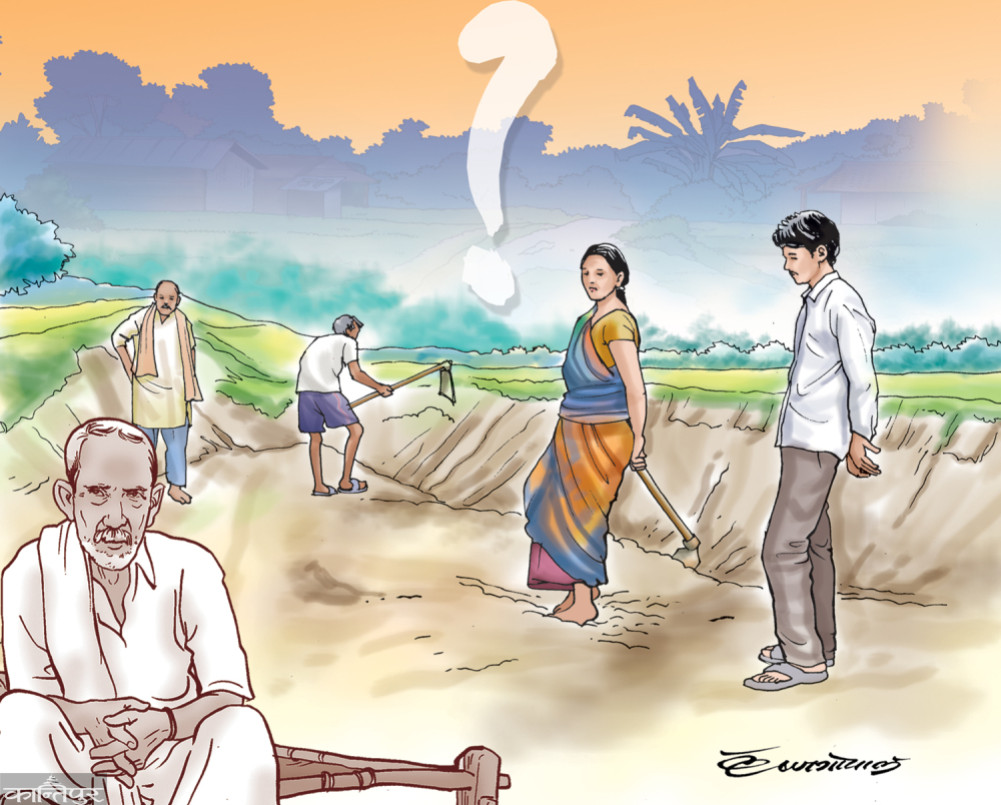
What can be a greater social injustice than not being able to say 'this piece of land is mine' even after generations of plowing the land with ten shovels?
We use Google Cloud Translation Services. Google requires we provide the following disclaimer relating to use of this service:
This service may contain translations powered by Google. Google disclaims all warranties related to the translations, expressed or implied, including any warranties of accuracy, reliability, and any implied warranties of merchantability, fitness for a particular purpose, and noninfringement.
The constitution with the resolution of economic and social transformation has started reaching decade, but the questions of social injustice are still there. Instead, the crisis is getting worse. Public confidence that the current political leadership will solve the complex issues of social injustice is also waning. This situation is very alarming.
Identifying the causes of armed conflict, addressing them, and ensuring sustainable peace and equitable prosperity for future generations is an important national responsibility. This is reflected in the Comprehensive Peace Agreement, the Interim Constitution and the present Constitution.
However, the state is not responsible in this direction. The transitional justice process, which was supposed to be useful for accountability, is gradually becoming redundant. Again, it faces a crisis of legitimacy — due to the recent appointment of officials in violation of the principles of transparent and competitive selection. As in the past, there are clear signs that commissions will once again become useless.
There has been no significant progress in addressing the issues of land, housing, food and other people's livelihood. Climate change, environmental degradation, and uncontrolled exploitation of natural resources have exacerbated the risk of water crisis and food insecurity. Now Madhes province is experiencing extreme water crisis. Marginalized and underprivileged classes and communities are the most affected by its consequences.
Rampant corruption and misgovernance are also responsible for promoting wastage and exploitation of resources including land. Officials who are responsible for protecting land resources have become accused in cases of corruption, which is a worrying thing. It is evident that such multifaceted reasons are pushing social justice further away.
Lately, the debate about land inside and outside the parliament has become intense. The debate is mainly in the 'Bill to amend some Nepal Acts relating to land, 2082', especially for commercial purposes, the provision proposed to ease the sale/distribution of land to companies occupying more land than the limit is at the center of the controversy. The said bill was registered in the House of Representatives on 24th Baisakh. However, the government has not tried to issue ordinances in the past with the same objective. However, the effort failed due to widespread opposition.
land is at the center of social injustice. It has not been addressed since 2007. The state is involved in ad hoc and sporadic efforts. The issue of state creation and promotion is profound and multifaceted. Incidentally focused or reactive debates do not lead to solutions. The debate should be narrow enough to cover all dimensions of the problem – depth, height, length and breadth.
Land injustice is also the factor behind armed conflicts in the past, before and after several social and economic injustice movements. The people of Dalits, tribal tribes and underprivileged groups were engaged in armed conflict because of the hope of safe access to land. This fact should not be forgotten.
Before starting the conflict, most of the questions raised in the forty-point demand letter submitted to the government on January 22, 2052 were related to land injustice. It seems that they are trying to justify the armed struggle by showing problems like landlessness, housinglessness, and extreme poverty.
Moreover, Nepali Congress and Nepal Communist Party have been keeping the theme of party objectives at the center of their party objectives since their establishment, redistribution of land and land reform.
In the Nepali context, redistribution of land is considered the basis of socialism. B.P. The formula of socialism put forward by Koirala - every Nepali should have a house, a farm to eat, a dairy cow, children should be able to go to school, should be able to get health care - also seems to put the land at the center.
Pushpalal Shrestha, the founder of the Communist Party of Nepal, has put forward land-oriented slogans such as 'land for plowing' and 'whose plow is his vessel' for the liberation of farmers and workers. The reflection of that thinking is clearly visible in the current constitution in one way or another.
The global perspective is also constantly exposing the reality that sustainable peace and prosperity are not possible without a solution to land injustice. Whether it is United Nations study reports or the views expressed by role models on historic occasions—they uphold this truth.
For example, the United Nations Environment Programme's 2009 report 'From Conflict to Peacekeeping The Role of Natural Resources and the Environment' highlighted the deep interrelationship between natural resources, including land, armed conflict and peacekeeping. The report states that at least 40 percent of internal armed conflicts in the past 60 years were directly related to land or other natural resources.
Similarly, the 'Guidelines on Land and Conflict' issued by the UN Secretary General in 2019 clearly pointed out that land can be the root cause of armed conflict and that it has a deep relationship with the three basic dimensions of peace, human rights and development. In addition, it has presented the fact that the equitable management of land is the basis of sustainable peace.
However, when will the issue of land injustice be addressed? Why is the state repeatedly failing to make a lasting and valid decision on this issue? Why does ad hocism dominate state efforts? Why are millions of people dependent on land still unfulfilled for decades, and they are forced to live in the fear of uprising? These important questions demand serious debate. It is essential to identify sustainable and credible solutions based on historical background and objective assessment of current complexities. It is important to understand
land objectively. Land is not just property, it is power, it is energy, it is the basis of life. Our state system has established Lalpurja as an indicator of citizens' dignity, pride and prosperity. Land ownership is connected with every facility and recognition provided by the state. In such a situation, what can be a greater social injustice than not being able to say 'this piece of land is mine' even after generations of plowing the land with ten plows?
Who actually owns and controls the land is extremely important. The state of land ownership determines whether a society moves towards justice or towards inequality and exploitation.
If land is owned by landless families, it becomes the basis for supporting livelihoods, human dignity, subsistence agriculture, housing, food security and micro-enterprises. It helps break families out of the cycle of poverty, dependency, discrimination and exploitation. As the livelihood of the family dependent on the land depends on it, the conservation and productivity of the land resources is maintained. That fact is also established by the distribution of land to free earners and its effect on economic and social empowerment.
But if the land gets into the hands of the mafia or profiteers, it is transformed into a profitable commodity. There is a risk that the land will be barren, turned into a concrete jungle, dependent farmers will be displaced and exploitation will increase against the principles of sustainable development.
Today's generation lacks knowledge of historical land injustice and its structural causes. They have the illusion that 'someone gained land by hard work, some lost it due to carelessness'. There is a lack of knowledge that the roots of land injustice in Nepal are buried in the state structure and land administration system. Ignorance of history shows that most landlords acquired land ownership not from legitimate sources but through hereditary privilege, the Birta system, legal weakness and political access.
In the light of historical injustice, the constitution has given a clear roadmap for land justice, but that knowledge has not reached the people. The constitution has become a document read by limited citizens, it has not become a scripture of people's life. This is why it is easy for interest groups to take advantage.
Who was born in the name of Birta in the past? Who was wronged by taking Kipat Khoser? Who was hurt and who benefited by the complexity of land administration? By what tactics were the Mohis expelled from the land? How was the system of limitation exemption misused? Who benefits from land-based corruption and mismanagement? Who has been displaced and marginalized by the policies and laws introduced in the name of forest and wildlife protection and who has benefited? What has been the victim of Mohiani's depriving him of his rights based on the fact that he earned the land of Guthi ? Policy making should be guided by informed debate on all these issues.
Nepal's constitution envisages socialism and considered access to land to ensure housing, food rights, food sovereignty, social security, equality and dignified life for all citizens. But in practice land is still at the center of commercial interests, policy corruption and exploitation. It seems that even now the rulers are trying to feed those who are greedy for land rather than those who need it.
If the goal was really to solve the problem of landless dalits, squatters and unorganized settlers, the current bill would not have gone the other way. The idea of introducing a bill with the aim of facilitating the sale of land due to occupying more land than the limit is problematic in itself. In order to solve landlessness, the post-conflict socialist government should identify more land than the limit and bring it into state ownership and bring forward a policy to distribute it to the landless. But the government has gone the other way. The Supreme Court's order in the case of Advocate Madhav Basnet (dated 23 Shravan 2076) has also been ignored. In the absence of the implementation of the demarcation provisions made by the fifth amendment of the Land Act, the Supreme Court ruled that 'when a limited amount of land is monopolized by limited landowners, the economic resources of the country remain centralized in the interest of a limited class, and if the land is not used properly, even the nation cannot get a return', it seems that it is necessary to take action to deliver the demarcation and acquired land to the hands of people who are landless but dependent on agriculture and who want to remain in the agricultural sector. But there is no sensitivity towards the implementation of the order .
Trying to pass the bill through the 'fast track' without discussing it in the committee system seems to have complicated the dispute. This is proof of the dual character of the government.
What is the reality on the ground, even today, millions of true farmers have not been able to claim the ownership of the land plowed with ten plows. They are forced to live with the identity of 'landless squatters' or residents of 'informal settlements'. It seems that about 1.2 million families including landless squatters and unorganized squatters have received applications (even those who have moved from the previous commission) in the Land Problem Resolution Commission. Assuming an average family size of 4, about 4 million people are directly affected. In addition, the situation where 25 percent of the land has not been measured has made the problem even more complicated. Its disproportionate impact has been seen on Dalits, tribals and other marginalized communities.
Amnesty International's recent report titled 'Nowhere to Go: Forced Displacement in Nepal' has exposed the structural, legal and practical flaws of land injustice. It has confirmed that forced evictions and evictions are still ongoing and are encouraged by the state.
Finally, land injustice must end not with slogans—through serious assessment, public debate, strong implementation and structural reforms. The government should abandon ad hocism. Rather than the 'piecemeal approach' of repeated revisions, a 'holistic approach' should be adopted to make all necessary legal arrangements at once to resolve the problem. The Act should be amended to give stability to the Land Commission for a long time. Arrangements should be made to keep district level commissions independent from party influence. The land mafia and their patrons who take unfair advantage based on setting up, bribery and political nexus should be brought to justice.
Instead of punishing organized settlements created on forest, intermediate, protected areas or government land due to past weaknesses of the state or other historical injustices, prudent and practical solutions should be sought. Legalizing such settlements will ensure land-dependent, need-based and productive Purpose should be prioritized, not profit driven greed. The Land Law Amendment Bill should be reviewed in the light of Articles 36 (right to food), 37 (housing), 40 (rights of Dalits), 42 (social justice) and 51 (Directive Principles of State Policy) of the Constitution. It should proceed on the basis of meaningful discussions inside and outside the parliament. The dispute should not be prolonged and the landless people should suffer more. The issue of land injustice is also a test of the character of political parties. The impact on the outcome of Mission 84 would be severe.