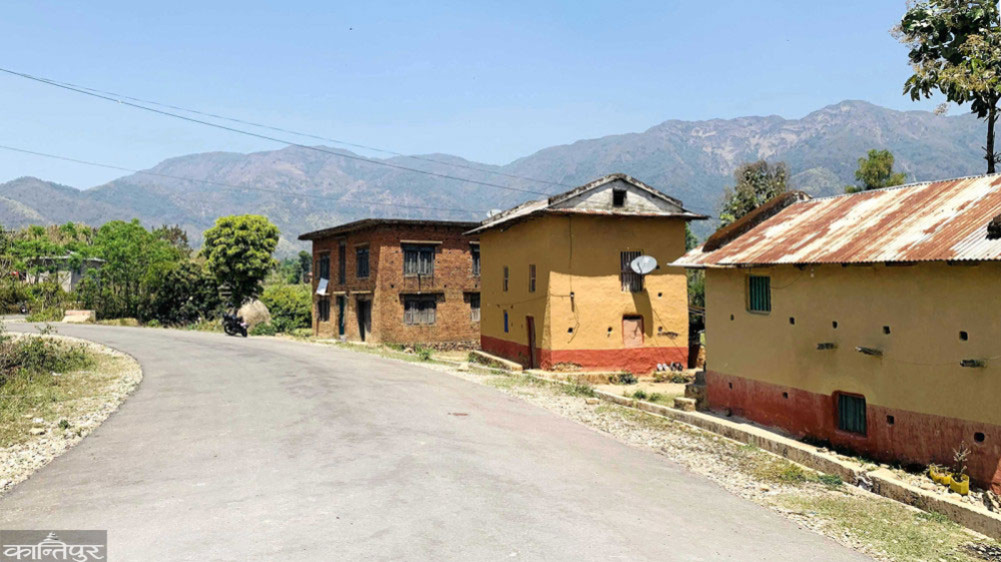
It is the group that succeeded in making the comment that 'development means roads and buildings', which has been trying to transform Nepal into a modern society for the past 70 years.
We use Google Cloud Translation Services. Google requires we provide the following disclaimer relating to use of this service:
This service may contain translations powered by Google. Google disclaims all warranties related to the translations, expressed or implied, including any warranties of accuracy, reliability, and any implied warranties of merchantability, fitness for a particular purpose, and noninfringement.
The term 'development' itself is multifaceted. Some say it is a positive change that society or human race as a whole has taken or is trying to take, while some say that it is a change in a class or group within it. Someone is looking at one aspect of it, that is, one of the components of the infrastructure that is necessary to be positive as a whole, as development.
When discussing the concept of development, it is necessary to look at 'whose development', 'what development', 'development by whom for what purpose'. Because ignoring the very broad context of such multi-faceted parts, looking at only one form within it, it is discussed whether a place is 'developed' or weak or 'backward in development'.
Even those who try to show their knowledge of society and culture, especially when looking at the development of the society as a whole, look at a small part, i.e. the physical structure, and say 'wow', and turn a common part of the larger context into a colloquial language and create a social commentary.
Especially those who say that a certain country or a certain place has done a miracle in development after seeing the big and wide roads and skyscraper houses are at the point of understanding the society. Even in Nepal, it is relevant to discuss about the 'Development Commentary' which has been made for a long time and the fate of the Nepalese society as a result of which the road network is the development.
In some respects, the comment that development is the development of physical infrastructure has taken root in countries including Nepal, which have become global and are especially known as 'underdeveloped' or 'underdeveloped'. In Nepal, where almost all the budget allocated in the name of development budget is spent on physical infrastructure, i.e. roads and buildings (including offices, schools, monasteries and monasteries), many people find the different opinion on this unpleasant.
Most of the money was spent on infrastructure, which only supported the interests of a small section of the society rather than the development of the society as a whole. Recently, it was asked to keep a budget for gender-friendly, Dalit-friendly, youth-friendly work or projects that work for the rights of women and gender minorities. But it seems that the government is determined to build roads and buildings by destroying them while spending, even though the budget for those titles is maintained on paper saying that road networks and buildings are indispensable for all genders, age groups, castes.
In Nepali society, there are those who blindly correct or facilitate the implementation of the statement that ``physical structure is indispensable for all genders, age groups, and castes'', who are capable of commenting that their self-interest is everyone's self-interest.
There is no single reason for the development and underdevelopment of society, this is the reality. But for a long time, in the name of infrastructure, roads and roads are being worked on in the name of roads, which means that other important areas to be managed, especially the agricultural production sector, have become devastated. When production lost focus, consumerism suddenly took over. The road network played a key role in transforming consumerism from production-based to import-based. In a society based on production or skills, money suddenly became more important than production or skills.
The demand for local products available in the village began to decrease slowly, advertising through the media, products like satu, chiura, siraunla, roti, mahi, chukouni, jerry, which were used in the society, were introduced to the public.
People began to remember Lito, Horlix and Lactogins, which are very useful for health and nutrition, instead of dairy foods, and the road network succeeded in bringing those imported goods, which are poor in terms of health and expensive, to homes and tolls. Because of the road, most of the villages in Nepal suddenly became a market for all the food products of the world.
It may be a coincidence that when we were working on the road network as 'development', at the same time another inhumane form of capitalism i.e. neoliberalism was dominating the world. The neoliberal system, which seeks profit over humanity in the overall product or service, will encourage profit making by compromising on the quality of daily consumer goods.
When neoliberal production reached the Nepali villages due to the road network, the pearl price of the goods produced for the sole purpose of profit and the goods produced by the farmers for themselves in the village was not the same. As a result, the goods produced and prepared for profit found a market, while the local products gradually stopped selling.
The daily ecosystem of the local people, who were able to produce a little bit more and sell the rest of the products they consume, came here and suddenly there was an upheaval. Farmers used to sell grain when someone in the family got sick or because they had to do some social work or to pay for the education of a family member.
When the surplus produce that reaches the family throughout the year is no longer consumed locally, the farmer also ceases to sacrifice or work harder to produce more. At the same time, the monopoly of the farmers in the agricultural profession or the autonomy of the farmers who do everything locally from fertilizers to seeds and necessary labor was suddenly dominated by the market.
In place of organic fertilizers, chemical fertilizers, locally produced and stored seeds, and occasionally through the market, packeted hybrid seeds have entered the village. To destroy this self-autonomous ecosystem developed by the locals for agricultural production, the state itself promoted 'development' fertilizers and 'development' seeds. The road network also succeeded in undermining farmers' autonomy over fertilizers and seeds.
Otherwise, it would not have been possible to reach the villages of chemical fertilizers and seeds. When development increased farmers' dependence on fertilizers and seeds from elsewhere, agriculture ceased to be a self-sustaining occupation because farmers were forced to interact with money and markets at times.
development The sudden use of fertilizers and seeds from elsewhere has resulted in ecological imbalances at the local level. Some of the plants and weeds that were being produced regularly started to disappear slowly, while the agricultural crops were also attacked by new insects and diseases appeared. Locally available fruit plants such as mangoes and berries were suddenly killed and destroyed by hailstorms and weeds in the fields.
In the name of controlling new problems and diseases in the crops that came with new seeds, pesticides entered the village. When developed fertilisers, 'developed' seeds and pesticides from elsewhere became indispensable for farmers, their every step was focused on money and markets, the autonomy they were using was further reduced, and local environmental problems became more complicated.
Moreover, the data that chemical fertilizers and seeds have increased production widely is also on the one hand. Due to this, the statistics of Amnepali being transformed into a family that can afford to eat can also be read from time to time. There is no doubt that with the use of chemical fertilizers, the production of grains such as rice and corn has increased and increased compared to the production through organic farming, but when the products that suddenly became expensive did not find a local market, the farmers did not want to continue farming because they could not afford it. It was seen that it is cheaper and easier to buy and eat in the market than to produce only for sustenance.
was the reason for that, shops filled with rice, wheat and other household goods that were imported from outside the country were growing in villages and trucks and tractors carrying such goods were running on the rural roads.
It is half the price of the local product and in a good looking and attractive package, while it is easily available in the villages, no one's eyes will be drawn to the expensive and comparatively less attractive products. In this way, Nepal's production and self-reliance-oriented character was gradually transformed into an import or dependence-oriented destiny. Thus, the road network itself worked to make this kind of change possible in a few years.
Amidst the unprecedented expansion of the road network, there was a sudden change in the local social structure in a few years when locally produced grain and imported goods available in the world market were stirring in the villages. A class that until recently had only been a miner managed to take full advantage of the new environment and establish itself as a class that played for some cash. Once established locally as traders, drivers or transporters, that class now engages in other extra-village activities.
This group, which gradually stopped engaging in organic agriculture and animal husbandry, which is necessary for the organic fertilizers required for it, or could not do it due to the lack of desirable land, now starts sending their children to schools that teach English medium and buy modern education.
Because of playing for cash, the group starts a routine of visiting private clinics, even if they are far away, not only for education and food, but also for treatment to make their own identity. As a result, the status of the 'thalu' who used to produce more than the grain that can be eaten for the whole year till now and made the kitchen of poor families in the village easier, the number of those who work for others or earn money from other people's land to save grain for food, started to increase slowly. This class started to look happier, happier and civilized than the 'Hunekhane' who had many and good farms of yesteryear, due to the ease of living because they did not have to work in agriculture and animal husbandry, the English medium of education that seemed modern, the access to increased cash due to the fast and high-paying profession, and the harmony with the outside world.
The internal and external pressures of this new class, developed as a byproduct of neoliberalism, focused on how quickly the new youth would exit agriculture and animal husbandry. Only those who are doing well in agriculture gradually reached Nirkyol, who no longer engage their children in agriculture and animal husbandry. When this kind of social change was observed within a few years, the effect of this was the idolatry of the village. After not doing agriculture and animal husbandry, the existing structures like schools, health centers, cafes, and markets in the village seemed insufficient and weak to the residents.
Along with this, family expenses increased. The cost of each day's food, health, education and transport and communication has become unthinkable. In the early days it was only possible for a limited number of people to have a different identity by taking up a profession other than agriculture. When many suddenly tried to take up a different profession, it was suddenly not possible in the village. But some members of almost every family who left their profession and wandered gradually started moving out in the name of education, employment (except agriculture and animal husbandry).
This beginning gradually took the form of a VCS cycle. Today's rural environment, which has suddenly turned into a dwelling place for an insignificant number of farmers and working-age people, is the culmination of that. People's expenses have suddenly increased when they have to leave their jobs without reliable alternatives and have to pay huge sums in the name of modern education and health. As a result, it is necessary to take a loan for the time being and some people have to go to Muglan for the payment of that loan and the regular increasing expenses. For example, according to a report released by the World Food Program a few years ago, it was seen that Nepalis spend 13 percent of their daily income on food every day.
Total health expenditure per capita increased from US$8 in 2000 to US$65 in 2022. The Nepal Living Standard Measurement Survey-4th has shown that per capita educational expenditure is 29,742. Today, 63.8 percent of Nepalese households take loans and 23.5 percent of them take loans for household work and 55.8 percent for other work. As the expenses on food, health and education increase, the risk of the family being pushed into poverty increases, and family members may have to travel abroad to meet these expenses. It can be said here that the daily life of a society based on bought health, bought education and bought food is not possible and was not different from today's Nepali environment.
In other words, the villages would not have been connected to the road network so quickly if the 'road economy' had not been started by pouring money on the roads in the name of development. Similarly, Dahimahi, which is a village drink, was not replaced by Coca-Cola, local liquor was replaced by beer and liquor, roasted corn, soybeans and chiura used as snacks were not replaced by noodles and chowmin and crisps. They would not have the courage and enthusiasm to go to villages 30, 30 kilometers away and collect children and run boarding schools. It was not possible to suddenly reverse the words of 'good farming, medium trade and low employment' and transform it into 'good employment, medium trade and low farming'.
In essence, it seems that the group that succeeded in making the comment that 'development means roads and buildings' is the same group that has been working in Nepal for the past 70 years to transform Nepal into a modern society. And, the same group is suddenly trying to make another comment that Nepali society, especially within it, is transforming into a society where the young generation cannot live.
The said group is not ready to accept that there is a 'development' policy taken by Nepal for a long time in the background of the scenario of Ukusmukus seen in the society today. As a result, even today, when we question about the standards of Nepal's development that we have set for 70 years, it becomes reactive and the critical commentators are ready to respond with 'anti-development' or other insults.