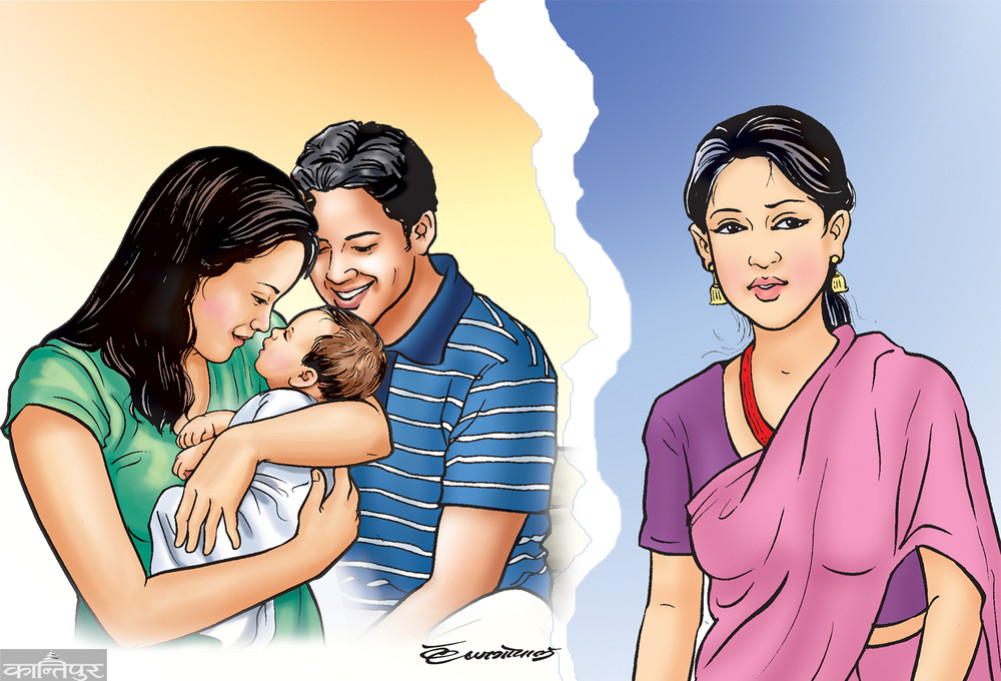
What is the limit of the number of women who are compatible for a man who is having a relationship with another woman if he is not compatible? In his lifetime, a Nepali man's 'heart' will not match with how many women or how many will he match with?
We use Google Cloud Translation Services. Google requires we provide the following disclaimer relating to use of this service:
This service may contain translations powered by Google. Google disclaims all warranties related to the translations, expressed or implied, including any warranties of accuracy, reliability, and any implied warranties of merchantability, fitness for a particular purpose, and noninfringement.
Since July, news of three types of legal system has been discussed in the Nepali media. First- Women who got married before October 16, 2072 will not get a share in the ancestral property. Second - Reducing the age of marriage below 20 years, which is declared illegal by the law of Nepal. Third - If a child is born from the womb of a married man after having an extramarital relationship with a woman, the relationship will automatically turn into marriage. Both the second and third drafts are in the same bill and according to sources, they have now reached the Cabinet. All the three drafts have denied the sovereign existence of women. The state has maintained control over women's sexuality. Step by step, the patriarchal family, social and legal system in the country, which has been named motherland, has revealed how much power has been given to women.
Let's talk about the first two in the next article. Now let's start with the third .
There is a saying in Nepali society from a long time ago, 'Mardaki ten vati' . Based on this statement, Nepali society has been giving family-social recognition to polygamy and extra-marital relations of a married person. Looking at the trend of male polygamy, it is seen that in the olden days, even men used to marry as children and the family married their sons for the second-third time after some time. Some of my acquaintances from the previous generation of women have said, "In our country, the daughter-in-law who is older than the son was brought in to make the daughter-in-law do the housework."
Some men have even brought another woman to 'show off' their wife for no reason, feeling a challenge to their masculinity . Some men have just chatted with a woman they met somewhere on the road for two to four minutes and said 'Walk with me' and have given 'Sauta' as a gift for their wives or wives at home . It is easy to say to a wife who has been brought in by her husband for trying to force her, "That's how it is if she can't 'persuade' a man." Moreover, it is also said that she is a "brave woman" if she can eat souta. What is interesting is that, to say all this, the patriarchy has put forward women as its agents . When I was in school, there was a report in the film magazine 'Kamana' about actor Bhuvan KC's extramarital affair. When a reporter asked his mother about actor KC's behavior and the betrayal of his wife Vijaya, she took her son's side and said, "We also ate sauta behorei". Condemning herself to be guilty of not being able to bear the lineage, the woman silently accepts this limitation on herself, moreover, she has spent years raising the children of the Souta by becoming the mother-in-law of the children that the 'Souta' has. He is forced to calm himself down by giving another name to the thorn in his chest as he (Sauta's children) is not looking for his mother. When I was a child, I saw that a man was getting married because he had no children. On the day of the second marriage, the wife of the person who came out decorated as a 'groom' bid farewell to her husband's 'Janti'. In the village, there was gossip about "running back crying" for two-four days . Even today, there is a Nepali man who keeps posting on Tiktok saying that he has 'mixed' his two wives. Jethi has participated in various videos with the expression of happily accepting Bademan's belly of 'Kanchi'. To those who comment that this is going wrong, the people of today's generation and even some women reply, 'They are living together, what do you need?' These comments alone are enough to prove that the patriarchy is making women their agents, frying their brains to the core. The life stories of the women of the mother generation who lived together in harmony are all over Youtube and Tiktok.
Most of the Nepali women have not come even till now, even if they can say that if they want to bring a partner, I will do it and live alone respectfully. Due to not having the strength to bear the emotional injury, social stigma and financial risk after divorce alone, the woman is forced to endure the endless behavior of her husband who brings "another" in front of her eyes . They are forced to show that they are sitting together. Because most of the relatives don't consider them to be of the same family . According to the decision of the Supreme Court on June 31, "Daughters married before seventy-two years do not get a share in the inheritance", the law does not accept it.
Last week, there was a news in the Nepali media, a draft is being introduced to legalize polygamy. Subsection 5A of the draft bill to amend the Civil Crimes Code, 2074 mentioned on the website of the Ministry of Law states, "....whatever is written, if a child has been born out of wedlock or if the woman is pregnant, such a marriage will not be annulled only because of the punishment for the crime of polygamy." Also not a healthy practice . It's just an attempt to dress up men's fun in legal clothes.
It is not understood why the state is going to introduce a strange law after listening to this . There is no direct and open discussion with the target group of women who are directly affected by such laws. The draft was put on the website of the ministry by detouring that it was requested to give suggestions within seven days, which is an unfamiliar and difficult way for most of the common people, especially women, to look at the website and make suggestions through the computer . It is not that the ministry and the drafters of this draft do not know that Nepali women have only reached about 70 years of getting formal education opportunities. Another thing is that even today, the citizens who listen to the news by attaching a small radio to their farm ears do not have the time to visit the websites of each ministry hour after hour and the availability of internet resources. After being criticized on social media, and after the line of memorandums and statements in the Ministry of Law, some news is going to come online, "Women behind fake news". The Law Ministry has now said that the language used in clause 5(a) of the draft will be amended as it does not sound respectable. Even if the language is amended, the ministry intends to remain the same. That is, if a man fathers a child from another woman while still being his wife, the relationship will remain an official relationship "for the sake of the child". The punishment for polygamy will also remain. In this, the law of polygamy will continue to be attracted in the first marriage, but there is no limit that a man can have a relationship with any number of women and give birth to children. Right now, in Nepal, the comment of 'living together with one another' is about to be established legally. "Mardaki Dus Vati" is about to be institutionalized.
Paraswar Dhungana, the Secretary of the Law Ministry, who was quoted in the news published in Kantipur on the 16th of July, "The draft law on polygamy is ready", said that the right to marry is free. To prevent that, we are going to make arrangements to give legal recognition to second marriage with conditions.'' We have no idea whether this expression of Dhungana was published by Kantipur, who is said to have given unauthorized expressions behind fake news. There is no official denial of this or any media quoting him being challenged by Dhungana . No, if Dhungana's statement is true, what is the limit of the number of women who are compatible for a man who is having a relationship with another woman if he is not compatible? How many women will a Nepali man's 'heart' not match with or match with?
There are footages of Law Minister Ajay Kumar Chaurasia saying, 'The law is about to be changed for the benefit of the children.' There is a large number of men who leave their city and live in other places without telling their real address, marital status, etc. It is true that the woman with the child suffered due to giving birth to a child from that relationship and running away one day . The woman does not have any other information about the address of the man except where the house is and the district. Some are illiterate. Some people don't even know about the process like marriage registration . They don't even know about the legal trouble they will have to face in the future for not registering the marriage. Not only do they bear the pain of betrayal by a person whom they trust and accept as a partner for the rest of their lives, they are also forced to see their children suffer the pain of being uncivilized for the rest of their lives. The number of youth who have not received citizenship is in millions in the country. Why are the high officials of the country not worried about them till date? Why is citizenship not ensured by mother's name?
Children's rights must be protected. Well, if a child is born from such a clandestine relationship, why is the state accountable for it? Has the state been able to take guardianship over it or has it been able to say that we will take it from now on? Any human being automatically comes under the protection of the state after birth, the state must take all responsibility for him, this is a universal thing . However, the state of Nepal could not take the 'contract', the parents had to take responsibility. Who has stopped the state from bringing the law to give citizenship in the name of the mother? If a mother can get citizenship for her children in her own name, why does a woman need a cheating man who pretends to marry her and leaves her with her children? Why does that child need his father who has never looked back. If you ask most of the citizenship affected people, you will know that there are many young people who do not want to see the face of such a father, who do not want to hear his name, and who say that every time they see his name forcibly written on the citizenship, their pain flares up. What is more frightening is that if it happens as proposed in the amendment at this time, how will the children born from such relationships assimilate this kind of family structure as they grow up? What will happen to his self-esteem as a person born from a relationship that society has agreed to be 'crime'? This draft, which the government only tried to play with the sentiments of the citizens as 'to protect the rights of children', is not a healthy practice even in practical terms . It's just an attempt to dress up men's fun in legal clothes.
Although polygamy is classified as a crime in Nepali society, it is widely practiced in practice. After the law declaring polygamy as a crime, Nepali women gained courage to say that the state is wrong to do what their husband did, at least on paper. Although they were suffering from not getting the support of their husbands in the family system, not getting financial support, living an unlimited life as an 'unliked' wife, having to bear the responsibility of their children all their lives, they were relieved that at least the law kept their dignity even if it was only a little . The amendment that is going to be made now has taken away even that small rope of self-respect from women . On the other hand, the state has presented its intention to control women's sexuality through this draft as well as in the provision of unequal citizenship, similar to other laws. The state has to keep women subordinate to a man, even if it is by giving them the position of 'second wife'. It is a different thing to name the country as ``motherland'', to call women as ``goddess'' but in practice to maintain a legal system that maintains patriarchy and to be liberal to some extent in the matter of true sovereignty .