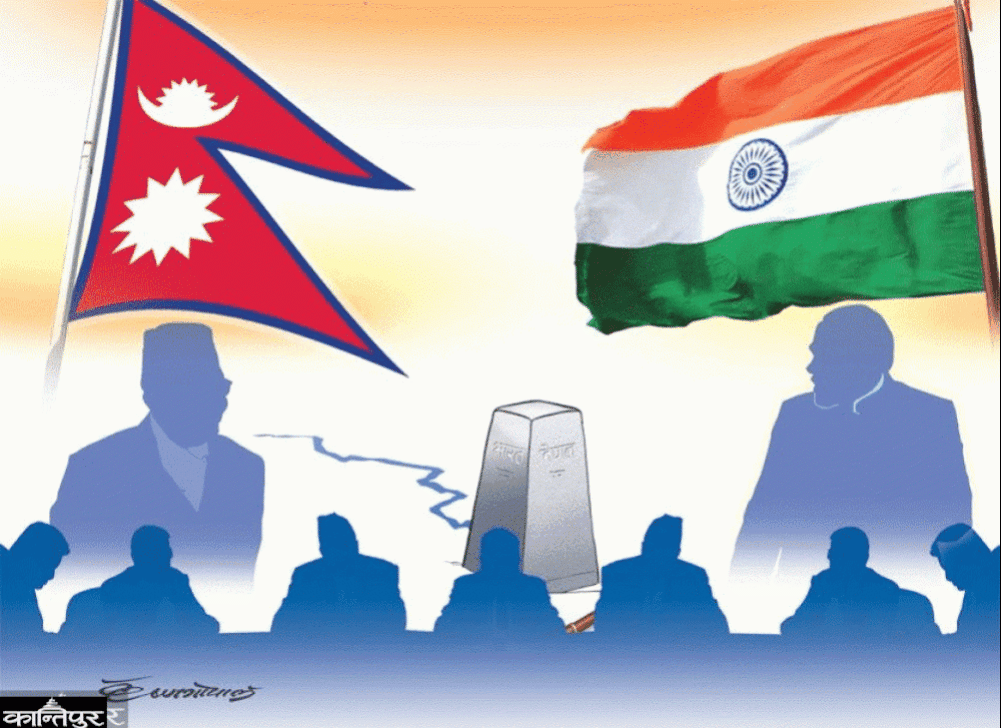
The two-day meeting of the Joint Working Group (Border Working Group) working on the border between Nepal and India has been completed in New Delhi. This meeting was held after 6 years on July 12 and 13. How fruitful was the meeting?
We use Google Cloud Translation Services. Google requires we provide the following disclaimer relating to use of this service:
This service may contain translations powered by Google. Google disclaims all warranties related to the translations, expressed or implied, including any warranties of accuracy, reliability, and any implied warranties of merchantability, fitness for a particular purpose, and noninfringement.
When Indian Prime Minister Narendra Modi visited Nepal for the first time from July 20, 2071 (even to visit Pashupatinath on Monday), a four-level border problem resolution mechanism was formed with the agreement of the Prime Ministers of both countries.
Border Working Group under the leadership of Director General of Survey Department, Survey Official Committee under the leadership of Deputy Director General, Field Survey Team under the leadership of CDO of Nepal and District Magistrate of India and Foreign Secretary level mechanism of both countries to solve Kalapani and Susta problem. According to the terms of reference given to the
working group, the survey official committee and the field survey team under both of them, repair the broken and dilapidated border posts, locate the lost and missing border posts using GPS, reconstruct the detected border posts in their original location, clean the Dasgaja area and make it uninhabited and uninhabited. The points were to jointly prepare the remaining border map (strip map) and to prepare the data of land occupied by cross-holding occupation. The Foreign Secretary-level mechanism of both countries was entrusted with the task of studying the Kalapani and Susta problems after taking technical information from the working group and submitting a report to their respective governments.
The three-level mechanism worked until July 2076. Then the work was stopped. Nepal repeatedly sent diplomatic notes to India to resume the work. But India continued to show the cause of Corona. Even after the end of the corona period, no interest was given. But now a joint meeting has been held on short notice. Perhaps it can be assumed that this meeting was held a little early even though India was heated by the terrorist attack that took place on May 9 in Pahalgam, Jammu and Kashmir.
In this meeting, the review of the progress of the work done in the past and the outline of the three-year action plan for the work to be done in the future were discussed and approved. Border inspection, pole restoration, maintenance, conservation were discussed as usual. It is understood that a decision has been taken to adopt new technology in the field of mapping, to adopt accuracy and transparency in the work.
However, it was not understood that there was a concrete decision regarding the resolution of the problem of cross-border interference by the border residents. 8 thousand 553 border posts should be established on the 1880 km border between the two countries, but 4 thousand 193 have not been established. According to the media, out of the 4,360 pillars installed, 202 are in dilapidated condition, 2,891 are in need of general maintenance and 202 are in river canals. It was not found that there was a discussion about taking precautions to erect the pillars that were washed away in the river. Although such poles cannot be installed in the water, the meeting would have been considered more meaningful if the technology to install witness poles at equal distances on both sides of the river had been included in the agenda.
In July 2071, no work has been done according to the responsibility given by the Prime Minister of both countries to the Foreign Secretaries. This is sad. However, this does not fall within the scope of the Border Working Group. However, the question arises - why the work could not be started? There are three reasons for this. Firstly, India may not be interested as India has published the 'New Political Map of India' on November 2, 2019 and included the 376 square kilometers of Limpiyadhura-Kalapani-Lipulek land in Kharlapp India.
We have moved on the map, we are still experiencing on the land of that region, and why should India have the intention to proceed with it. Second, Nepal sent diplomatic letters repeatedly for negotiations. But India showed no intention to negotiate. That is why Nepal has duly published a new (Chuchche) map on May 20, 2020 with Lipulek-Kalapani-Limpiyadhura attached. This angered India, and the relationship between the two countries became cold. Thirdly, it may also be because India does not have solid documents, evidence, historical maps of the Kalapani region. Nepal has repeatedly presented the argument that the territory up to Limpiyadhura belongs to Nepal by referring to 12 types of official old maps including 1821, 1827, 1856 and Article 5 of Sugauli Treaty of 1816. It is for this reason that India may not have taken forward the secretary-level mechanism.
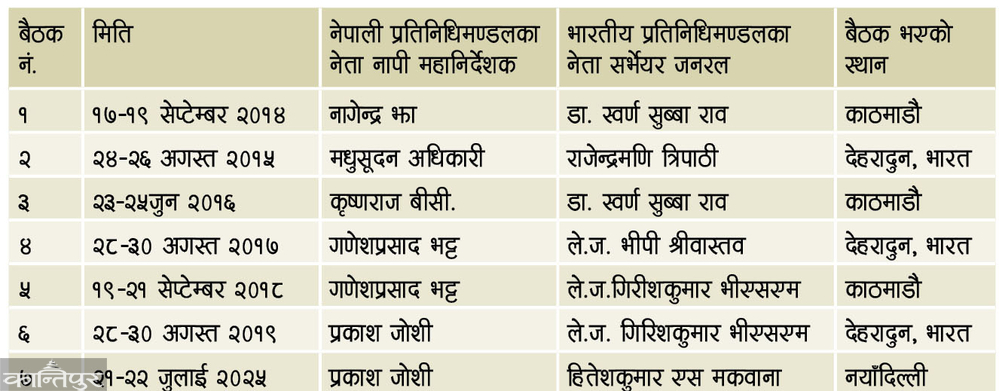
According to the modality of the bilateral joint border mechanism, 22 joint meetings should be held since 2014. But only seven meetings have been held. In that too, the gap between the sixth and seventh meeting was 6 years. Although the current meeting has made a three-year action plan, if the field work is not done in time, there is also a possibility that this plan will be limited to the memorandum of agreement. In this, Nepal should show diplomatic tact and demonstrate the ability to create formal/informal pressure on the Indian side to complete the work within the stipulated time period. When and where did the
meeting take place?
17-19 September 2014 : Kathmandu
24-26 August 2015 : Dehradun, India
23-25 June 2016 : Kathmandu
28-30 August 2017 : Dehradun, India
19-21 September 2018 : Kathmandu
28-30 August 2019 : Dehradun, India
21-22 July 2025 : New Delhi