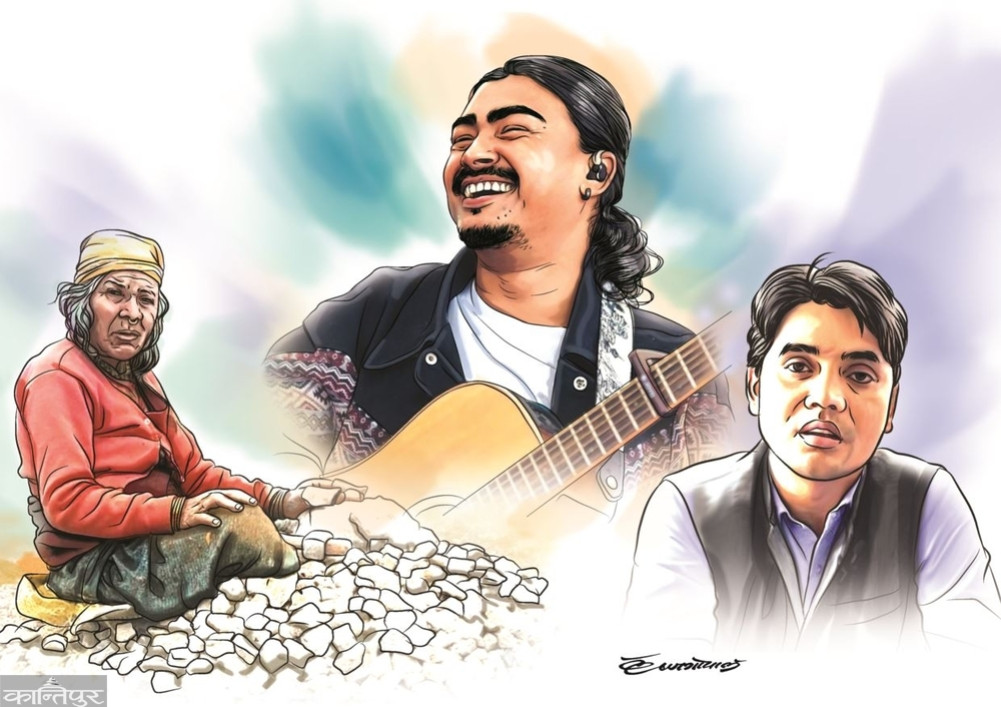
After all, what will become a country? Tower? road? train? Sismahal? Who actually makes the country? Spiderman, Superman, Batman or some Trump-incarnate?
We use Google Cloud Translation Services. Google requires we provide the following disclaimer relating to use of this service:
This service may contain translations powered by Google. Google disclaims all warranties related to the translations, expressed or implied, including any warranties of accuracy, reliability, and any implied warranties of merchantability, fitness for a particular purpose, and noninfringement.
Why was Nepal not created? How much Nepal was made, how much was not made? You have read/watched/heard heated debates on these and such questions many times. They have seen one face of each other who claimed to have come to build the country. We have also seen leaders who are proud of the same thing and are boasting that only they can make the country themselves. Or you must have heard the words of the intellectuals who are making dozen-dozen arguments about the fact that this country cannot be made. Let's rub our hands a little in this rap that makes the country, and see how much heat is falling on which palm line.
Let's start with the original question. The debates about why Nepal did not become or how much Nepal became, etc., do not go to the basic question of what constitutes a country or not. About a hundred years ago, the commentary of development in Nepal is based on the logic of making Switzerland. Nowadays, it is customary to compare the Burj Khalifa of Dubai or the romantic pictures of European cities or the American splendor on one end of the scale and the dilapidated Nepal on the other end. It simply means that the concept that Nepal can be created is not in the map of our historical imagination. Either make Nepal Switzerland or Singapore, or Europe, America. Therefore, the hypothesis of what to become, how to become, and how to become Nepal has not been outlined.
When Europe/America is the country of our dreams, instead of going through the hassle of making Nepal, the ticket to Europe and America was cut directly. Filling the brains of children with the dreams of Europe/America, selling the same scheme to colleges and colleges, opening a shop that sends them to the street, running a business worth billions, and making a fuss about 'don't let the youth have migrated abroad' is just a fraud like saying 'you pretend to be beaten, I pretend to cry'. Therefore, nowadays, informal gossip is circulating on the Internet that this country is rented out to another country, and the so-called nationalists are also looking for a bag to go to America or other western countries. There is also a tradition of 'nation-building' maharathis coming from America one by one in this messo. It is obvious that their first and last Arjunadrishti is the electoral district where the books are published.
After all, what becomes a country? Tower? road? train? Sismahal? Who actually makes the country? Spiderman, Superman, Batman or some Trump-incarnate? There is no system in this country, Ray! What system? Dictatorship system that passes zebracross with handcuffs? Utpatang things are going on. Now let's proceed with the discussion in the light of three specific characters of this country.
Map of Dhauli Bhul
If you want to see a map of the country, you should look at the face of Dhauli Bhul. His address: Baitadi District, Dasharatchand Municipality-4, Gothlapani. Age : 73 years. Profession : Worker grinding gravel on the roadside. Responsibilities : household expenses, son's treatment (Ekantipur, Shravan 14, 2082). Everything else is correct in this sabbatical of Dhauli Aami but one thing is wrong. Even in his old age, the responsibility that he is carrying out with his beard is not only to run his own household and treat his own son. The basic knowledge of economics says that the crushed stone is a part of physical production, the household expenditure means consumption and the tax paid through it is a direct contribution to the economy, and the treatment of his son is also a social responsibility he has taken.
That is why Dhauli Bhul is making her own country. The attitude of not seeing that he is building the country day and night by pounding the pebbles with his old arm without saying anything is indicative of a serious philosophical crisis. A similar view is being made by the kind of wait-and-see thinking, "Why did Nepal not become?" Waiting, a superman costume filled out or a liberal(?) tyrant wearing a fancy logo. Until millions like Dhaulis know the map of the country they are creating in Poyapoya, Kesrakesra, and every wait is canceled by some accident.
After the global financial crisis of 2008, a hotly debated topic around the world is inequality. French economist Thomas Piketty's historical analysis of the global distribution of inequality and its ideological and political dimensions has caused a great stir. According to Piketty, the legacy of capital formation and control is also a legacy of inequality. That is, those who conquered the world, built colonies and empires, have a monopoly of wealth and power in their hands. The disparity between rich and poor countries stems from that history. In the same way, even in those rich countries, the same families have a monopoly of state power and wealth till today, who had access to power and wealth since colonialism and imperialism.
Dhauli Bhul's face has a similar map of inequality. And this map is also a map of the country. Even in the permanent government here, there is a streak of people rooted in oligarchy since the establishment of Gorkhali power. They are also the ones who transfer most of the wealth accumulated by the blood and sweat of the people abroad through the state system. The system of not creating exchange relations between the state and the people and running the state as a private pawn of the ruler was also created from there. Therefore, the country made up of farmers/agricultural laborers, artists/sculptors/musicians/craftsmen doing various professions and workers (most of whom are Dalits, tribals, tribes, Tharu, women) who use their skills to produce many goods remained like a yoke of a handful of rulers. The country became the player, the people became the audience. This tradition of politics teaches us to look for supermen and conspiracies to confine the people to the audience.
Kum: the scent of the ocean
If the essence of a country is something, it is in the knowledge system, culture and life system. In music, as in other aspects of life, these same systems dissolve. Country and state power are the same, but not. The greater the distance between the country and the state, the greater the inequality and poverty. The singular nature of the Nepali state power has cut the historical threads of diverse knowledge, culture, and production of the country. If that had not happened, we would not have looked to Switzerland or Singapore to find a design (outline) and model for making a country. In historical continuity, the Raithane system was formed and we used to add new innovations to that system.
In this context, Kum Sagar has become an example. Historians say that the people of Khwapah (Bhaktapur) had created various clans to save their existence from the harsh oppression of the state power. The same legacy of Khwapa has been enhanced by Kum Sagar. Formally named Siddhisagar Prajapati, a potter by ancestral profession, Kumha, he named his musician avatar Kum: Sagar. Kumah not only adorns the essence of Khvapah with his name, but also proudly engraves the melody, rhythm and pronunciation of his songs. Narayan Gopal was also chased by the ruling party on the charge of not matching the pronunciation of 'ta' and 't'. Coming this far, it is not a matter of choice for Kum Sagar to raise his head and imbibe Raithane's accent, style and qualities.
Self-esteem cannot be imported, it must be determined by one's own consciousness and struggle. The struggle till the republic has already underlined the great spread, depth and height of self-respect in us. Kum: Sagar is burning with the incense of music spreading its fragrance. Whether it is music or painting, literature or cinema, classroom or public stage, politics or social movements, the new generation is striving to awaken the vital essence of the country. They are the ones who make the country, not those who walk to bury the electoral register. How can working minds, brains and limbs work without cleaning the yard of the country by increasing injustice, inequality and discrimination?
Venus Chuman's Mirror
After traveling to the Republic, politics is caught in the abyss of ideological crisis. Otherwise, we wouldn't be stuck in the bane-banenwala gossip. This crisis has come again because of the failure to establish a relationship of exchange between the state and the people. How does the character of the state, which takes a loan from a foreign creditor and builds a useless international airport in Pokhara and Bhairahawa, bring love to the people? Therefore, there is a mirror that should be shown to the political parties and their leaders who adopt this character of the state - Shukra Chuman's mirror.
Ainpahara found on the road from Muglin to Ambukhareni can be taken as a symbol. Abandoned until recently, the guard of this waterfall is now carved with magnificent sculptures and has been built into the Nagbeli of the waterfall – a view point and restaurant. More important than the decoration of Ainapahara is the plan to run Karma Hospital here. Shukar Chuman, Chairman of Ambukhaireni Rural Municipality, has made the local government a mirror, where the faces of the people are being reflected. Ambukhaireni has given an ideological challenge to the Singh Darbar power which has created a dependent and lifeless economy in the name of Thultula Yojana.
Whether it is by going abroad to earn remittances or by doing business in the country, by plowing the fields or by working as a wage laborer, by working in a talakdar office or by taking a government job, the largest part of an average Nepali's income goes to educating children and treating illnesses. If the burden and stress of education and health are only reduced, then people's affection towards the state will increase directly. People are creative and healthy too. And the people's work to build a country is gradually expanding. The scene of Shukra taking up this challenge is magnificent.
A municipality with small resources, most of the territory is rugged hills, many people did not think that the president of such a municipality insisted on building a hospital. When he started a hospital in the municipal premises using available resources, the situation turned upside down. After one private hospital in Chalti surrendered all its goods and dedicated itself, the municipal hospital buried the flag of success. Another milestone initiative was the plan to reform government schools under the direct supervision of the municipality. Paik The school bus operated by the municipality has changed the daily landscape of Ambukhareni so that all school students can board from the place where the
happened. Government schools are now competing with private schools.
Few enterprises/businesses and very large geography/population living in a difficult mountain economy What can be the way to irrigate people's labor, skills and enthusiasm? The beautiful answer can be equally simple – Haatbazaar. The enthusiasm of the people would really return home when the unsold Jinis will be purchased by the municipality at the market of Ambukhareni, where the agricultural and craft products arrive, at a minimum price. Chuman told this columnist - people liked the bazaar more than the hospital. Of course, the place where the struggle of life flourishes is much dearer than the place where you go when you are sick. What is the essence of this challenge given by a rural municipality to the policy and program and budget of Singha Darbar? Water the minds, brains and bones that make the country. Only then will the state and power be distinguished. Otherwise, mistrust and disdain for the state, party and leaders will build. Ultimately, building a country means building the homes of the people. - [email protected]