While services and facilities are being expanded in international airports around the world, serious initiatives have not been taken to improve the weaknesses that were once seen in our country.
We use Google Cloud Translation Services. Google requires we provide the following disclaimer relating to use of this service:
This service may contain translations powered by Google. Google disclaims all warranties related to the translations, expressed or implied, including any warranties of accuracy, reliability, and any implied warranties of merchantability, fitness for a particular purpose, and noninfringement.
Despite the use of modern technology and human discretion, sometimes problems occur in aircraft. In that context, the manufacturing company and the operating company also review their own aspects. This is a natural process. Unnaturally, it is the leading organizations of the Nepali Air Service, who have not been able to create an environment for easy maintenance and management in the event of a problem with a large aircraft at the Tribhuvan International Airport.
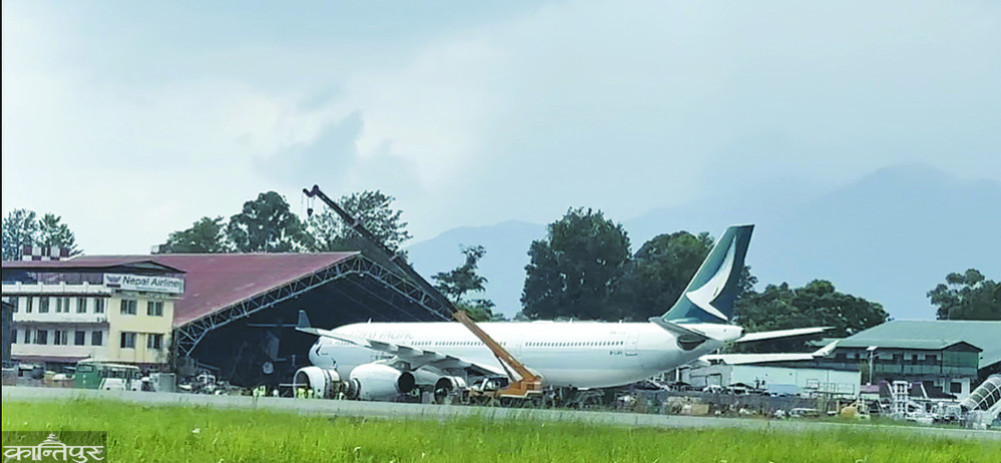
Even in the background that has caused embarrassing situations many times in the past, they have not taken the initiative to properly review and improve. On June 27, Hong Kong's flag carrier Cathay Pacific Air's widebody plane engine was 'grounded' after a problem, and the same lack and mismanagement has worsened. After Cathay brought a spare engine through a cargo plane, the engine is currently being changed in the open area of the airport. The plane will be leaving in a few days. But the weak status of the international airport and our attitude that we do not think it is necessary to improve it is more likely to remain the same. The government should give top priority to making the airport organized and convenient for connecting airlines and passengers from all over the world.
Cathay's Widebody A-330 aircraft with the call sign 'Bravo-Lima Bravo Hotel' had a problem when it was about to fly from Kathmandu to Hong Kong on June 27. After reaching the runway for take-off, when the pilot turned on the power of both engines, the left engine burst. The vessel, which was declared 'grounded', was placed on the apron. There was also a problem with the airport management when Cathay's widebody occupied the parking lot for two weeks. Due to the lack of space for parking other ships, the airport staff tried to take the Cathay ship sometimes to the parking near the depot of the oil corporation and sometimes to the remote parking in the northeast area. However, Cathay's staff disagreed. After Cathay brought a spare engine through its own company's Boeing 747-400 series cargo aircraft, the engine change is being done by taking Cathay's widebody in front of the hangar (ship maintenance) of Nepal Airlines Corporation. The engine will be checked after installation. After the technical clearance, the ship will be taken to Hong Kong without passengers.
Many companies like Cathay have suffered extra after their aircraft had problems at Tribhuvan Airport. Due to engine problems, India's Jet Airways, Qatar Airways, Thai Air and UAE's Etihad Airways also had to 'ground' their aircraft in Nepal for weeks before Covid. In February 2071, international flights were suspended for four days after a Turkish Air widebody plane from Istanbul skidded off the runway during landing. The 'brand new' ship worth 26 billion rupees could not be repaired in Nepal. The Turks handed over the ship to the insurance company and took away the working parts. The hollow ship was auctioned for around 1 crore. Such references make it necessary to repair large ships in Nepal at an international level. Looks like a
hanger is needed. Due to the lack of it, there is a problem in the engine of the big foreign aircraft, so it is forced to bring technicians, engines, spare parts from the charter ship and repair them under the open sky. As Cathay's insurance agency did not allow open air repair of the engine in Nepal, he had to carry the problem engine with a spare engine via cargo. It is certainly a shameful situation that the 7-decade-old Tribhuvan International Airport is not in a position to provide technical service to large aircraft.
The problems inside the Tribhuvan airport do not end there. After 18 people died in the accident of Solar Airlines while flying to Pokhara from this airport on 9 July 2081, the report chaired by Ratish Chandra Lal Suman led by the government has exposed the regulatory body Nepal Civil Aviation Authority's ability to regulate and monitor. The record commission found that a high pitch rate was adopted 18 times in two years during the 'take-off' of two CRJ aircraft of Sourya Airlines. Why this fact is important, the 'pitch rate' was found to be increased excessively during the 'take-off' of the plane that was involved in the accident. But it was not seen that the authority had already monitored these aspects and made them follow the standards. If the incident is considered special, there are other such examples.
There is a fuel depot of Oil Corporation within the Tribhuvan Airport complex. This has added risk not only to air safety, but also to dense human settlements around the airport. There are voices that the depot should be relocated to reduce the risk. But even this urgent work has not been able to gain speed. It can assess how much priority is given to the safety of citizens and aircraft. Even in other minor managements, there is cheating. For example, last year after Surya's plane crashed, the fire brigade was hampered by piles of construction materials at the crash site. Suman-led commission has suggested that Tribhuvan International Airport should not keep construction materials at the emergency entrance.
On the whole, while services and facilities are being expanded in international airports around the world, there has not been a serious initiative to improve the weaknesses that were once seen here. It is not found that there is a priority for reform or a sense of urgency and responsibility for it. It is disrespecting the country among international airlines and passengers. Therefore, it is important to rise above the thought that an airport will be built with a wide pitch. All necessary infrastructure, services and security should be realized. In addition, there should be readiness to immediately correct the weaknesses that are seen frequently.