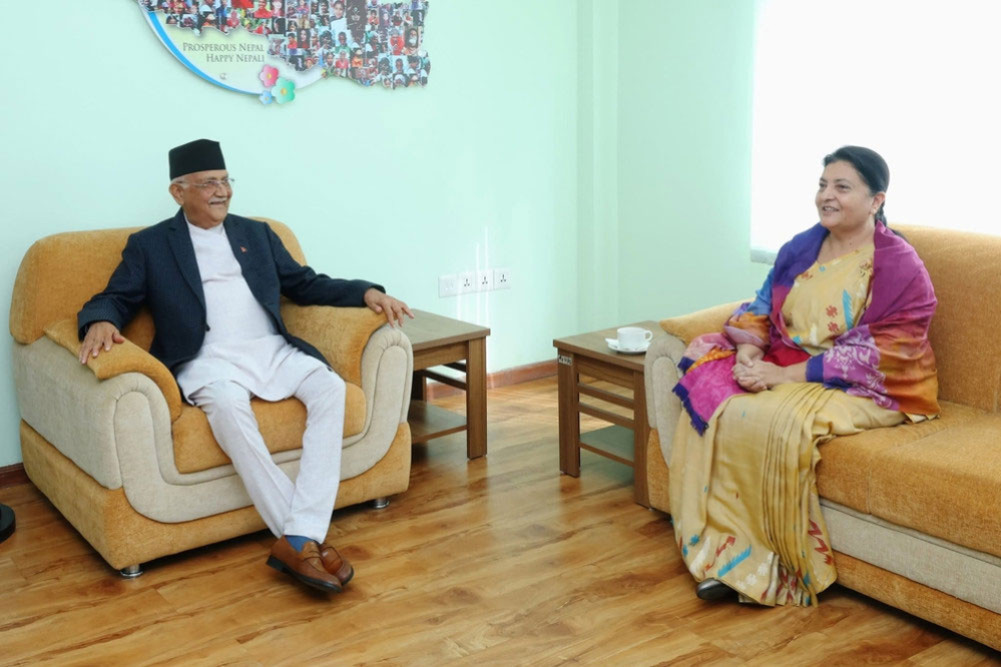
Where Oli is today, he has reached there by violating the boundaries of values, beliefs, ethics, decency and dignity all along the way.
We use Google Cloud Translation Services. Google requires we provide the following disclaimer relating to use of this service:
This service may contain translations powered by Google. Google disclaims all warranties related to the translations, expressed or implied, including any warranties of accuracy, reliability, and any implied warranties of merchantability, fitness for a particular purpose, and noninfringement.
Prime Minister Khadga Prasad Sharma Oli, who escaped from a very difficult situation and reached the top of power politics, has an amazing ability to captivate the audience by mixing logic and emotion. In English, the adjective 'logical' is used for logical things. The opposite word is, 'illogical' means an irrational argument. Inconsistent positions are often based on conjecture.
Some of Sharma Oli's expressions are more shocking than Anulom, Vilom or Pratilom. In public debate, the newly coined term 'oliological', i.e. 'olitological', can be used for that kind of argumentation.
is semantic, basically baseless expression but aural evidence based on speaker's personality. Recently, he has used a similar oligaristic trick - 'If 70 years of age is considered as the age limit, I should reduce the time spent in prison by 14 years. I could not work for 14 years while in prison.'
Not being able to work while in prison seems logical. If we look at the reality that his political personality is formed because of his imprisonment, he is talking irrationally. It is a hypocritical strategy to force a party to change the age limit provision because of its own ambitions. Overall, Sharma Oli's political maneuvers can be called Oli logical tactics.
Once upon a time, they used to say, "When Jange spoke, he spoke." Hey, now it's almost like that - Oli's speech, lead shot! The will of Khasarya Mukhtiar Sharma Oli cannot be bound by the constitution of the party. The cultural acceptability of the ethnic Mukhtiyar was higher than that of the major Khasary-dominated political parties like the Congress or the UML. He is the most ardent defender and promoter of such communal supremacy. Politically, now Sharma Oli is UML and UML is Sharma Oli. He
did not earn their cultural-political capital with little suffering. His Makafuin and Makhesanglo, which became very popular among the united Khasarya Jamaat, were not insensitive but used strategically to revive the ethnic pride of the dominant community.
Native cunning is the ability to achieve one's goals in an innate or naturally clever, powerful and sometimes devious way. Due to bitter experiences of long prison life, Sharma Oli's natural ingenuity has been refined.
Even now, the condition of Nepal's prisons has probably not improved much, but those who embraced politics as a lucrative business after 1990 cannot even imagine the excesses of the shah rajas' law era called panchayat system. Sharma Oli's indomitable willpower and ardent ambition are discussed in the book 'Unwritten History' written by Radhakrishna Mainali, a Rumani warrior of Jhapali Naxal Panth.
The word 'Kathjeeva' is used in Maithili for a person who keeps his desire to live even in any adverse situation. What it means to be a Kathjiva is that such a person becomes very self-centered and can do anything for his own interests.
The highest moral for Kathjeeva is self-promotion. What about helpers, colleagues and fellow travelers, even their own family, friends, promoters and patrons are just a means to prove their selfishness. One cannot use someone else as a tool to achieve one's goals without abandoning the basic tenets of public morality that each person's will, purpose, human dignity, and personal autonomy are respectable. Therefore, Kathjivas consider morality as a hindrance.
The harsh prison life, the company of various types of criminals, and the neglectful behavior of prison guards and other staff can make the average prisoner's state of mind anything from moral, immoral, or amoral. After being released from prison in apartheid South Africa, political prisoner Nelson Mandela emerged as a paragon of morality. Hard criminals turn out to be even more immoral. According to scholars of prisoner psychology, prison life makes most people desensitized and their empathic powers become extremely weak.
The use of personal qualities such as determination, courage and courage such people begin to use only in self-defense and self-promotion activities. Ethical-Absolute Such activities can be either ethical, immoral or unethical. Sharma Oli's political trajectory, which started with his involvement in the suicide campaign of Jhapali Naxalites, has remained completely immoral, regardless of whether it is violent or non-violent.
The role of the Jhapali Naxalites in the long movement for the restoration of the multi-party system was, however negative in essence, because the Maoists of that time, known as Marxist-Leninists, were committed to establishing the 'dictatorship of the proletariat'. Whether proletarian or apocalyptic, authoritarianism and a multiparty system cannot go together. By boycotting the 1980 referendum, the then Malay group supported the royal system of government.
Due to Ganeshman's strict conditions that no democratic movement could be carried out together with the communists, the birth of the political initiative now known as UML was possible around 1989-1990. Although the respected communist faces of the movement were hardworking Marxists like Manmohan Adhikari and Sahna Pradhan, it did not take long for the party that emerged under the name UML from the United Left Front to come under the control of those who were 'leaders emerging from the party'.
Madan Bhandari, who became popular in a short period of time due to his simple life, linguistic excellence, provocative yet sophisticated oratory and amazing personality, was also adept at political innovation. His concept of 'people's multi-party democracy' can be directly called revisionism in communist rhetoric. After the implosion of the Soviet Union and the spread of Dengism in China, perhaps the relevance of orthodox communist ideology was weakening.
The fact that even Pushpa Kamal Dahal, who entangled the country in armed struggle for a decade, finally arrived at the 'Madan Bhandari Path' is the strongest proof of the contemporary relevance of revisionism. Regardless of the behind-the-scenes games of the country's permanent power and foreign powers, credit must be given to Madan Bhandari who pulled Sharma Oli's peripheral political role towards the center. The political trajectory of former president Bidya Devi Bhandari, who started from a white saree and went to a golden garment, is also connected with Madan Bhandari, the creator of the concept of 'people's multi-party democracy'.
Vidya Devi Bhandari, who became President twice and Sharma Oli who became Prime Minister for the fourth time through UML's politics, but the political fortunes of Madan Bhandari and Jivraj Ashrit were indirectly the byproducts of the Dasdhunga Jeep accident. Regardless of the talk of equality, hierarchy and hierarchy are of great importance in communist politics.
After Madan Bhandari, Madhav Nepal, who is currently in the UML, increased Sharma Oli's political stature by entrusting him with a one-member accident investigation committee. Sharma Oli, who realized early that any report cannot remain without controversy, conducted the investigation well, but did not announce the conclusion. Riding the wave of sympathy after the accident, Bidya Devi Bhandari appeared on the horizon of national politics.
These two political beneficiaries of Madan Bhandari's untimely and unnatural demise have started to appear as potential competitors for some time. From the outside, the question of the future leadership within the UML is an internal issue of that party, but the resolution of the Oli-Bhandari case is likely to affect the speed, direction and destiny of the future politics.
The basis of morality
It is a human tendency to enjoy discussing things that are strongly desired but less likely to be found. Cheating in the game of power politics is considered natural anywhere and Nepal is not an exception in that regard. Racial dominance, majoritarian arrogance, nepotistic behavior and slave capitalism have been the government character of Nepal from the Shah-Rana dictatorship to the republic. It can be seen with the naked eye that all the struggles to empower the common people eventually end up in fatalism through compromise, capriciousness and escapism, no need to wear the glasses of idealism. The search is for ethics in politics.
At the swearing-in ceremony of the Prime Minister, the politician who does not hesitate to tell the sitting President that 'it is not necessary' from the public platform does not think it is a bit awkward to talk about official dignity. And, those who see political future in jobs, financial interests in transactions and cultural superiority in ethnicity expect ethics from politicians, honesty from businessmen and patriotism from nationalists. It is not so much that arrogance and hypocrisy gradually become the character of common people.
Without definitional clarity, the exploration of an abstract topic like ethics is not possible. The purpose of ethics is almost self-evident - the definition of what to do, what to do and what not to do to ensure justice and peace is a matter of personal choice for personal improvement and promoting social harmony, but it is affected by the prevailing values and beliefs in society. It does not make sense to judge right and wrong behavior within the law as immoral only on the basis of tradition or custom.
Pragmatic ethics scholars suggest determining the morality of an action or behavior based on standards such as virtue, utility, consequences, and pragmatism. According to idealists, integrity, honesty, fairness, kindness, sympathy, empathy, self-control and duty are some of the criteria of morality. Religious leaders have considered the five guiding principles of morality to be purity, contentment, self-reliance, penance and good deeds and complete faith in divine law. Neither of the two main ideologies—Bahunism and Communism—that are highly influential in Nepalese politics, promotes political morality. To break the story, any religion and sect is rooted in superstition, but Bahunism, which prohibits upward socio-cultural mobility by institutionalizing innate superiority and inferiority, should not be called status quo, anti-judicial and therefore immoral. Innate inequality, subordination of the governed, irrationality of the ruler, insensitivity, undemocratic character based on racial superiority, devaluation of physical labor and overvaluation of worship, obsession with the past, communal antagonism and caste patriarchy are considered natural in the land of Hindutva politics and promoters of traditional 'Nepali nationalism'.
Going down a step lower than Bahunism, the communists call morality a "curtain for the powerful and a trap for the weak" and call for a storm of revolution by tearing up the hypocrisy of bourgeois morality. Generally speaking, there is no 'morality market' available in contemporary Nepalese society. The rule of Bahunists and fake communists through Shah-Rana has not allowed to become a base for clean political practice. The common people, by pointing out the dream of clean politics, encourage the successful politicians and enjoy themselves by scratching their wounds.
The world of self-imagination
Those who study the social status of the countries that came into existence after the collapse of the Soviet Union have found a wonderful similarity in them - "fantasy" is prevalent in all such societies. The word Swaikalpana, which gives the impression of an alternate reality, cannot capture the power of the noun fantasy, perhaps that is why even the Nepali dictionary has given indirect acceptance to the expression 'fantasy'. When the surrounding disorder becomes unbearable, one's first reaction is to try to change the situation.
After repeated failures, a depressed person tries to escape. It is not natural that more than two thousand Nepalis choose the option of going abroad every day, the failure of the state system is inseparable from that reality. Not everyone enjoys escaping from reality. Those who went to Arabia are under pressure to pay off the metered loan. Those who have come to Australia and the United States, despite their low economic status, are surprised to see their insignificance in developed countries, remembering that they are still poor in their country.
Those left behind in the country want to take momentary pleasure by blaming personal failures, social inadequacies and economic stagnation on foreign conspiracies, manipulations of middlemen and selfishness of politicians. Pragmatic politicians like Sharma Oli have not only made self-concept a tool for political mobilization in newly independent and democratic countries.
Railway across the mountains, gas in every stove, water in every farm, road network, undiscovered uranium mines and the possibility of getting rich by exporting electricity are not unknown to the common people. But to live, even if something is dreamy, you need a base. There is a famous saying in Urdu - 'Hum ko maloom hai jannat ki haqikat lakin / Dil ke khush rahken ko 'galib' ye khayal achcha hai.' But the fantasy that it is a 'golden nugget' teaches us to indulge in false facts and alternative realities instead of accepting reality. Sharma Oli, who has shown his ambition to be UML president for life, knows that the only person who can challenge his supremacy is Bidya Devi Bhandari, who has reached the top of politics from a parallel trajectory.
According to bourgeois political ethics, Bidya Devi Bhandari is a challenge to the patriarchy. Communist ethics do not allow marginalized politicians to return to the mainstream. After that, what remains is the political dignity - it may seem "naturally unnatural" for a person who has "reached the dignified position of the President and has become the supreme ruler" to have a desire to compete within a party.
Whether armed or peaceful, transitional politics proceeds by violating established norms of decency and decency. The Constitution of 2015 has only slowed down the transition period and prolonged it, it has not given a factual and rational definition of the disputes of nation building that have been going on for centuries. Where Sharma Oli is today, he has reached there by violating the boundaries of values, beliefs, ethics, decency and dignity all along the way.
He thinks that talking about political ethics or government dignity is like calling a kettle black. The contemporary tragedy is that, even if the coin of UML leadership is flipped everywhere, the possibility of qualitative change in national politics is not zero, but very low - if there is no cloud in the sky, where can you see the silver circle! The will to change the situation can only be gathered by encountering the reality, not the joy of self-conception. There is a possibility that Sharma Oli will contribute to the transformation of Nepali society by using his prison experience. His proverbs and sermons have now become commonplace.