We use Google Cloud Translation Services. Google requires we provide the following disclaimer relating to use of this service:
This service may contain translations powered by Google. Google disclaims all warranties related to the translations, expressed or implied, including any warranties of accuracy, reliability, and any implied warranties of merchantability, fitness for a particular purpose, and noninfringement.
The expectation that the National Assembly will unanimously correct the 'cheating' regarding the 'cooling off period' during the passage of the Civil Bill by the House of Representatives has become weak. Especially, the amendment proposal registered by the ruling party, UML, has increased the suspicion that the bill will be further tampered with.
The MPs of UML have collectively filed an amendment proposal to remove the provision of two-year 'cooling off period', through which the party intends to approve the 'manipulation' in the House of Representatives. The UML itself is leading the government, Prime Minister KP Sharma Oli has been displeased with the 'cooling off period' and the MPs of the same party collectively proposing amendments have given many signals and messages.
Mainly, the basis that the 'cheat' in the House of Representatives was not only a human error or a procedural weakness but also a result of a serious conspiracy has been strengthened. As the 'Special Committee to Investigate Errors in the Report of the Federal Civil Service Bill' is working, there is bound to be a delay in time, now the National Assembly should dispose of the bill judiciously.
The Civil Servant Bill registered in the Parliament by the government in February 2080 was passed by the State Order and Good Governance Committee of the House of Representatives with a 'cooling off period'. In that order, he decided that the employee who resigned or retired from the civil service or other government service will not be eligible for any constitutional appointment or appointment to any government post before the completion of two years from the date of retirement.
The same provision is contained in Section 82 (4) of the Bill. After a clear decision came from the committee, it was natural to make a law accordingly. But on June 15, the House of Representatives passed the conflicting provisions in addition to the mentioned provisions while passing the bill. According to which, in section 82 (5), the provision of 'cooling off period' was made ineffective by providing that appointments cannot be taken only in 'constitutional or diplomatic appointments and any other appointments made by the Government of Nepal'.
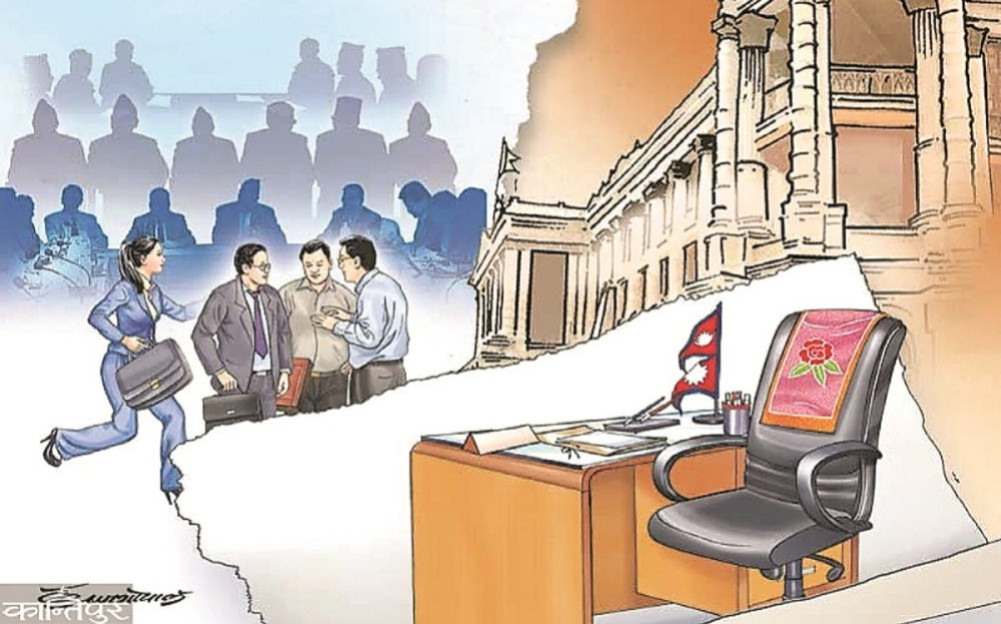
The 'cooling off period' itself was a much-discussed provision. To remove it from the bill, the staff leadership including Chief Secretary Ek Narayan Aryal made a political run and gave public statements against it. Chief Secretary Aryal had expressed the need to remove the 'cooling off period' in the bill. General Secretary of Parliament Padma Prasad Pandey made a public statement that the provision in the bill was unconstitutional. Prime Minister Oli also stood in solidarity with the employees.
And, at this time, UML has put forward a collective amendment proposal. Whereas, it was expected that he would stand in the forefront to correct the error in the House of Representatives. Therefore, what is happening now, it is not just a 'clever' error in the bill, but rather a conspiracy under the guise of strong political power. UML has reached a place where it has to answer whether it has political involvement or not and what is the party's official opinion regarding the 'cooling off period' in this case, which will destroy the dignity of the parliamentary system.
The absence of a 'cooling off period' has made the staff leadership extremely opportunistic. There is a growing tendency to maintain self-interested close relations with the political leadership, to abuse the position for the interests of both parties. Appreciating the closeness and contribution, the government or the party also forces such employees to be appointed to various constitutional bodies within a short time of their retirement or resignation. There are many references that have started to be set even for resignation. Due to this, the entire process of appointment has become polluted. It has become a situation to be criticized even if someone who is said to be good gets appointed.
Mainly, the dignity of the appointed position has started to fade. Even after being appointed, there is growing criticism that the appointing party shows loyalty to the government or the party and is indifferent to constitutional obligations. Due to this situation, the dignity of constitutional positions and officials from government service is getting weaker. To prevent this, the debate of 'cooling off period' has been effective. It is believed that if such a provision can be made, the employee will not be tempted by the immediate appointment and will not be ready to do unfair work. If the 'cooling off period' can be kept long, the employee's relationship with the political party and special leaders will also be thin, so the basis for not being affected by party interests during the performance of official roles is strengthened. It helps to make the post before retirement and the role of the reappointed post effective, fair and in accordance with the constitution.
Even though it was a 'cheat', the bill has been passed by the House of Representatives and has come to the National Assembly. Therefore, the role of the National Assembly is important at this time. The National Assembly should dispose of the bill by keeping some aspects in mind. Firstly, the House of Representatives is considered to be energetic and the National Assembly is considered to be mature in nature. The National Assembly has been envisioned with the expectation that the works and errors done by the House of Representatives will be maturely examined and made suitable for the national interest. He should take care of his role and expectations of himself.
Secondly, it has been felt that there is a weakness in passing the bill by the House of Representatives. The State Administration Committee itself has requested the National Assembly to correct the error during the passage of the bill on June 18. As this is a unanimous decision, it would be desirable for the National Assembly to take note of it.
Third, what is the public's opinion on the ongoing debate about the 'cooling off period'? What are the suggestions of political-administrative reform activists? It is easy to reach a conclusion if we take care of such aspects as well.