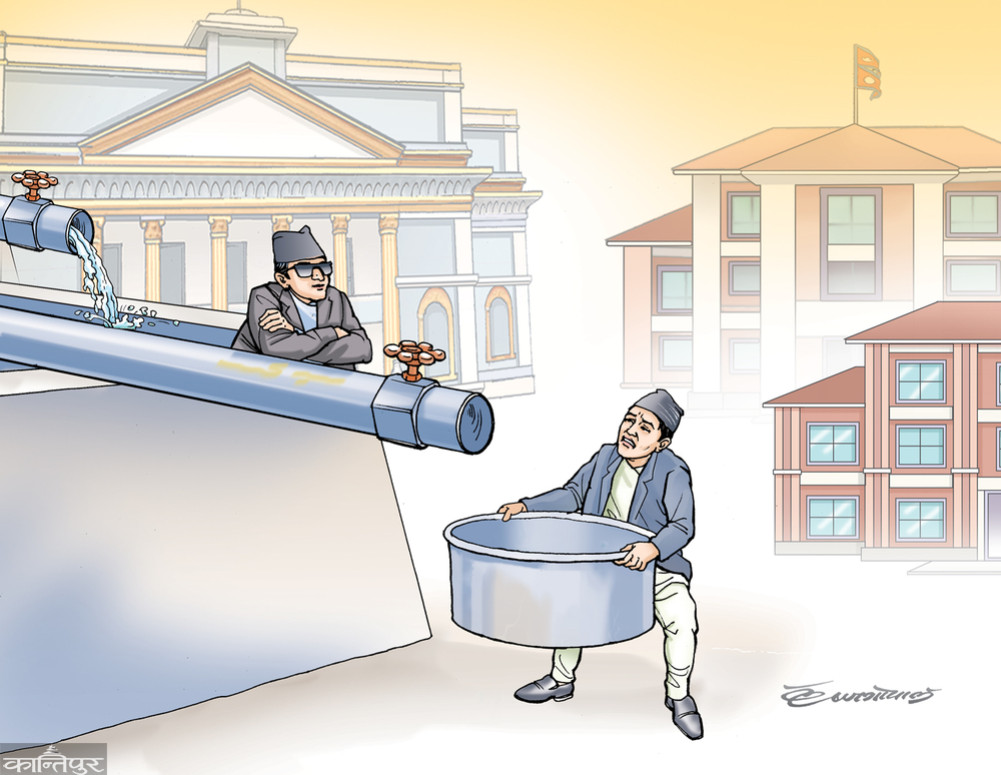
Equitable grants are a great tool to protect and promote federalism. With such a grant, the province gets to work in its specialty. Local governments get an opportunity to localize development.
We use Google Cloud Translation Services. Google requires we provide the following disclaimer relating to use of this service:
This service may contain translations powered by Google. Google disclaims all warranties related to the translations, expressed or implied, including any warranties of accuracy, reliability, and any implied warranties of merchantability, fitness for a particular purpose, and noninfringement.
As citizens did not get what they expected through federalism, the volume of dissatisfaction among citizens has increased. Now it is necessary to uncover the deep cause of dissatisfaction. The first reason is the archaic bureaucracy, which has not adapted itself to the rhythm of federalism.
Our politics did not throw the stone of federalism at the employees. Not only is there a centralized mentality, the people's representatives are in the grip of the bureaucracy. If the bureaucracy is not restructured in the framework of federalism, then federalism has become only an appearance. The second main reason is fiscal federalism.
Even now, 62 percent of the state's total treasury is in the union. The province has been tricked by giving 10 percent. In federalism, the provinces work as circulatory systems that are linked to local governments. There is also a connection with the above association. There is a growing trend of giving 10% to the state and accusing it of not delivering anything.
Local governments have been given 28 percent of the funds. 28 percent amount is low. This allocation is unscientific. Financial federalism has not strengthened our federalism. It is natural that state and local governments will not be able to deliver as long as fiscal federalism remains.
basic recognition
There are some basic principles of fiscal federalism. A basic principle is that wherever authority is vested, there should be more human resource management ie more employees. Financial management also had to be in the rhythm of authority. Now the state and local governments are in this trap. Employees do not agree to go to state and local government. They try to stay in the union as much as possible.
Teachers do not like the arrangement of education provided by the constitution. Teachers do not want to cooperate with the local government. The authority lies with the local and state governments but not the employees. no money And how is it delivered? It is true that the state government has not been able to do this in an organized and systematic manner. So now our province is under the control of employees on one side and union on the other. The same is true of local government. As a result, the local government and state government have not been able to work according to the spirit of federalism.
For example, when the local government works on education, it does not work on physical infrastructure. To work on educational issues. Recently, during such a discussion in Khanikhola Rural Municipality of Bagmati province, the chairman said that - not to build physical infrastructure may be in principle, but it is not applicable in our country.
because the union does not build the physical infrastructure of the school. The local and state governments have to bear the brunt of the union's weakness. They have not been able to do what they should do. From the point of view of financial management, the local government has to do the work to be done by the association. Because they are financially weak, they have not been able to work on it as a priority. The provincial government also has this irony.
The aspect of financial distribution
In particular, the financial management of our federalism is very difficult. When broken down by population, most of the money falls in urban centers. Most of the money goes to Madhesh. Madhesh's problem is one of identity. The state had to manage identity, play a role in promoting self-esteem and identity for the Madhesh. Considering the population as a big indicator, less money went to the Karnali, Far West, Himalayan and Midhill regions. As a result, the local government could not do what it wanted and we arrived in the form of migration.
Let's look at a statistic - 34 percent of households in Far West are in Kailali district, 18 percent of households are in Kanchanpur. 52 percent households are in 2 districts. We have arrived at the height of migration. On the one hand, migration is emptying the hilly and mountainous terrain. A large amount of arable land in the hills is becoming barren. The unprecedented biological diversity of the mountains is becoming useless without people. Mountain agriculture and mountain tourism are in great crisis.
On the other hand, the identity of the Madhesi community is being attacked by the rapid migration to Madhesh. In Kailali and Kanchanpur, a Tharu could not stand with dignity and self-respect. He is becoming a minority in his own place. This type of financial management has neither benefited the mountains and Himalayas, nor has it benefited Madhesh and some centers. But there is no debate about it. There is no creative direction to restructure fiscal federalism. It is right for citizens to express dissatisfaction with federalism. What are political parties doing? Where are the experts, intellectuals and researchers? Why is there no public discussion on this matter? is strange.
In particular, looking at the global recognition of federalism, it is necessary to manage 45 percent of the funds for the local government and 35 percent for the province. The remaining 25 percent is kept by the association. The personnel had to be restructured in this proportion. Even today, federal offices are like bus parks. There is no space to park vehicles in any ministry.
That is staff congestion. Employees should also go down in numbers and capabilities in federalism. But a successful bureaucracy does not go down to keep politics in its grip. If authority is down, people have to go down. In this matter, the political leadership at the highest level is weaker than the bureaucracy.
The bureaucracy in Nepal is also terrible. The rally is led by the chief secretary to remove the two-year cooling period after retirement. What is left of the ability that was not seen until the time of the Chief Secretary and had to be at a higher position? Our leaders cannot say this. Any appointment to 'retired' employees is stopped because the potential has been exhausted.
unbalanced grants
Now the federal government has increased the conditional grant. Equalization grants are being cut. This trend is increasing in the last 7 years. Why is this done? What is clear is that the union is trying to keep the provincial and local governments under its control by increasing the conditional grants only. Conditional grants are actually a practice based on centralization. It is a mistrust of state and local governments. It is a story created to weaken the provincial and local governments.
is a game to cut the responsibility of state and local government to the community and make them accountable to the union. The Chief Minister and Ministers should carry files around the Federal Ministry and come to ministerial jobs. The intention is that the secretaries should be able to show their agility at that time. Which does not accept any recognition of federalism, conditional grants have categorically denied provincial autonomy and local government autonomy.
equitable grants are a great tool to protect and promote federalism. With such a grant, the province gets to work in its specialty. Local governments get an opportunity to localize development. In a country with cultural diversity, state and local governments can draw the framework for identity-friendly development.
is actually the beauty of such grant federalism. More importantly, our process of centralization yesterday has perpetuated development imbalances. Sudurpaschim, Karnali or Madhesh are examples of imbalance. It is the wish of federalism that the economic, political, social and cultural status of such areas should rise through federalism. But our current aspect of fiscal federalism is not working to reduce the imbalance, but increasing the imbalance. Which was done by centralism.
federalism had to reverse it and go in the direction of balance. Provinces should be able to work creatively on regional specialties. What is the development of your province? Based on what belief? Which strategy to work on? In which field to work? Such rights fall under the general jurisdiction of the province. But the province has not been able to work because of the lack of financial support to such a jurisdiction. The state should make up its own mind. It is not a central organ that implements centrally imposed ideas. But today, through financial and personnel means, an organization has been created that obeys the orders of the center.
If this is the state of the province, what will the local government do? How will development be localized? How to think at the local level? It is very difficult. The development association is not a matter of coaxing, piling up and imposing on the state and local governments. When will it be established in our federalism that it is not recommended? The day this recognition is established, the state and local governments will take an original and creative path. Politicians should understand this very well.
experts also had to understand that it is not our job to sit in Kathmandu and recommend development to the provincial and local governments. However, most experts or intellectuals in Nepal do not prefer to produce knowledge. Leaders want to reach the leader's yard by theorizing their speech.
Thinking and pondering independently is not the domain of experts or intellectuals in Nepal. However, it is time for some independent experts or intellectuals to raise their voice. The number of which is very low. If this recognition of development, the financial aspect and the rhythm of the employees are compatible, we are still not in a place to panic. We can address issues like production, employment, industrialization. But the biggest pain in this direction is not politics.
Union's tyranny
Provinces and local governments are not given a place to collect taxes. Even now, the union collects 80 percent of the taxes. Let's see from the experience of a common forest. The biggest tax collector in the forest is the tourism tax in the national parks. But there is no federalism. All taxes accrue to the Union. Neither the state gets to collect tax from its area, nor the local government gets to collect tax from the forest near it. A similar arrangement is also in Annapurna conservation area.
There is no place for local governments and provinces in the hydropower sector, be it high tension lines or anything else. The same is the case with taxes on private forests or herbs. Industries revolve around this problem. Federalism has not come there either. What is meant is that state and local governments should have a place to collect their taxes.
Tax collection area should be expanded. But this kind of federalism came which does not give space to the state and local governments and says that they could not collect taxes, this is something that cannot be reconciled. If we look at the practice of federalism in the world, it is the work of the union to raise local governments and provincial governments. But how can our union be weakened? It seems that The chances of state and local governments growing up and flying are very weak in this trend. If we do not immediately restructure the financial aspect, our federalism cannot take the right path.