Due to the increasing corruption, good governance based on speeches, some controversial decisions that could not be accepted by the people's hearts, there is now a serious distrust of the people towards the government.
We use Google Cloud Translation Services. Google requires we provide the following disclaimer relating to use of this service:
This service may contain translations powered by Google. Google disclaims all warranties related to the translations, expressed or implied, including any warranties of accuracy, reliability, and any implied warranties of merchantability, fitness for a particular purpose, and noninfringement.
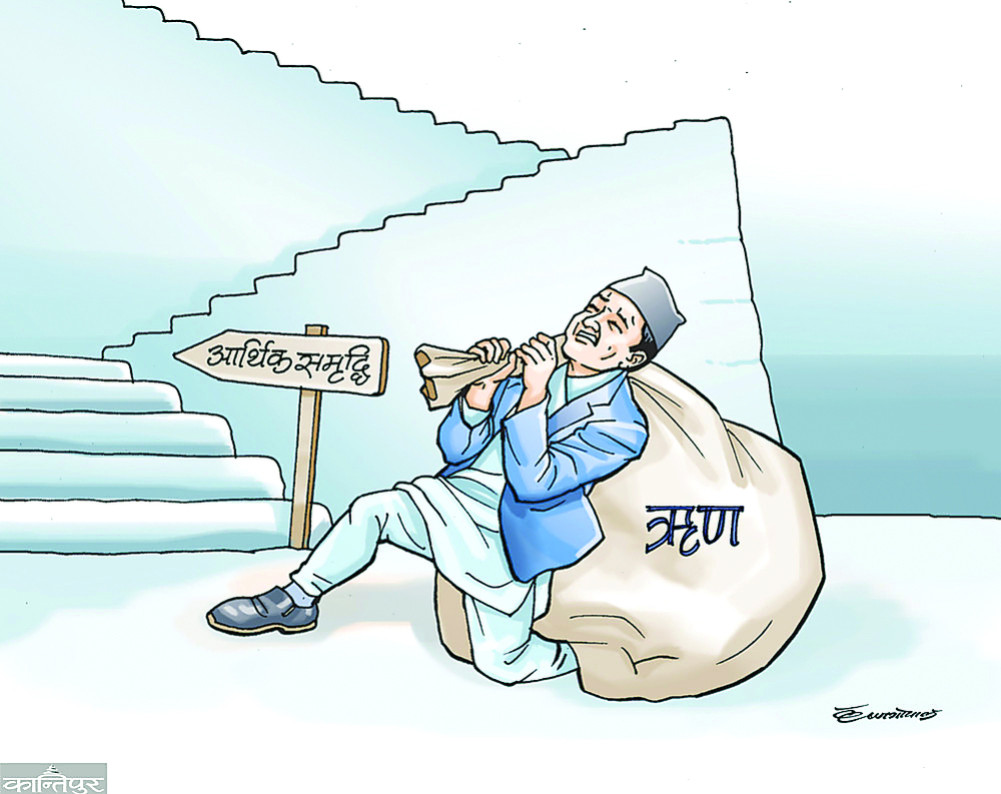
Increasing debt as a proportion of GDP, defaulting on payment obligations has brought a crisis to Nepal's economy. The future of the country's economy depends on the quality of spending, the speed of debt growth, the government's ability to collect revenue and the art of risk management.
Historical facts have proven that public spending on health, education, transport and communication has a positive impact on the economy. Empirical evidence shows that a 1 percent increase in public expenditure has the potential to increase GDP by 0.47 percent. Where current and development expenditure contributes to economic growth. But when most of the government's spending goes to debt repayment, none of this makes sense.
Due to the small size of the economy in Nepal, it has been difficult to carry the burden of debt. Because our financial space is small, the external and internal shocks of the economy could not be tolerated. After spending the entire debt to pay the principal and interest, the opportunity cost (opportunity cost) increases and the programs allocated to consumption, investment and economic growth are stalled.
effect of war
There is a great possibility that the war in the Middle East will affect Nepal's remittance flow. In some countries, the departure of workers will be stopped, they will have the opportunity to work less than regular hours due to security reasons, and those who want to return to Nepal have started to return, so there are signs that the source of income will shrink. In this way, if the regular source from abroad is low, many households in Nepal are afraid of financial crisis.
Nepal imports nearly 70 percent of essential consumer goods. The supply system is being disrupted. On top of that, since Iran is the main OPEC country, the nuclear security has been disrupted due to 'bombing', and even after the current cease-fire, oil supply has dropped by 5 percent every day. Since the important route used by India is unsafe, it cannot but affect the price of coming to Nepal.
Sea channel The Strait of Hormuz is the basin country of Oman, Iran and the United Arab Emirates. From where 20 percent of the world's oil is supplied. If the war resumes, supplies through this channel will not be reliable. The short-term unrest affected South Asia trade and energy security, as well as increased prices in transportation and food globally.
More liquidity, less demand
Nepal's current banking system has about 7 billion savings. In order to control inflation, Nepal Rastra Bank has repeatedly allocated 2.5 trillion rupees. Remittances have reached around 13 billion 56 billion 61 crore rupees in 10 months. This means that the foreign capital savings has also reached about 26 trillion compared to last year. Which easily reaches to import about 15 months worth of goods.
But due to political and policy instability, the private sector could not be confident even in the announced commitment of the government, so they seem to be confused in the demand for intermittent loans to sustain the business rather than in long-term investment. consumption or 13.27 percent more. However, there is no improvement in the contraction in demand for investment. This much contraction is not good for building a sustainable economy. The real meaning of available funds is to divorce the system. How to associate abundant liquidity with declining demand?
We may have a current account balance. But since there is no facility of capital account matching, foreign capital is converted into local currency. Although liquidity is high, when demand decreases, banks feel that buying government securities is more profitable than extending loans. The government has not been able to encourage industrialists and investors to invest in the productive sector by giving special incentives through legal provisions.
Due to increasing corruption, good governance based on speech, some controversial decisions that the people could not accept, now people have serious distrust towards the government. If such an unfortunate cycle of development continues, there is a strong possibility that in the near future there will be a disruption in the essential services already decided by the government.
Increasing dependency
In the fiscal year 2082/83, 60.1 percent of current expenditure, 21 percent of capital expenditure and 19 percent of financial management are in the budget of 19 trillion 64 billion 21 crores, which is 4.6 percent more than last year. For its implementation, foreign loans are estimated at 2 trillion 33 billion (11.87 percent), domestic loans 3 trillion 62 billion (18.44 percent), and foreign grants 53 billion (2.70 percent). If the economy, which is dependent on others, cannot be collected as expected, the political situation may become more dire.
Apart from the allocated resources, our economy is still carrying a financial deficit of 5 trillion 95 billion 66 crores. Even if funds are somehow raised from all three possible sources, it will cover only 33 percent of the total requirement in our estimated expenditure. Even in such an uncertain situation of resources, we have to reduce the allocation to the areas where capital can be built and keep 60.1 percent provision for current expenses. Although the government expressed its commitment to implement hundreds of recommendations and dozens of commission reports to expand the existing resources and gather alternative resources, in our experience, it seems that it has adopted a policy of keeping understanding in the mouth of the opposition and being indifferent to implementation. Often the recommendations that fall within the government's priorities and interests are addressed in the policy.
We are in the situation of 'capital is there, capital is not'. The gap between needs and resources is increasing day by day and the debt is rising. Debt repayment is a mandatory obligation of the state. Due to this reason, we have not been able to allocate the amount allocated in the budget for several important areas. A significant portion of the revenue to be spent on physical infrastructure, health, education, and investment has to be allocated to pay off debt. The burden of debt has increased the financial pressure on the economy and has indicated possible social, economic and political crisis in the future. Because it has increased the risk of shaking the confidence of potential investors, increasing the cost of debt and weakening the dream of long-term sustainable economic development of Nepal.
option
Increasing debt liability has become an incurable disease in Nepal today. If the cost of debt to revenue ratio continues to increase, the country falls into a debt trap. Therefore, more funds are needed to fulfill the new obligations. It is feared that if the excessive debt cannot be controlled, it will create a vicious cycle of possible financial crisis and destabilize the economies of failed countries.
By mid-March 2025, public debt has reached 46.91 percent of GDP. Trading Economics estimates that it may reach 50 percent by 2027. With increasing resource requirements and public debt reaching around 42-47 percent within a short period of time, the days of the country being able to service the growing debt seem to be over.
Therefore, by giving the example of foreign debt-GDP ratio in other countries being higher than our debt, saying that we still have "fiscal space" is causing a big risk to the economy. Because we have not been able to formulate a far-reaching policy to maintain the strategic fiscal discipline necessary for economic growth and its stability. It is also important to adopt the methods of study and implementation of projects that have been successfully applied globally in terms of spending, borrowing and appropriate tax policy.
Developing countries that have done well despite high debt-to-GDP. He has been able to manage the external economic shocks by investing the loan amount effectively. The problem of Sri Lanka and Pakistan is similar to that of Nepal. That is, the inability to control the risks posed by inefficient spending, financial disorder and external shocks.
Nepal will be deprived of concessional loans in 2026 after rising from least developed country. Therefore, one should carefully approach commercial loans gradually to avoid falling into the debt trap. In addition, lessons should be learned from the ineffectiveness of Pakistan's public institutions and the failure of transparency before Sri Lanka's elections. To add to the problem, in some projects, the donor and the borrower's loan
Loans are being approved without a good assessment of the ability to pay, so our debt is increasing. Similarly, there are many problems in the utilization of loans due to unprovisioned budget and inappropriate project design. According to the debt management policy, it is necessary to manage the risk of the exchange rate and maintain bilateral agreements with many countries and try to take concessional full loans at low interest rates.
Not attracted to new loans, loans can be taken for projects that have direct impact and measurable achievements for physical infrastructure, education, health, and export promotion industries that have the potential to sustainably grow the economy. By doing this, administrative expenses will increase and the policy of taking loans in unproductive areas for false popularity should be abandoned. We are already 26 trillion 76 billion in debt.
We need to update and cost estimate the area and extent of financial risk. In Nepal, public organizations such as Nepal Electricity Authority, Nepal Airlines and other organizations have to set aside only 86 percent of the funds as contingent liabilities in the Deposit and Credit Guarantee Fund for facilities to be given to retired employees, guaranteed credits, etc. According to the International Monetary Fund, the amount guaranteed by the government for public institutions has reached 46 billion.
What is the risk of external debt when the currency fluctuates? Analysis is required. Information on exchange rate volatility should be kept up to date to protect the economy from external risks. What is the share of foreign currency in the total public debt, what is the ratio of short and long term debt, all these are essential information that we should have. When will the period of loans taken for various purposes end? Possible fluctuations in interest rates, and other comprehensive databases on loans are required. Therefore, sensitivity analysis (sensitivity analysis) and scenario simulations are necessary and should be done to accurately calculate the cost of debt. Implementation of such mechanisms has become common in many countries.
Even though real estate transactions in Nepal are counted as business activities, due to the complex legal and regulatory framework in its implementation, less tax is collected. Some multinational companies are found to be paying less than the minimum tax of 15 percent. To get rid of this problem to a large extent, the OECD (Organization for Economic Cooperation and Development) Undertax Profits Rule, which is being used all over the world, has been adopted.
We also need to value such a successful mechanism. It is necessary for Rashtra Bank to review its policy as loans are given according to the ratio of the loan compared to the value of the land and the income of the borrower. Similarly, there is a lack of liquidity as cooperative operators buy and sell real estate with savers' assets. The assessment of property in urban areas by the government is much lower than the market value. Therefore, gradually linking the valuation with the market value may increase the capital gains tax recovery.
As digital tools bring transparency in real estate business, capital gains tax can be improved through it. Tax revenue can be increased by applying electronic service tax under digital economy and services like media platforms like Facebook, Viber. By implementing a progressive total wealth tax on all wealth created by an individual's wealth, investments, liquidity, wealth inequality can be addressed by increasing income.
Similarly, if a clear rule is made between the union, state and local governments to collect house rent tax, the tax collection that has not been done so far can increase. For example, many service providers are still caught in the tax trap. Revenue collection can be further improved if the tax is levied on highly skilled professionals such as lawyers, doctors and engineers. Apart from this, VAT collection is also required for private hospitals, audits, legal advice providers and retail businesses involved in the service sector through digital technology.