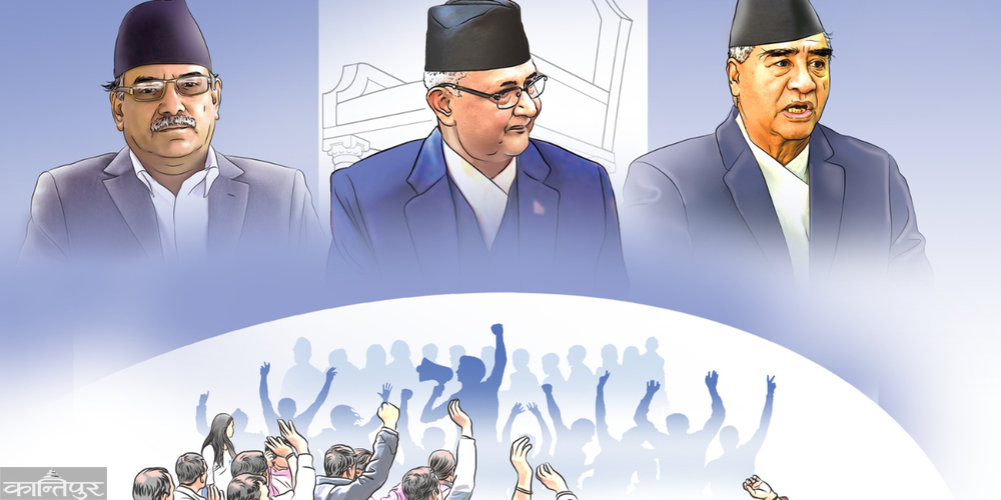
This question has been deeply raised in the minds of the common people who respect the struggle and sacrifice of Deuba, Oli and Dahal for a major political change in the country - How long will this chair race between them last? How long will the people listen to the dramatic statements of development and stability of these leaders?
We use Google Cloud Translation Services. Google requires we provide the following disclaimer relating to use of this service:
This service may contain translations powered by Google. Google disclaims all warranties related to the translations, expressed or implied, including any warranties of accuracy, reliability, and any implied warranties of merchantability, fitness for a particular purpose, and noninfringement.
Former President Bidya Devi Bhandari recently voluntarily renounced the prestigious status of 'Former President' and stepped down as a UML worker. She could not give up her fascination for active political life. It is a commendable act to give up the respect, facilities and security provided by the state to fulfill one's fascination and aspirations for power politics.
If she reaches the top leadership of the party, what kind of reforms would she like to bring to change the inconsistent structure of Nepali politics? His views will be made public in due course. It is true, the state of Nepalese politics has never been consistent.
If we study the history seriously, the country has become a seat of power before Prithvi Narayan Shah's state unification campaign and even after the state unification. Be it in the Rana-era monarchy, constitutional monarchy and multi-party democracy or federal republic, the hopes and expectations of real people-Janaardan for a change in their condition have never been fulfilled.
After the major and minor political changes in the country, there have been 'cosmetic' developments according to the administrative needs of the state, but such developments do not seem to have anything to do with the basic needs of the people. In recent times, the road network has spread, the details of the achievements in the fields of education and health are long, the slogans of the development of rivers and canals are resounding. Electricity generation has increased.
call - the factory is open. However, these 'achievements' of development have not benefited the dependent people - Janardhan. Yes, Janardan, who is dependent on the comforts and conveniences of the Khwamits, has been getting a small wage by wielding a saber and a shovel. To date, the alleged development achievements have proved to be political gibberish.
At the moment, the United Government is 'functioning' under the leadership of KP Sharma Oli, President of UML, the second largest party, with the support of Congress, the largest party in the Federal Parliament. From the outside, this government appears to be 'very strong' among the governments formed after the establishment of the Federal Republic. Internally, the government is very hollow.
Most of the parliamentarians of the forming party are expressing their displeasure that the federal government is not effective. The names of the home minister and many new and old members of parliament have been linked to various corruption scandals.
MP's complaints of 'having to pay a commission to the Finance Minister' to carry out development plans and projects in their area have started to appear on television screens and social networks. The government does not seem to have any grip on the administration. It seems that the 'administrative leadership' that keeps the government administration in their hands has completely dominated the leaders who are in the political leadership. In an informal conversation, industrialists and businessmen of the country say that the investment environment in the country is unfavorable.
Many such incidents prove that the credibility of the government is falling. Newspapers, social media users and intellectuals are complaining that the government is ineffective. The government is in the process of controlling the media and social media to open its own polls. Opponents of the federal republic are not only happy to see this state of republican governance, they are seeing the 'dream' of the restoration of the monarchy.
The issue of administrative disorder and corruption has affected not only the federal capital, but also the provincial capitals. No province has been able to work in a balanced manner for the development of its province. There are political disputes on every matter that is needed or not. None of the parties that have joined the government have done serious thinking about this matter.
Political analysts who have a good understanding of the political situation in Nepal want to look at the current situation from the early stages of the establishment of the republic. Everyone seems to agree on the conclusion that the roots of politics in Nepal have not been properly buried. Commenting on the developments, analysts say - KP Sharma Oli is not sitting at the head of the Prime Minister for the first time. He was also the Prime Minister in 2077. Even at that time, Prime Minister Oli's political nature was not different from now.
It was the time after the constitution of federal Nepal was promulgated under the double pressure of the earthquake and Covid-19. Pradeep Giri, an ardent thinker of democratic socialism and the then MP of the Congress, while speaking in the Parliament, criticized the 'obligatory' situation of the Oli government and said that power has been transferred to us. However, the state was not transformed. Pradeep Giri drew everyone's attention to the lack of 'representativeness' in the House of Representatives.
State mechanisms designed to control corruption have proven to be useless, drawing the attention of the Parliament to the surface of the problems. It was brought by MP Giri. But, Giri's voice was just like that. After Oli, the Congress government was formed with the support of Maoists. Later, the government was formed under the leadership of Maoist Chairman Pushpa Kamal Dahal. The Prime Minister's chair was not new for Dahal.
The leaders and workers of the Maoist party, who formally entered public life on November 5, 2063 through the Comprehensive Peace Agreement after shedding the burden of a decade-long people's war, were proficient in the game of 'democratic' power in a very short time. They had the zeal of the People's War.
was a reminder of the difficult situation he had experienced. He had direct knowledge of the shabby condition of the country. The courage and determination to do something to improve the standard of living of the people was also visible. However, the situation after the Comprehensive Peace Agreement did not become easy for them. After the first election in the Constituent Assembly, although Maoists were established as the largest party, nothing of qualitative significance could be achieved.
Dahal's first term as Prime Minister was not successful either. He had an unnecessary tiff with Congress President Girija Prasad Koirala, who is considered to be the main architect of the Comprehensive Peace Agreement. The people thought that the first Constituent Assembly would decide the work of constitution making. But the rift with Congress president Koirala proved fatal for Dahal. He was out of power. Later, Madhav Nepal, Jhalnath Khanal and Baburam Bhattarai became Prime Ministers. The period of political transition was prolonged. By the time of the second election of the Constituent Assembly, the position of Chairman Dahal and the Maoist party had deteriorated significantly. However, in any case, the Second Constituent Assembly completed the work of writing the Constitution of the Federal Republic of Nepal.
The then President Dr. Ramvaran Yadav issued the Constitution of the Federal Republic of Nepal on October 3, 2072. This constitution formally established Nepal as a federal republic. The monarchy was displaced. This constitution has many fundamental qualities. This is what the constitutionalists themselves have done. But the constitution does not clearly mention the rights and duties of the central government and the provincial governments.
Because of that, the current situation of the Republic of Nepal is like a lost batuwa. Leaders of all parties, big or small, who are given the responsibility of running the government, are themselves confused. This is not a strange thing for a political society that is not used to governing by looking at the constitution.
The directors of the country's administrative bodies, known as the 'Karmacharitantra', have their own method of running the administration - the Bhardari system. Those directors are not compatible with the republican system. The operators of the administrative machinery have become able to 'turn' the government to run an 'independent' administration.
After the Communist Party of Nepal abandoned the Maoist "people's war" and came to the path of peace, the people who were stuck under the pressure of armed war expected to get some relief. The atmosphere of Nepalese society became a little easier after the ceasefire. Maoists won the Constituent Assembly elections. However, their victory proved futile. The political situation could not remain as it was. It was not easy for the Nepalese society, which has been mired in violence for a long time, to follow the simple path of politics. With the first election of the Constituent Assembly, there were no signs that the road to peace would be easy. Although the atmosphere was somewhat hopeful, relations between political parties were cold. That hope did not last long.
This question has been deeply raised in the minds of the common people who respect the struggle and sacrifice of Deuba, Oli and Dahal for a major political change in the country - How long will this chair race between Deuba, Oli and Dahal last? How long will the people listen to the dramatic statements of these leaders' development and stability? When will the people's hope that the country will be on the path of political stability and economic development be fulfilled? Who will put an end to this undemocratic system where party presidents are prime ministers? These are the questions. Who will answer these questions? Who will strengthen this most federal republican system? When will people realize that the country is on the path of development?