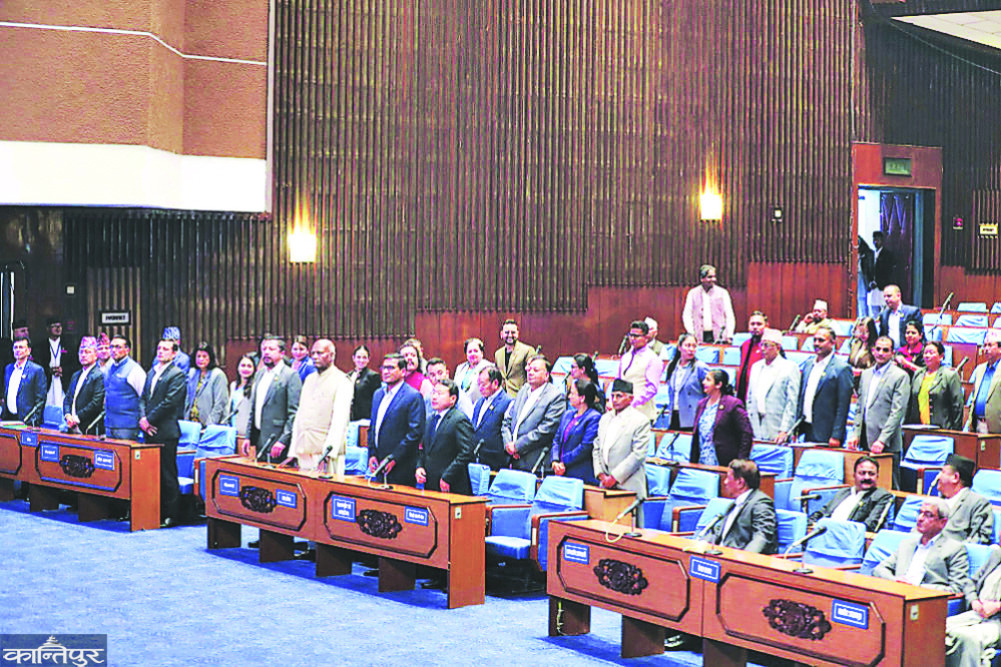
Since there is no possibility of overturning the system in Nepal's political scenario, whether it is the government or the opposition, everyone has to focus only on the development of the constitution.
We use Google Cloud Translation Services. Google requires we provide the following disclaimer relating to use of this service:
This service may contain translations powered by Google. Google disclaims all warranties related to the translations, expressed or implied, including any warranties of accuracy, reliability, and any implied warranties of merchantability, fitness for a particular purpose, and noninfringement.
Whether in the previous government or the current opposition, the role of the Maoist party has been relatively positive. It did not tarnish its image while in government. Party President Pushpa Kamal Dahal himself has been saying that although the Maoist government felt that it had to leave the government when it tried to expose some scams, its reputation has increased. Despite the Maoist name, it is a happy thing for those who believe in democracy that the work is being reduced to parliamentary practice. It is objective when reviewed based on fidelity to democracy rather than partisan narrowness.
In fact, Dahal's statement that the present government was born unnaturally is true. Because there was no need to replace the government by the leaders of the two parties overnight. The Maoists have accused that they have reached the stage of changing the government after arresting some of them, and today the Oli government should have reassured the people by showing more anti-scam activism. But the government is silent about the alleged scam. Apart from the case of Ravi Lamichhane in the co-operative fraud case, nothing concrete seems to have been done.
When KP Sharma Oli was the Prime Minister, people are outraged by the fact that some of the scam cases committed under the carpet have been thrown under the carpet instead of investigating the truth and finding out the truth. These actions have been done under the pretext of not having the authority to call it a policy decision of the Council of Ministers. But since Madhav Kumar is accused in the Nepal Patanjali land case, now there is a debate whether the authority will be applied to other Nikes or not. In a democracy, whatever the decision of the Council of Ministers is, it cannot be touched in the name of policy decision? If so, during the Panchayat period, as the court was the supreme court, the judicial standards made by the court were above the Supreme Court. How many cases did not proceed by the decree of the king. But today's system does not expect that and the letter and spirit of the constitution does not accept such practices.
The opposition role of the Maoist party is meaningful. Because its background, purpose and working style were completely different. Even though the so-called left-wing parties in the main political stream today adopted almost the same principles and style, the people's war of the Maoists was actually different from the others. Starting with a simple gun barrel, gaining the power to fight the state for ten years, and then being forcibly converted, it is natural for believers in open politics to find this strange.
UML also transformed from the same purpose and style a few years ago and although it is senior than Maoist, today all parties are drinking water from the same well. Some small groups are still found wandering. Among them, the Rashtriya Prajatantra Party stands out from the others. Because the only objective of this party is to bring back the king and create a Hindu nation. Although Hindu nation is a matter of sentiment of some people, it is not a matter of improving people's lives. For a country with multi-religious, cultural, linguistic and regional diversity, it is not considered fair for the state to cut off any one religion.
The current role of the Maoist opposition can be seen from different dimensions. This time the political role of the Maoist has been responsible. It has helped parliamentary practice by focusing on issues of public concern but not being overly aggressive.
The home minister should resign on the grounds that he was dragged to the ministry and caught by the authorities after the involvement of a joint secretary of the home ministry in corruption in the name of visit visa at the immigration office of Tribhuvan airport. After the matter raised by the Maoists and other opposition in the Parliament, the government promised to form an inquiry committee within a month, so the Maoists stopped the obstruction of the Parliament and allowed the work to resume. But two other parties National Independent Party and RPP have been obstructing so far.
In fact, there is no need for Home Minister Ramesh Ukhtar to resign as soon as the authority takes action against an employee. It is private that he himself will resign on moral grounds. The investigation committee showed the involvement of the minister and cannot stay.
From a theoretical point of view, the Maoists seem clear. This party is committed to the basic principles and principles of the constitution such as republic, secularism, inclusive democracy, federalism and stands strongly against regression. This time the campaign to return the king has been well resisted. Although the official view of the Congress is similar, many voices are heard within the party which reinforces the regression.
UML and all other small parties are also committed to protect the constitution. Therefore, there is no difference of opinion on this matter except for the RPP. This is a very positive aspect for democracy. It is the government's job to alleviate the people's frustration and anger. But it cannot be said that there will be any significant people-oriented work as the government seems to be in a quagmire. Since the development in the country could not be conveyed to the public, the opponents are cultivating negative propaganda on the basis of social media and political bias. There is no place where it can be said that one minister of the government has done a good job.
The partisanization of the bureaucracy has created a sort of chaotic situation. As the leader of the government party bowed down under the pressure of the employees, the personnel bill registered in the House with the unanimous decision of the parliamentary committee has come to a standstill. To disable the provision that retired employees are not appointed to another position for two years, the chief secretary and other employees are opposing it and are trying to influence the top leaders of both parties to ritualize the parliamentary practice. Dahal has a clear stand on this issue. He said in an interview that he is in favor of a two-year cooling off period.
Although he was in favor of Maoist inclusion, Dahal could not do concrete work for the upliftment of Dalits while in the government. As the Maoists, like other parties, have been bourgeoisified, the style of their leaders and activists has now become more elitist. After coming out of the government, the Maoist leaders have started to tour the country and have direct contact with the people saying that they have launched a reform campaign. The effect of this on the people can be seen in the upcoming elections. But now Dahal's image is comparatively more refined than before and maturity is seen in some of his interviews or actions. He wants to gain people's trust by presenting himself as a dynamic leader with more forward thinking. Therefore, he wants to get rid of the image of a do-it-yourself leader like others.
Although the basis of Maoist foreign policy is the same as others, Dahal's style is different. They are more objective, practical and flexible. The fact that he doesn't want to pick up unnecessary things and argue can be seen in the policy and operational stance he has taken while he was the Prime Minister and now. In relation to China, he can balance his political sentiments and closeness with a neighborly attitude. How much China believes in a Maoist leader is up to him.
But he understands his limitations and behaves. China's efforts to unite the left have failed, but it is clear that China is still striving for it. Dahal has normalized this by saying that China meets all left-wing leaders and says the same thing. In the past, when Oli and Dahal formed the CPN, there was a debate that their correct form was revealed by the decision of the CPN to promote Xi Jinping's ideas. However, against China's wishes, the CPN disbanded and returned to their respective parties, forcing them to understand a more ground-based basis. Dahal admitted this in an interview with Kantipur Daily on June 8.
Whatever is the positive side of the Maoist leader, he does not hesitate to admit his mistakes and moves according to the times and circumstances. He sees relations with India from a pragmatic point of view. Some issues are too sensitive and do not try to raise them for cheap popularity. Despite opposition to the Millennium Challenge Corporation (MCC) of America, he participated like other parties despite China's opposition to get it approved by the parliament.
Some people call him a man of opportunistic character. But in politics, leaders fail if they fail to take care of the fact that two and four are not equal. BP Koirala was no less a leader who changed his stance but BP always took decisions keeping in mind the time and situation. Backing away from the position of the Constituent Assembly, accepting the election of the Parliament and accepting the constitution given by the king in 2015, it could have been criticized as abandoning the old position.
But at the time of his situation and the rise of the king, no other option was possible. BP considered politics as a game of chance and persuaded the party to take such a decision. In 18 months, the constitution given by the king himself was destroyed by the soldier 'Ku'. After 30 years, the end of the system imposed by him and the decision made by the people's movement of 2062/063 destroyed the monarchy. Similarly, BP fluctuations are seen in later events. There are also those who market the situational decision by saying that Bangyai BP is in favor of the monarchy. But in the assessment of his entire political character and principles, there is no basis to believe that he is in favor of monarchy.
Maoist today has emerged as the main opposition party in the multi-party democratic parliament. This party will be evaluated based on its role and principle commitments mentioned in the constitution. After 2046, it was not seen as fiercely as compared to the UML's opposition role. Perhaps, in the new situation at that time, the thinking of UML was that it would be possible to topple Neka's government by playing such a role. Such a strong opposition role was seen during the employee movement. Now almost all the parties have matured except for a few exceptions and since the alternative to today's democratic republic is only a higher quality democracy, everyone's maturity will be more exposed.
Today there is no place for non-managerial opposition. All are within the system and although some have engaged in violent campaigns from outside, they have come on a peaceful path. Since there is no possibility of overturning the system in Nepal's political scenario, everyone should focus on the development of the constitution, whether it is the government or the opposition. But the role of the constitutional opposition is important for the functioning of the government and leaders, the fight against corruption and a competent governance system.
Today, some leaders paralyze the parliament and use it as a means to fulfill their selfish interests. Everyone should understand the fact that such practices should be put an end to and the dignity of the parliament should be increased. More responsibility for this belongs to the so-called big party. The leaders of the party currently in government should find a solution for this. It is difficult to predict what the speed will be. Dahal will become an exception among the leaders who are considered to be old, he will have to wait patiently for some time. He's going to have to watch him for a while because he keeps repeating that he's different now.