We use Google Cloud Translation Services. Google requires we provide the following disclaimer relating to use of this service:
This service may contain translations powered by Google. Google disclaims all warranties related to the translations, expressed or implied, including any warranties of accuracy, reliability, and any implied warranties of merchantability, fitness for a particular purpose, and noninfringement.
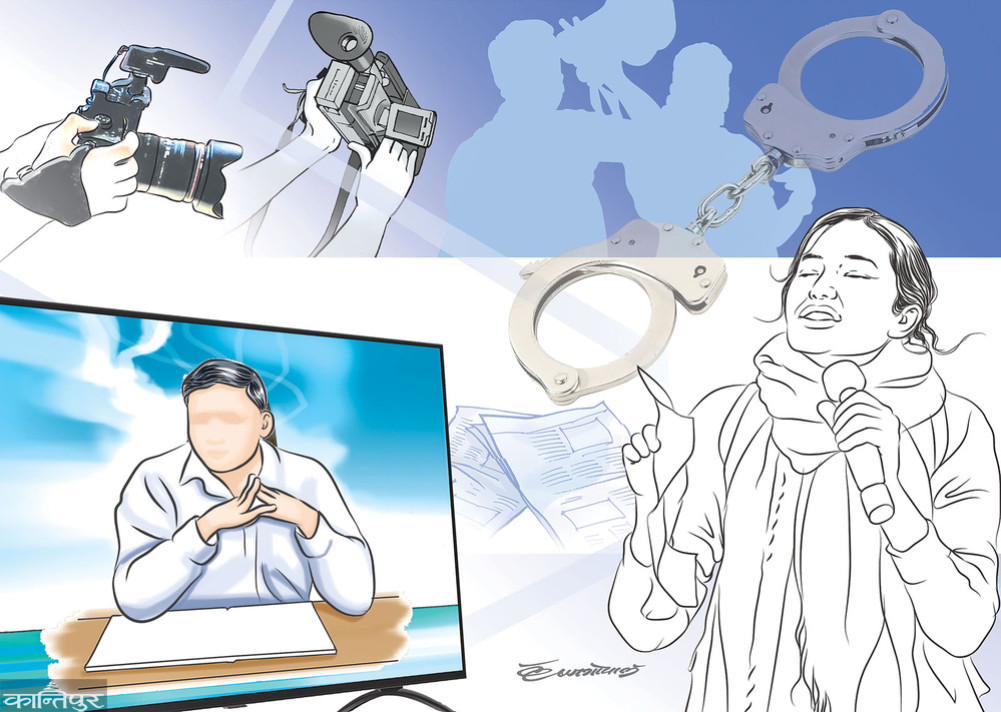
In Nepal, the interim order given by the district court to remove the news published in two online media and the arrest warrant issued by the court to the journalist in the news about the purchase of a hotel in the electronic media have started a debate on freedom of expression, press freedom and defamation law.
The media, political parties, press council, journalists' federation, journalists' affiliated organizations and legal scholars have commented that this incident is an attack on the freedom of expression and press freedom granted by the constitution.
An essential element of public life is accountability and transparency. Public officials and any media and person in the communication sector cannot be left out of this. The communication sector itself needs to be transparent in order to teach others the lesson of accountability. If you become transparent, it is easy to point the finger at others and the popularity of the media and the organization will increase even more. The media should stick to the truth without infringing on the right to personal freedom and privacy of the citizens granted by the constitution.
In America, President Donald Trump continues to try to maintain political control over the academic and communication sectors. In India, the media and organization 'Godi Media' is being transformed into a distorted form, and in Nepal too, the credibility of true and fair ideas, news, organizations and social networks is being criticized. It is time for the communication sector to unite to protect the freedom of expression and self-existence of citizens.
On the one hand, there is no research and analysis on the damage caused to the society by the conflict between the dissatisfaction, frustration, anger, frustration, fear and rebellion that arises in the minds of the general public, curious readers and listeners, and on the other hand, the media's mission success, economic-political benefits and immediate self-interest. Journalists, writers and academics work together alone or together in the work of communicating ideas, articles, reactions, news, content through the media, and in some specialized fields, they work separately as needed.
Due to the weakness of the legislation and the selfishness of the state power, from time to time a conflict is created between the right to freedom of expression and communication and its implementation. The current situation is also a product of this.
The changing media
The traditional media is struggling to survive due to the challenge of electronic media and now digital and social media. As the new medium has become the priority of the listeners, readers and viewers, the readers, viewers and listeners of the old media have decreased significantly all over the world. There has been a sharp decline in the income of media organizations. The traditional means of communication, newspapers, radio, and television, are being replaced by digital means at a rapid pace, competition and the challenge of defending independent existence. At present, the expansion of social networks has made it difficult for the ancient media to live in the world.
Readers and advertisers have shifted to digital media and social media, resulting in a decline in income for media organizations as well as a decline in the number and quality of journalists. A journalist has to engage in a new profession or business. Some newspapers published at the national and local levels have been closed.
In the digital media, the air of 'breaking news' rather than the factual news and the tendency to spread false information and increase sensitivity has reduced the public's trust in the media. In the dream of becoming viral without accountability, social networks involved in misleading information and declared or undeclared 'mission' operated media will have to make themselves more credible to face the challenge posed to the traditional media.
fake sensitivities, misinformation and polarization have damaged intellectual and mental health. Every family is haunted by the addiction of youth and children towards digital media. Comparatively, the credibility of print media is higher than digital media. In a democracy, a citizen's duty is not fulfilled just by casting a vote. It is also to be informed about the work done by the representative you have voted for, to keep a watch and if you feel that your vote has been misused, to correct yourself through the vote itself.
The study has confirmed the fact that the results of public audits and the presentation of print media are more helpful in monitoring this process than digital media.
journalists and the religion of the media
Communicators and journalists who carry the heavy burden of communicating freedom of expression have been accepted by the society as distinguished intellectual members. The world has been appreciating the important contribution made by the media in political, social and economic transformation. The contributions of journalists and media workers who put their lives in the palm of their hands and reach the war zones, deserts, natural disaster areas, mountains, mountains, disease-infected areas, forests, corners and places of accidents and crimes immediately and inform the people, cannot be appreciated as much as they can.
Journalists who engage in investigative journalism by taking risks and bring out the truth, academic groups and impartial media organizations that convey unbiased opinions should not be underestimated in strengthening democracy and uplifting the society. Even in Nepal, there are many cases where journalists have to suffer lawsuits, jails and have sacrificed their lives. Digital media has further helped to confirm the fact that investigative journalism exposes complex and deep issues. Organizations such as the International Consortium of Investigative Journalists (ICIJ), in which journalists from Nepal are also members, are assisting in the participation and exchange of information.
journalists belong to radio, television, newspaper and online news media and perform duties according to their respective roles. In doing so, it is the journalist's responsibility to research, analyze information, consult with subject matter experts and publish and broadcast based on truth. They also help in presenting editorial ideas based on the depth of the subject matter, current importance and public expectations.
The actual situation of Nepal
The constitution of Nepal has vested the sovereignty and state power in the Nepalese people. The constitution has provided citizens with freedom of thought and expression and the right of communication. There is no doubt that the responsibility of expressing opinions, ideas and news lies with the citizen. In case of expressing or broadcasting an expression or opinion contrary to the law, there is no obstacle to punish the responsible person according to the relevant law. Also, the constitution has ensured that there will be no restrictions on publishing and broadcasting, printing and information transmission by any means. The constitution also provides that the legislature can make laws to regulate the media.
Press Council Nepal, which was established in 2027 with the aim of protecting press freedom, has been organized and operated in 2048 under the Self-Governing Act. There is a feeling in the public mind that the activities of the Press Council, which was formed with the aim of developing healthy journalism as a self-governing organization, amicable relationship between the press and the government, and the dignity of citizens and press autonomy, have not been effective.
Since only 5 members are currently working in the 12-member board, it has become futile to look for its effectiveness. How can the current structure be effective in using the rights given by the Act? Apart from the continuation of the work of providing support to the private media through advertising from public funds based on certain criteria, there is little information about the significant achievements in press freedom. The role of the council will be even less in the situation where it has entered the court.
The Electronic Transactions Act, 2063 provides punishment for those who broadcast illegal content on electronic media, publish content that offends public morals and decency. The Criminal Code was passed by Parliament in 2074 and came into effect in 2075. The content is included in the schedule of the Criminal Code, 2074. The Electronic Act and Code contain provisions to restrict the freedom of expression and press provided by the Constitution. Because the provision about public life or private life is unclear, it is wrongly used and the freedom of expression and press is affected, so the voice for correction was raised at that time.
The bill that was submitted to the parliament in 2075 to restrict freedom of expression could not move forward after protests. Currently, a bill has been submitted in the House of Representatives to repeal the Electronic Transactions Act, 2063 and replace it with the 'Information Technology and Cyber Security Act, 2082', which should be amended to remove the restrictions on freedom of expression. Similarly, in the name of regulating social media, the Social Media Bill, which seriously curtails the rights of citizens, is also under consideration in the Parliament. It is being criticized that the freedom of expression will be curtailed due to strict punishment provisions for the media, social media operators and users for various crimes.
news and factual search, police action, prohibition on separation of powers, anti-national terms, viewpoints, ideas and editorial autonomy, control of ownership and obstacles in research are being faced by the media. In a situation where the constitution provides freedom of expression and the right of communication, any direct or indirect attempt to limit the flow of knowledge is reprehensible.