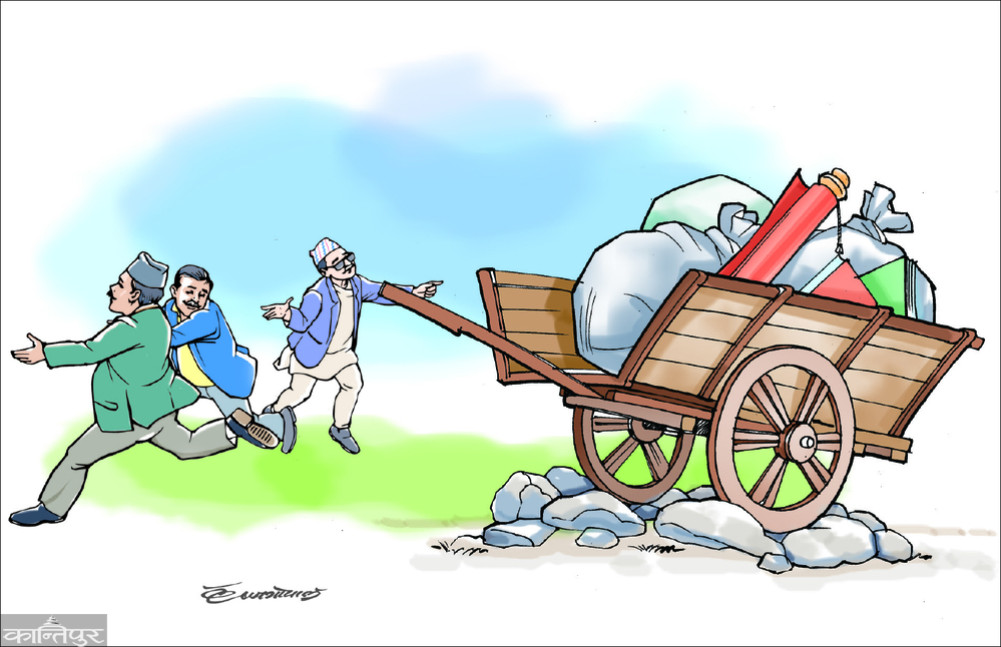
When the civic leaders also started carrying the bags of the special party, its influence began to decline. It seems that various types of civil movements are demonstrating on the streets because they could not provide good governance, but they are not heard as in the past.
We use Google Cloud Translation Services. Google requires we provide the following disclaimer relating to use of this service:
This service may contain translations powered by Google. Google disclaims all warranties related to the translations, expressed or implied, including any warranties of accuracy, reliability, and any implied warranties of merchantability, fitness for a particular purpose, and noninfringement.
After the Russia-Ukraine war and the Palestinian genocide, the Iran-Israel conflict has started. As the world geopolitics continues to suffer from war, Nepal, beyond it, has become a battlefield of its own domestic strife, conflicts and interests.
Government, parliament, courts, media, political parties, civil society, etc., all the components of the state, their role is under question. The advocates of these political institutions and forces have their own urges and intentions. People's issues are disappearing somewhere. To say, everyone gives the people's dua, although in the end, only individual, group or party interest dominates . As a result, the Nepali society is falling into a terrible trap of despair and mistrust. And, the future destination has become more confused . In this background, an objective review of the contemporary role of the Nepali state power has become relevant.
Arbitrary government
Government is the parent of the common citizen . However, the 'powerful' coalition government of Congress-UML could not give the people a feeling of guardianship. On the contrary, on the contrary, the fear of who will be trapped by false charges has increased in the civil circle . Prime Ministers/Ministers are riding on the chariot of arrogance and arrogance . They are looking for legal loopholes to 'crack down' on critics. The character who thinks it's an achievement for removing him while playing with an ordinary employee, is dominant up to the level of the Prime Minister. Under the guise of democracy and parliamentary mathematics, the coalition government is heading in an arbitrary way.
It has been almost a year since the formation of this coalition government. At the end of this month, the government will celebrate the anniversary. In other words, perhaps Congress-UML leaders can claim that the government has lasted for one year as a result of 'political stability'. However, in reality, this government has taken a 'discount to fail'. This alliance was formed by wearing the seven-point agreement including the amendment of the constitution saying that there is no 'freedom to fail'. Now that Berco is broken .
Usually in the coalition culture, one of the first or second largest parties in the parliament is in the ruling party and the other is in the opposition . It is believed that such a parliamentary practice is going on because of the fear that the government will be oriented towards totalitarianism and the opposition politics will be weak when the two big parties come together . However, Congress-UML leaders called this alliance a product of special circumstances. He made many promises to address the grievances raised through the amendment of the constitution, to remove the atmosphere of political instability and confusion, to maintain good governance, to improve the economic situation, etc. However, the government is oriented towards arbitrariness and totalitarianism, not promises. The process of 'selling people' in the name of visit visa has not stopped . At the time of promising to boost the economy, the country has been included in the 'grey' list . People have not forgotten the farce in the appointment of a governor. How did Oli 'diffuse' the issue of forming a powerful property commission by forming a high-level governance commission under his own leadership? know . Although the cooperative victims could not be relieved, the government has succeeded in seeking political revenge. Sitting on the throne of power, the Arju Ranas are looking for 'justice'. And, the government is determined to give 'justice' by misusing power.
Parliament held hostage by party candidate
The House, which has been blocked for a few weeks, partially opened after demanding the resignation of Home Minister Ramesh Akhtar in the case of visit visas. The government forcibly opened the house after the Maoists, among the opposition parties that were obstructing the movement of the house, backed down from the demand for resignation and the Home Minister Alekhar stood on the rostrum despite the opposition of the parliamentarians of the RSVP and the RPP. And took a stand with a warning not to resign. However, RSWP and RPRPA are saying that they will not back down from the 'bottom line' of resignation . In other words, the blocked House has not been fully restored.
Parliament is a place for constructive debate and discussion or encounter? This episode has once again raised questions about its role. And, this is not only a question for the political parties blocking the parliament, but for everyone. That is because, due to the double standard of the parties, the supreme body of the elected people's representatives, the parliament is becoming ineffective. As if the Home Minister was teaching ethics lessons to the then Home Minister while sitting on the opposition bench. Today, when a question of the same nature was asked about him, where did his morals disappear?
On the other hand, there is Swarnim Wagle, he stood on the rostrum as the real watchman of the parliament when the opposition party demanded the resignation of its chairman and then home minister Ravi Lamichhane. He advocated dialogue and constructive parliamentary practice. Today he has become a blocker in the same parliament. In essence, parliament is becoming ineffective due to the double standards of political parties, both ruling and opposition. Whether it is in terms of making the government accountable to the people or its role in law making, the question has been raised.
The shadow of court politics
The two organs of the state, the executive and the legislature, are not the only question raised. The last refuge of justice is the court itself in the courtroom of the question. When politics left the leak, in some cases in the past, there are examples of the court returning the politics to the right leak . In the past, a situation where the court became the solution to the crisis when politics went astray. The internal affairs of political parties also became the subject of judicial determination . The court also made a political declaration by escaping from the responsibility of constitutional declaration. However, how fair was the role he played in these judicial and political decisions, and how much was the product of influence? Occasionally raises questions .
These questions arise when the division goes on in the name of judge appointment. When there is an admission of maladministration in the judiciary, reports of the court becoming a hotbed of corruption are made public, and whenever justice is denied to the families of the victims who were burnt alive in brick kilns, then the role and credibility of the judiciary becomes a mockery of the rule of law. Now, the same thinking is taking place in the civil circle towards the court. crisis of trust in
media
is the main religion of the media, communicating truthful information . But isn't the media "misinforming" somewhere? Now such a question arises on the media with apprehension. New media is slowly taking the place of traditional media . There has been a flood of platforms related to new media such as newportal, podcast etc. There is a race to collect 'TRP' more than quality and professionalism in media content . The mushrooming media, which are turning into opaque investment and bargaining tools, have become like 'intermediary production centers'. Party media, leader's media, businessman's media of many forms and colors of media, readers/viewers are confused as to who will give true news and who will give false news.
i.e. the fourth organ of the state media sector is facing a crisis of confidence that has never been faced before. At the same time, the financial crisis is happening . Also, it is a global 'phenomenon' that the media finance market and the scope of trust are being limited. However, in a society like ours where democracy is still in transition, the erosion of media credibility is a matter of concern . Nepali media expanded after 2046 years and widened the 'public sphere' and the narrowing of that 'public sphere' is not a happy aspect for the democratic system .
Leadership within the party
Political parties are the main pillars of multi-party democracy. In order to develop a democratic culture, the behavior and working style of the parties should be democratic accordingly. However, the parties born in the legacy of the democratic movement are not able to be democratic by themselves. There are several leaders in that party. From the point of view of internal democracy, the parties are in a middle state .
Let's see the current situation of major political parties. Nepali Congress General Minister Gagan Thapa is saying, let's choose the leadership from the ordinary members of the Congress. How nice it would be if this happened. This could have been the highest exercise of internal democracy. But, is it possible in Congress? Where there is no place where the convention should not be held at the specified time . Shekhar Koirala has been demanding that the convention be held on time for a year now. However, Deuba has not opened his mouth. He is planning to announce a convention based on his identity and political compatibility.
The internal democracy within the ruling party UML is in a bad state. In terms of internal democracy of unity, this party was considered strong. Oli has been making many inappropriate statements and yet no one dares to open his mouth against him. UML has been running under Oli's leadership for ten years. Recently, several questions have started to be raised as a challenge to Oli.
In Maoist, Janardhan Sharma is complaining about being persecuted for raising questions about the leadership. Uninterruptedly, Prachanda is under the leadership of Maoists. The National Independent Party, which emerged as an alternative power, has not become an alternative. His/her efforts/expressions seem immature and driven by emotion . The right-wing political power RPP is trying to live and waste time wearing the name of meaningless monarchist movement. Due to the tendency to be guided by factions and inspired by power opportunism, the role of parties is not leading to strengthening the democratic system. This is another reason for the widespread despair.
Civil society: the weight of many bags
There was a time, when the parties started to lose their way, the progressive political issue tried to deviate, that time the civil society came forward . Pressure was created on the parties to carry those cases . Sometimes the role of TAPKA, organized in the name of civil society and sometimes civil movement, is not played now. The civil society had demonstrated its strong role during the Second People's Movement and then during the constitution making process through the Constituent Assembly. In a way, the civil movement used to guard the parties. However, over time, when the civic leaders also started carrying the bags of the special party, its influence started to decline. Civil society became a strong voice during the 2063 public movement and then during the constitution writing process. Now that voice of the civil society has weakened . It is true that from time to time, it seems that various kinds of civil movements do street demonstrations because the parties have become power-oriented and failed to provide good governance, but they are not heard as in the past . It has not been able to have a single and strong voice due to various tendencies that came down to the civil movement with many tags and baggage.
Thus, the role of all these components of state power is weak . All are polarized . Therefore, the reason for the widespread disappointment and dissatisfaction now is the sum of the weak role of all these. Having said that, the original political leadership cannot be freed from blame . The main political leadership is the most to blame for not being able to deliver what the democratic system should have been able to meet the expectations of the common people.
Finally, a Chinese folk tale describes the current fate of Nepali politics. Where three bullocks try to pull a cart and slip on each other's tails and keep moving in the same place . While all the three bullock carts are pulling in their respective directions, it does not move an inch . The oxen slip on each other's tails and the cart gets stuck in one place . Due to the lack of direction of the Nepali political leadership, the fate of the country's republican power is now like that of the Chinese folk tale. And, at this time there is a dire need of leadership to move the stranded cart.
@Rajaramgautam