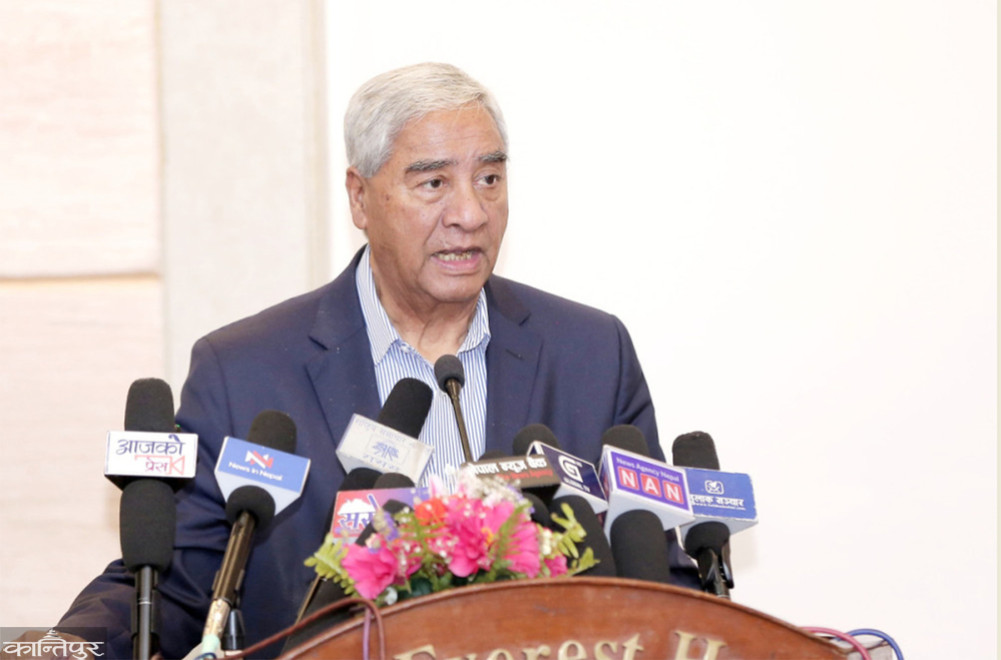
A little before us or a little after us, some countries that are underdeveloped like us have made extensive changes in their economic and social life, why are we still where we are?
We use Google Cloud Translation Services. Google requires we provide the following disclaimer relating to use of this service:
This service may contain translations powered by Google. Google disclaims all warranties related to the translations, expressed or implied, including any warranties of accuracy, reliability, and any implied warranties of merchantability, fitness for a particular purpose, and noninfringement.
The Chairman of Nepali Congress, Sher Bahadur Deuba, recently expressed the idea of the situation where Nepal has to export people in a function held at the party office. However, the meaning of his statement is remembered, 'We have no other source of export. Therefore, people had to be exported.
Human export is not the first and last truth for Nepal. Even during the Rana period in Nepal, Nepalis skilled in the art of war used to go to Lahore, Burma and Malaya. Young people from western Nepal meet in Bagrelti, in the Indian city of Mumbai. Going abroad for employment is not a big deal . However, thousands of people fleeing the country like a group of locusts is not a good sign for any country.
Some famous cities of Nepal, including Kathmandu, the capital of federal Nepal, have been rejuvenated for a few decades. Although the development of these cities is satisfactory in terms of physical and commercial purposes, this development is not permanent . This type of urban development has not been able to provide employment to the local tannery . Cities from east to west have big bazaars, big bus stops, decorated dance halls and fancy kitchens, party palaces, big bars, big restaurants. Cities have been transformed . A little economic importance has also increased . However, these cities are aimed at young people returning home for a short period of time from overseas employment.
Two decades of radical political changes have passed in the country. The city, the market and the environment have changed . However, history is over. The present has not been able to establish its identity yet. For the last few decades, the city of Kathmandu is in the transition of economic, social and historical changes. The face of society is changing. However, there has not been much change in social customs and nature.
Congress President Deuba is in a similar situation. This speech of Deuba, who spent a long time struggling in the Far West by 'playing' Congress politics from the beginning of his youth, was thought-provoking. After thirty years of active monarchy, he had an opportunity to lead the centrist line within the Congress in the 2046 Jan Andolan tussle among the top leaders. As the first elected Prime Minister, Deuba became the Prime Minister for the first time after the defeat of the Congress in the mid-term elections suddenly held by Girija Prasad Koirala. After that, Deuba, who has been the prime minister many times, is now waiting for the 'key to power' as a 'waiting' prime minister.
He clearly knows - before or after us, some underdeveloped countries like us have made extensive changes in their economic and social life, why are we still where we are? How did we end up exporting people? Its interpretation will be slightly bitter and slightly tart. Looking for an answer to this question will not be appropriate at this time, when the sky is covered with words and bad words . Congress President Deuba as Prime Minister has worked with everyone, from Panch who believed in non-partisan system to Maoist who brought a big storm of change through armed movement in the country . Since the beginning of competitive politics in Nepal, no other party leader has had the same opportunities as President Deuba.
But, the shameful thing is, after two decades of radical change, Deuba is saying - we have nothing else to export except people . One of the main reasons for this helpless statement is that he and his two contemporaries, KP Sharma Oli and Pushpa Kamal Dahal, are 'Prachanda'.
Before the beginning of parliamentary democracy in the country, the slogans of development have started ringing . At that time, for the balanced development of the country, plans were made and spoiled according to the wishes of the king. Integrated development projects used to be announced individually and jointly in different districts. The king himself used to go on regional visits to inspect these development projects. There was no reason for those state visits. The 'instructions' from the king used to be left lying around. The country was the poorest of the poor. Employees engaged in nurturing their petty interests used to buy apples from Kashmir and used to call the king 'apples grown in Jumla'.
King Birendra did not understand this. However, there was nothing he could do. In personal terms, King Virendra had only one benefit from this. He was selected as the President of the International Conference of Least Developed Countries held in Paris. After he was established as the supreme leader of the poor countries, there was no reason why the respect of Nepalis would not increase. The strangest thing is that the 'dob' of development that started during the reign of King Birendra is now nowhere to be seen .
Over the past decades, Nepal has been ruled by an upper-class elite-like oligarchy. The realization that this is a wrong style has not come to our leadership even today. A new type of economic and political system is needed in the country as desired by the people. Village should be given first priority. After the establishment of parliamentary democracy, a 'wave of development' has spread in Nepal. However, the wave of development and reconstruction spread after the implementation of the liberal economy and privatization policy could not last forever. That development has now slowed down. At that time, the new roads opened in the name of convenience for the people have been stuck due to lack of maintenance. Water dams are broken. The government has not been able to provide the people with salt and oil.
The tiny, scenically delightful, Everest-like country is now in turmoil in every way. There is no dearth of news about widespread misuse of the development budget. But, where has the development been and where has it gotten confused? Speaker Deuba and his party have not gone to review it. No need to go too far, Deuba started the Mahakali scheme when he was the prime minister, what is the status now? It is enough if you meditate on it. In most parts of the country, which is said to be rich in water resources, even now, ``Ujyalo'' and ``Khanepani'' have become mere slogans to make people forget.
It is true, we Nepalis, who are said to be rich in water resources, are mired in poverty. The cry of sorrow and pain of our young people who are looking for a new destination for work is echoing everywhere. Corruption and dishonesty are continuing in development work. The current 'human export business' has become another source of income for those who run the government . Leaders are trapped in the bureaucracy that calls themselves 'permanent government'. This voice of Sanatan culture, "Dhanat Dharma: Tato Sukham" has become a daily bandana of both leaders and middlemen.
Our leaders are busy weaving new dreams for the country's development. The principles of democratic socialism of Congress, multi-party democracy of UML and democratic socialism of Maoists have been disrupted. With those slogans, the current three main leaders and rulers - Deuba, Oli and Dahal, are not ready to bear the weight of their incompetence. The new leaders standing in the leadership line are immersed in the enthusiasm that social media will bring about change .
Sher Bahadur Deuba has been building and manufacturing the government since the change of 2046 until today, being a parliamentarian, being the head of the government, sitting in the opposition, opposing the government, joining hands with others when his vote was not enough. After the restoration of constitutional democracy in the country, Krishna Prasad Bhattarai became the Prime Minister. Then Girijaprasad Koirala, Manmohan Adhikari, again Krishnaprasad Bhattarai and Girijaprasad Koirala, again Sher Bahadur Deuba, Madhav Kumar Nepal, Pushpa Kamal Dahal 'Prachand', Baburam Bhattarai all came to the leadership level . But change ? Nothing seems to have changed. The country is the same, people have the same hopes and fears. Currently, Prime Minister KP Sharma Oli is the Prime Minister. Changes have been made. However, the home minister of the government who came after such a big epochal change is trying to purify himself by standing on the rostrum of the parliament.
In this situation, not only Congress President Deuba, UML President Oli and Maoist President Prachanda should also take steps after discussing with their workers . The current generation is not looking for a leader who follows tradition, but a leader who works according to new ideas and new beliefs. Leaders who think of their workers as peasants and indulge in the illusion that I am the ultimate truth are promoted by themselves . No one can disprove this truth .