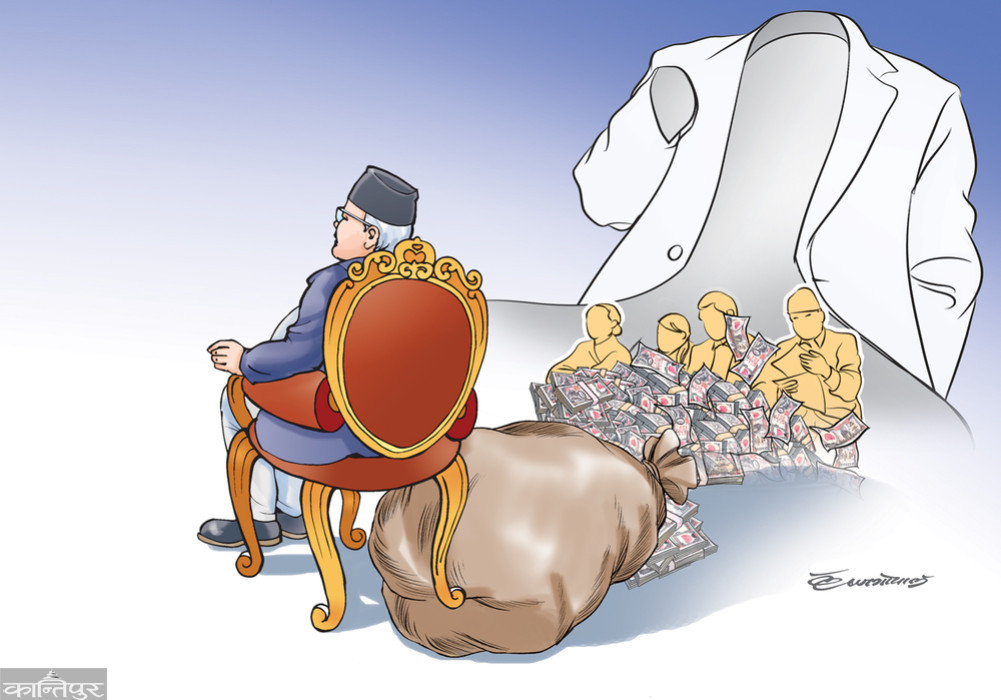
Seeing the faces of sitting, former and future Prime Ministers Khadga Prasad Sharma Oli, Pushpa Kamal Dahal or Sher Bahadur Deuba, most common people have stopped getting angry. But there are few people who do not say hi when they hear his name.
We use Google Cloud Translation Services. Google requires we provide the following disclaimer relating to use of this service:
This service may contain translations powered by Google. Google disclaims all warranties related to the translations, expressed or implied, including any warranties of accuracy, reliability, and any implied warranties of merchantability, fitness for a particular purpose, and noninfringement.
Due to the priority of permanent power and the facilitation of some geopolitical players, a political consensus was established between the three major parties of Nepal through the 16-point conspiracy concluded on June 8, 2015. Vijayakumar Gachchdar, who was made a symbol of Madhesi who stamped the witness mark on that conspiratorial document after its usefulness, later returned to his mother party, so there is no need for a separate discussion about his deception.
Since then, top politicians of Nepali Congress, CPN-UML and CPN-Maoist Party have been leading the government in turn. Although the names and leaders are different, there is no significant difference in the cultural beliefs, economic and political policies and government programs of the three dominant parties. Since there are no policy differences at the top political level of the country, there should be no hindrance in good governance and service delivery. The reality on the ground is disappointing. The political power has not been able to instill hope and trust in the common people.
periodic elections are providing the legitimacy of public approval time and time again to familiar faces without exception. The rides of the republican rulers are regular with a procession of leading and trailing carriages. The day-to-day administration of the country is in an 'autopilot mode', running automatically with the submission of prevailing 'Dastur' prescribed by the customer. The economy is still being supported by remittances - 'Record in remittances, 1 trillion 65 billion received in April' is the main news of this newspaper.
The oligarchy of the political elites and the tycoon of financial middlemen will be extremely powerful. The stability of tyranny cannot be shaken easily. Inertia resulting from unbalanced political stability can cause mental fatigue, unreasoned dissatisfaction and distress mixed with a terrible fatigue (anvi) in the common people.
Nowadays, most of the common people have stopped getting angry after seeing the faces of incumbent, former and future Prime Ministers Khadga Prasad Sharma Oli, Pushpa Kamal Dahal or Sher Bahadur Deuba. Rather, there are few people who do not say hi when they hear his name. Sharma Oli, the ethnic leader of the Khas-Arya community, does not stop telling stories in public speeches to show his presence, but his pieces sound stale and stale. President Deuba's expressions have lost the ability to make people angry - why be angry with innocent and incompetent politicians! It's been a long time since President Dahal's promises have been stopped even by his own party.
Nepal's permanent power is perhaps aware of the widespread discontent among the common people. Hindutva and monarchist politicians have killed the provoking elements of ethnic nationalism like xenophobia, blind devotion and patriotism. After the unconditional surrender of the Madhesh-based parties to the ethnic power, the power of the method of inciting the subordinates to increase the hegemonic solidarity has weakened. Due to the repulsion of the West and the attraction of Hinduism, 'Andha Bharata' is not selling much in the political market today.
The rulers of ancient Rome understood that the circus was as important as bread to entertain the common people. He used to entertain the common people by fighting pesvara fighters in the arena. The practice of stoning criminals in public squares is still practiced in some Islamic countries. In decent stage performances, interludes unrelated to the plot but displaying excellent dancing skills are shown to mesmerize the audience.
The main objective of all such undertakings is to entertain the common people and allow the excesses of the rulers to run unhindered. It is as if the permanent power of Nepal has turned the demonstrative anti-corruption campaign into a circus, swordplay or interlude in order not to loosen its grip on the government machinery.
It is difficult to find a high-ranking public official who has not been accused of corruption. It is no secret that the names of at least three chief commissioners of the Abuse of Authority Investigation Commission have been involved in various scandals. But what is the power structure, even those who live in the glass palace do not stop trying to divert the attention of the common people by throwing stones at other people's houses.
Dua'a's activity over the past few days is commendable as well as spectacular. There are few people who do not know that except for a few honorable exceptions, small and large loans are not available from the banks of Nepal. Therefore, it should not be surprising that a corruption case has been filed in a special court against the then chairman of Nepal Bank Limited on the charge of asking for bribe from a customer who took a loan.
It is the reality of most poor countries that if there is a government contract, the transaction must be done according to the size of the amount. And why should you be surprised that a case has been filed in a special court against 16 people and 2 companies, including the former minister of communication, in the case of the purchase of Terramax technology of the Nepal Telecommunication Authority! Cases like the Bhutanese refugee case, the Baluwatar land case, the so-called Yeti-Omni scandal and the Giribandhu Tea Estate land case are there.
A corruption case has been filed against 18 people, including the Managing Director and the Pre-Managing Director, on the charge of corruption in the billing of Nepal Telecom. Ravi Lamichhane, who has been accused of misappropriation of cooperative funds through Gorkha media and has been the deputy prime minister and home minister twice, is still in prison, but still holds the position of chairman of the National Independent Party.
The Parliament, which has been stalled for demanding the resignation of Home Minister Ramesh Akhtar, who is involved in the case of human trafficking and fraud under the cover of visit visa, has not been able to open even for the urgent budget discussion. Such events, which seem like scenes from a thrilling 'suspense thriller' movie, are taken by common people as mere screenplays unrelated to their lives.
The corruption case against 93 people including former Prime Minister Madhav Kumar Nepal accusing them of corruption in the Patanjali land case has exposed the underlying character of Nepali power. Two Hindi lines associated with the corruption of traditional power are in vogue—'Hamam mein hum sab nage hain' and 'Kajal ki kothari mein kajal ki daag lage hin lage'!
British administrators at that time used to mention that the cost of plainclothes security personnel who had to travel safely in the third class of the train to Mahatma Gandhi, the epitome of morality, was several times higher than the price of the first class ticket.
Indian Prime Minister Narendra Modi, who created an image as a 'fakir aadmi', is no longer considered to be commenting on his royal clothes and powerful emperor-like lifestyle. Deuba's palace, Dahal's watch and Sharma Oli's shoes are no less than any of Nepal's treasures, but they have long ceased to be discussed in public.
The argument that the former Prime Minister of Nepal may not have done anything wrong in the Patanjali case may be false. Prima facie it appears that beneficiary Patanjali has misused government facilities. No one can guarantee that the decision of the then Prime Minister of Nepal to trust the venture linked to 'Lala' Ramdev and businessman Balakrishna was not calculated for personal or party benefits. The question is merely to select and demonstrate the importance of the background to the case and the time when the proceedings were commenced.
Why is it difficult to consider being the first ex-prime minister to be prosecuted in a political circle where corruption is considered normal, despite his anti-nationalist 'UML character' based on satlipsa and other-hatred, among the top politicians of contemporary Nepal, Nepal is also among the very few politicians who have a relatively simple, liberal, normal lifestyle and therefore a clean public image.
In India, the Enforcement Directorate (ED for short) of the central government has become an instrument of political revenge. Whether the anti-corruption campaign intensified in Nepal is an entertainment show, political revenge or a campaign to clean up the government will be revealed over time. Since the entire state system is dependent on exploitative organizations that exploit the common people, it is not easy to reduce corruption in public life. A mental evaluation of the
hypothesis effect is called a thought experiment. Perhaps the main reason why there is very little chance of being established in Nepal's national politics by opposing corruption is that the Rana-Shah culture of considering public office as an innate right (entitlement) has been further strengthened by the practice of chauvinistic 'opportunity'.
Loyalty is considered more important than honesty in the traditional government culture of Nepal, the people of the subordinate community are not provided with facilities to maintain their existence by being virtuous. They then follow the instructions of 'Mahajano Yen Gath Sa Pantha'. An objective analysis of the public behavior of the hegemonic Khas-Arya politicians needs to be continued.
The Thirteen Criterion
Economists Daron Acemoglu and James A. Robinson have blamed exploitative institutions for Nepal's backwardness, along with Haiti, Afghanistan, and sub-Saharan African countries, in discussing the causes of state failure. Acimoglu and Robinson, who later became co-winners of the Nobel Prize, defined an exploitative state system as a centralized structure that promotes and protects elite interests and is indifferent to the common people.
Although the definition seems somewhat inadequate because of the generalizations, one cannot disagree with the conclusion that an exploitative state undermines policies that could benefit the wider population. But as economists have pointed out, it would be insufficient to blame the dual policy of colonial control alone for the rise of exploitative institutions.
It is true that the institution was built according to different approaches to settler colonies and resource exploitation colonies of Europeans. Along with that, the role of trends that have become roots in the course of social development cannot be minimized.
Exploitative institutions are often rooted in political culture. The chieftains of the clan, who were a single caste as a family, had priority in the communal property. The practice of levying taxes by the priests as more important than revenue was prevalent in almost all primitive customs and organized religions. The political concept of sovereignty was established by the Peace of Westphalia in 1648, which separated religion and state power.
Although the belief of ensuring freedom, equality, fraternity and secularism had been institutionalized by the French Revolution in the 1790s, the ancient belief of ensuring the sovereign's rights as 'Jiudhan Sarkar' was maintained in Nepal until 1951. Political thinkers from Kautilya to Machiavelli share the view that the ruler has no moral rules.
British thinker Thomas Fuller (c. 1654-1734) collected and often quoted saying that 'the law is always higher than the man who has risen' is the underlying weakness, that human-made laws are higher than the laws known as natural and divine. The creation, observance and monitoring of laws are determined by the balance of power in the society and the characters involved in that process. A righteous ruler does not fall from the sky.
Adda-Adalat Hakim does not come from Mars. Like any other human flawed common man on earth, the values and beliefs of the people who make, implement and monitor policies, rules and directives are also determined by the society in which they grow up. Although 'Vediki Violence-Hinsa Na Bhavati' is the name of a satirical play written by Bharatendu Harishchandra, but the fictional narrative has brought into question the classical validity of the practice of offering silent animal sacrifices.
If anything can be argued along those lines, government corruption should not happen! Even if the contemporary Nepali practice of punishing the ruling, ruled and subordinate classes according to separate standards is a modern version of the discriminatory civil law issued by Jung Bahadur. Based on the prosecution of the former Prime Minister of Nepal, if the investigative bodies do their work with fearlessness and impartiality, the supremacy of the Supreme Court will be maintained in Nepal and the primacy of the permanent power will be strengthened.
Institutional weakness
Being honest is the obligation of the weak because they do not have the ability to suffer the consequences of dishonesty. Integrity is a combination of honesty, morality and incorruptibility shown by those in power. Collection of moral principles directing the behavior of a responsible person's behavior or conduct operation is the collection of moral principles (Ethux). Only if integrity and the code of conduct is only based on the society. In order to explain the charges of
choli, going to hold a long bridge and navigator, which may be more dangerous than the compose that invites them. There are illustrations that are being punished for corruption in China. As much as the risk, there is a lot of decisions, increases the revalantation of his rensition by the immoral officer. He will not allow the passage of transaction at
lowest lower level. The role of middle of the middle of the monarchy is important in large business of the participation of many more decisions. Despite some decrease in small crimes by showing a fence of punishment, there is no alternative to institutional reforms and behavior. Rupping political warships in Samek Samuntitan and his non-disciplined Francissan Fukuya, explains the grad lots of governance organizations. Some organizations have been created to meet certain social needs of particular period and regulate social behavior. The old situation changes in chronology and new challenges appear. Oldamics cannot cope with the challenged circumstances. In the same way, Haba Samihanta has completed the successful state-welfare if the Haba Convincing on Raji Rajatha has a successful state. Story-BREAP Bathshan promoted Hakahakhi's relative regimony and legged pattern of serving, which may cause a selvical community from a deployed community. The possibility of suicidal violent insurrection cannot be forbidden. The economy of self-refundance in Republican is a parliament. Along with the most activism of the so-called constitutional body, relative to the Sharp-Rana state of parliament is undermining the agenda of modernizing the latest rule of rule implemented inherited.
could not show the bright initiative of the political proof of the political process to reinforce the world's culture to reorganize the culture. Unfortunate, parliamentary process, is irrigated to endure thinking of the 'three tops that the parliamentary.