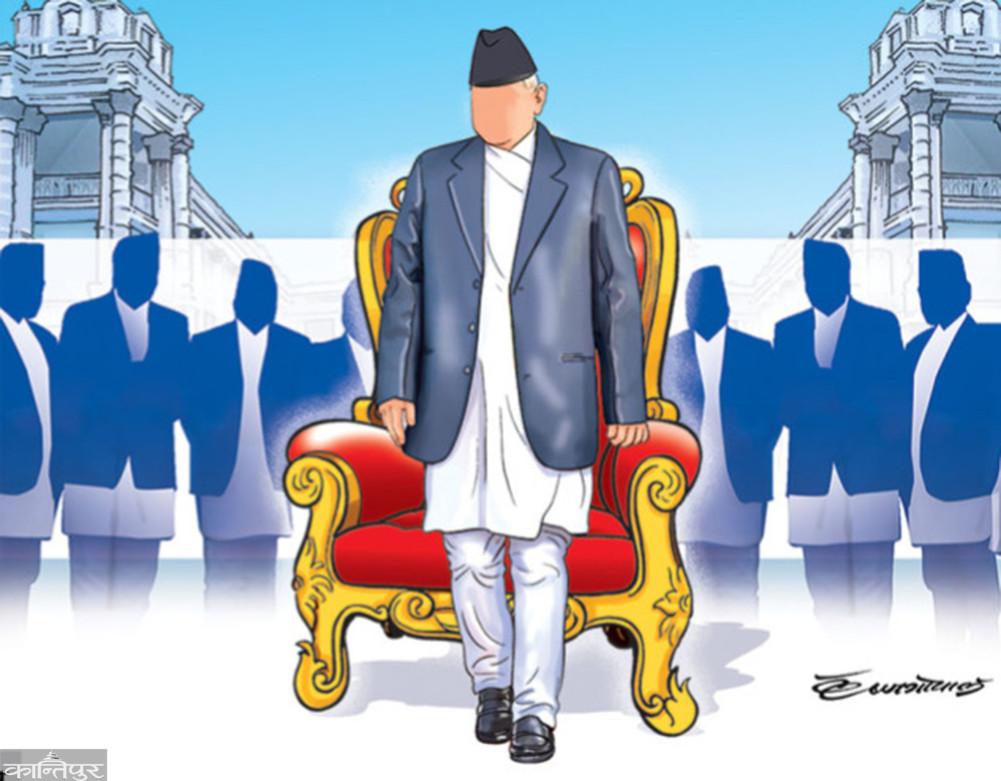
Our society is still under the yoke of patriarchy, iron filings are being chewed for the male-dominated society to implement the constitutional system.
We use Google Cloud Translation Services. Google requires we provide the following disclaimer relating to use of this service:
This service may contain translations powered by Google. Google disclaims all warranties related to the translations, expressed or implied, including any warranties of accuracy, reliability, and any implied warranties of merchantability, fitness for a particular purpose, and noninfringement.
As envisioned by our constitution, all women and men should be able to live a dignified and free life in the republic. But even after the establishment of the Republic, especially the daily life of Nepalese women has not changed as expected. Nepal has a long history of political change. Nepali people have experienced many ups and downs from Rana period to Republic. Hundreds of Nepalis have not only become martyrs in the name of political change, they are also living as martyrs.
It is not that the political parties have not tried to fulfill the goal and responsibility of making a developed, prosperous and well-governed country. In Nepal, a multi-party country, various problems have appeared due to unstable politics. Because of this, citizens of all levels and levels are not able to get their rights. Due to this instability, a monarchy or another system is being sought as an alternative to the republic. However, the best governance system in the world is a democratic republic system.
The current hot issue in Nepal is the question of representation, the objective implementation of inclusion, proportional system. Inclusion or inclusive theory is the subject of today's special debate. Because it is clear in the history that the Nepali people have been sacrificing and making sacrifices for uprooting autocracy, discrimination and oppression time and again through people's movement and armed struggle. Nepali women's role in such changes is unparalleled and respectable.
There is a common understanding that the representative governance system we have adopted in Nepal is a liberal practice. Such an arrangement should be based not on individual but on collective interest. But the situation in Nepal is opposite. In the Federal Democratic Republic, Dalits, women, minorities, indigenous tribes, and marginalized communities all have equal access and opportunities. It is clear that a republic has equal access and representation. But in Nepal, we are failing time and again in the implementation of the system we fought for.
There are a few reasons for this. The first reason is that the democracy that was introduced in 2007 is being run in the same manner in today's democratic era. Another reason is the inability to keep renewing and revising the governance system. Here, the landlord remains the landlord, the owner remains the owner forever, nepotism and nepotism prevail. The lives of the poor people were not improved and the wishes and aspirations of the citizens could not be addressed. Because of this, the system is always being questioned. Especially at the policy making level of the state, every level and level is looking for equal representation. More than 51 percent of the total population are women. They have been fighting for 33 percent representation for the past decade and a half.
As a result of that fight, only 33 percent of the presence of women in the Parliament was not seen - from the President, Chief Justice, Speaker, to the Chief Secretary. So the present republican system has given something. From literacy rate to other fields, women are coming forward. However, as much as was imagined, such a change has not happened. Women are not in the situation as imagined or provided for in the constitution. Those with wealth and access quickly seized the opportunity. The situation of low-level families, poor families and women who are outside the mainstream of development is still miserable. The tradition of giving
representation but not giving leadership opportunities is still going on. Even in politics, patriarchy is clearly visible due to the fact that those in power or leadership do not allow women to move ahead of them. In such a situation, a lot of work needs to be done regarding women.
To increase the representation of women in a democratic system, first of all, the representation of women in the government and parliament should be increased. If the presence of women is strong at the leadership level, women raise their voices against the injustice done to women. From a constitutional and policy point of view, the current constitution is not only a good document but also addresses the gaps of social character, economic diversity, political, marginalized and ethnic groups. Therefore, it is necessary to pay special attention to the representation of women to implement this constitution. Among these, rights over property, issues of identity and citizenship as well as establishing coexistence have come as major challenges for women's rights. The issue of identity, respect and coexistence should be addressed prominently in a republic.
In the one and a half decade since the establishment of the Republic, the efforts made for economic empowerment have seen an improvement in both the condition and status of women. Due to liberal economic policies, the economic condition of women in rural areas has changed drastically. However, the participation of women in the legislative, judiciary, executive, civil administration and other sectors as well as private and professional sectors is not satisfactory. Even women from Dalit, tribal and marginalized communities have not been able to come to the mainstream. They have to face discrimination and violence at home and in society. Our society is still under the influence of patriarchy. To implement the constitutional system, it is like chewing iron shavings for the male-dominated society.
Article 70 of the Constitution of Nepal states that 'President and Vice-President shall be of different gender or community', but the tradition of depriving women by misinterpreting it is still alive. Although it is written that one of the president and vice president should be a woman, but men should be given the opportunity, the law should have one of the heads of the local level and the deputy head, but men are dominating in the name of electoral alliance. In the majority of municipalities, both the chief and deputy chief are male dominated. Despite this, political parties and party-affiliated women's organizations are not able to raise their voices collectively. In this, women leaders in different parties should self-evaluate and improve.
Although voices are being raised that women's participation should be 50 percent instead of 33 percent, a collective voice has not come out for it. It seems that women leaders have to remain silent because of the party syndicate. In order to protect the achievements, it is necessary for Nepali women to speak, write, fight, fully implement the written constitutional and legal provisions and increase the numerical and qualitative participation of women in every field and increase the pressure above the circle of the party. Especially Nepali women, who cover half the sky, cannot be meaningful until Nepali women are given an equal place in policy making and leadership. We need a republic where all Nepalis are guaranteed food, clothing and shelter, no injustice is done to anyone, everyone has equal opportunities for personal development and the state helps the Dalits and the oppressed.
– Sangraula Nepali Congress's profession and The intellectual is the head of the department .