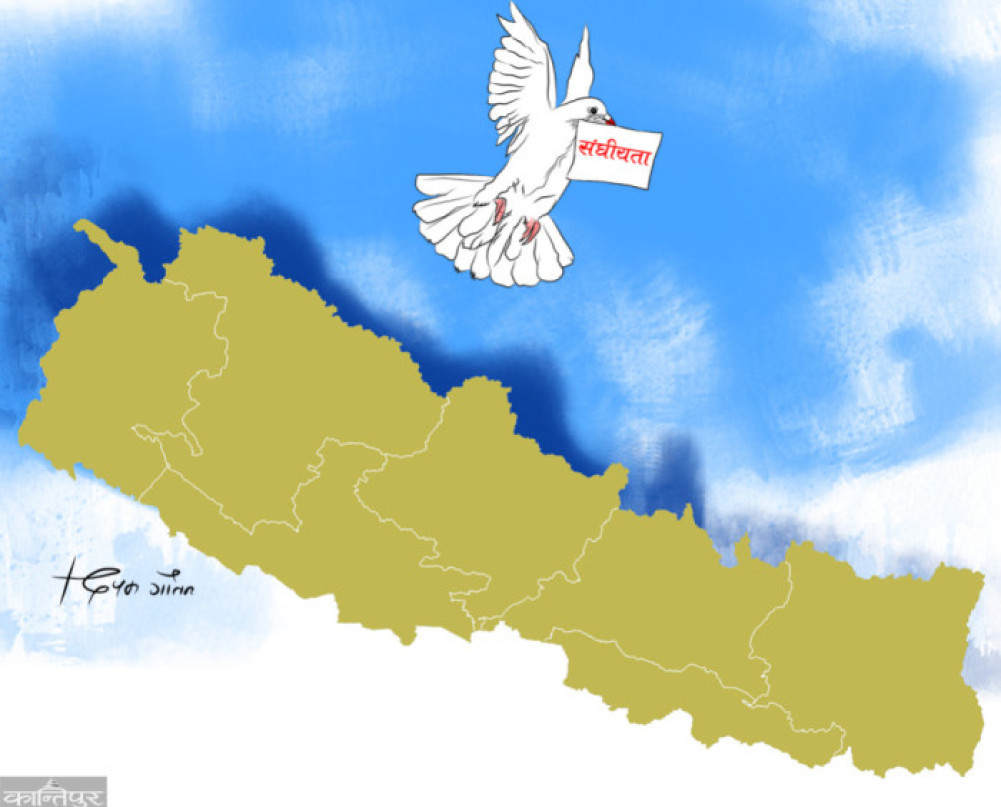
If the federal government makes an agreement with the syndicate or any other party to suspend the regulations brought by the state government, will the state accept it or not? Gandaki's 'ride sharing' case has also weakened the spirit of 'right sharing' (rights sharing) of federalism.
We use Google Cloud Translation Services. Google requires we provide the following disclaimer relating to use of this service:
This service may contain translations powered by Google. Google disclaims all warranties related to the translations, expressed or implied, including any warranties of accuracy, reliability, and any implied warranties of merchantability, fitness for a particular purpose, and noninfringement.
According to the constitution of the Federal Democratic Republic of Nepal, after the general election in 2074, three levels of government have been exercising their respective rights and responsibilities. Federalism is not only about governing with three levels of government, but also about having the freedom to formulate and implement policies according to their regional needs and rights.
However, due to the fact that the centralized mentality of the main political parties in the federal government in Nepal has not changed, the essence of federalism is being repeatedly attacked. The latest version is the postponement of the 'Ride Sharing' regulation introduced by the Gandaki province after the intervention of the federal government.
Article 56 to 60 of Part 5 of the Constitution has a clear provision regarding the structure of the state and the distribution of state power. There is mention of the clear division and authority of the three levels of government structure, Union, State and Local. Those rights are further clarified in Schedule-5 to 9 of the Constitution.
according to which the federal, provincial and local levels have the right to work independently in the fields of law and policy formulation, law enforcement and public service delivery. But the provincial and local levels have not yet been able to use these rights in practice. When trying to work, either federal laws are getting in the way, or the federal government is interfering.
Now the Gandaki province wanted to regularize the 'ride sharing' service to manage the public transport system according to its provincial needs. For this, the Provincial Assembly has now issued regulations based on the Act made in 2076.
The federal government has not even been able to bring a traffic law. Instead of defending the laws and regulations introduced by the state government, the federal government sent a letter to suspend the state regulations by kneeling before the syndicate of transporters. Based on that letter, the province has suspended the regulations. Both the association agreeing with the syndicated transport businessmen to suspend the state law and the state maintaining its law based on the same agreement are not healthy practices.
In the past, the association intervened when the Bagmati government formed the state service commission, the Lumbini government established an agricultural university, and the Madhesh government tried to exercise forest rights. Moreover, it is not a practice to give political instructions to the Provincial Assembly even in relation to the naming of the province. Although two-thirds of the state assembly legally approved the name, the process was only taken to the state assembly after political agreement was reached at the center about the same name.
The issue of revenue distribution is becoming the seed of eternal discord between the local level, the state and the union. The Sangh has been dominant in all these developments. State and local levels have been made harmless. Federal Civil Service Bill, Federal Police Bill, School Education Bill have been stalled in the Federal Parliament for years.
There is a clear provision in the constitution that states and local levels will make their own laws about this only after the federal law is made. However, according to that arrangement, the state and local levels have not been able to work since the union did not pass the law. Instead of facilitating the state and local levels by advancing such bills that have been stalled in the federal parliament, on the contrary, the center has also imposed a curvilinear view on the practice of the states in matters of their jurisdiction. This is undermining the essence and practice of federalism.
Nepal practiced centralized governance in all periods of Rana Tantra, Monarchy, and Democracy. In the democratic period after 2047, some powers were transferred to local bodies under the name of decentralization. However, lower level citizens could not get the facilities. Therefore, during the republican regime that started after 2063, a constitutional arrangement has been made to transfer the country to a three-level federal structure.
After the centralization of power, forgetting the fact that the federal system was introduced as an alternative to it, the parties, their leaders and heads of government, who are called the 'designers' of this system, are weakening it. The federal government considers the state and local governments to be subordinate and the parties leading the government are behaving like branches of their own party.
There is a mindset that the central government will weaken when the provinces and local levels start working independently. This kind of thinking is the opposite of a centralized government structure. which is weakening the foundation of federalism.
How can they serve the people without giving the necessary resources, manpower, policy-making authority and freedom of implementation to the provinces and local levels? If all decisions are to be made at the center, what is the meaning of spending billions of rupees in the name of the state and local levels? The Union should not be slow to understand that federalism is not just a distribution of geography, it is a structure of people's rights and participation.
Using the state and local levels for operational and political interests ultimately means weakening the federal government system itself. If the federal government makes an agreement with the syndicate or any other party to suspend the regulations brought by the state government, will the state accept it or not? Gandaki's 'ride sharing' case has also weakened the spirit of 'right sharing' (rights sharing) of federalism.
Federalism is weakened not only by the authority of the federal government, but also by the tendency of the provinces to devalue their own rights. The 'Ride Sharing' case has also made this fact clear. Thus, both the tendency to encroach on rights and to allow them to do so should be discouraged. Federal rights should not only be limited to the pages of the constitution, but should also be made alive in practice.