No matter how democratically elected the head of state and government is, freedom of knowledge is being interfered with in the 'Trump era' and 'Modi era'.
We use Google Cloud Translation Services. Google requires we provide the following disclaimer relating to use of this service:
This service may contain translations powered by Google. Google disclaims all warranties related to the translations, expressed or implied, including any warranties of accuracy, reliability, and any implied warranties of merchantability, fitness for a particular purpose, and noninfringement.
US President Donald Trump has adopted a repressive process that severely damages academic freedom to achieve his ideological political goals. Hence, academic freedom or academic freedom has become a global concern. Because, American universities have a significant impact on global education. Establishes standards for research and academic excellence.
According to a recent report, international students make up 5.9 percent of the total US population. The Swedish Parliament 'Riksdag' has also discussed how to invite American researchers when discussing the 'Research and Invention Proposal'. Because of Trump, academic freedom has become a topic of intense debate among the Swedish left, liberals and far-right.
Basically academic freedom depends on the inherent autonomy of universities. Universities should be autonomous whether they are run by government or private financial resources. Academic freedom is defined as the autonomous right to explore, teach, discuss and publish knowledge and ideas without fear of financial investor interference or censorship, retaliation or institutional pressure, curriculum control. Autonomy is closely related to accountability. Universities are, and should be, accountable to society.
The current global challenge is how and to what extent to conduct valid inspections of universities? How to strike a balance between oversight and protection of academic freedom. Universities need protection and financial support from the state. But educational leadership must be free from the influence of political leadership. Political interference disrupts the neutrality of the curriculum, the objectivity of research and the diversity of opinions.
The influence of political leadership hinders the development of critical thinking and the progress of knowledge. In this context, the individual academic freedom and autonomy of students and researchers and the institutional autonomy of universities are equally important. For example, a professor should be free to criticize government policy in his lectures or published articles, even if the university or the state disagrees.
awakening and political correctness
The African-American word 'vocism' (awakening) means to be aware of social injustice, especially racism. "Vocism" has been politicized and controversial in terms of academic freedom. For example, can the racist word 'Enword' be used or not? Critics argue that 'vocism' silences dissent or punishes perceived transgressions. Proponents of 'vocism' believe it is essential for equality, justice and inclusion.
s emphasize awareness of inequality and injustice. In Europe and America, the left and right political classes are active in the debate about academic freedom for their own interests, that is, the debate of 'political correctness' (political correctness) and 'political incorrectness' (political impurity).
Political correctness reflects deep cultural conflicts over identity, power and civility in public life. Those on the left who use words that respect people's identities support politically correct speech and see it as a defense of free speech. But the right wing considers it a hindrance to freedom of expression.
Trump and the Modi era
Contrary to the universal principle of autonomy, the Trump administration is also deciding who to admit, appoint and what courses to teach in American universities. Universities are being threatened with a range of punishments, including cuts in grants, loss of their nonprofit status, and taxation of grants.
Banning discussing and publishing any topics related to racism, gender equality, non-capitalist economic systems, different definitions of masculinity, Palestine, non-Christianity, LGBTQ+ identity, anti-Israel and anti-Americanism. States like Florida and Texas have sought to ban certain courses and assert more political control over universities.
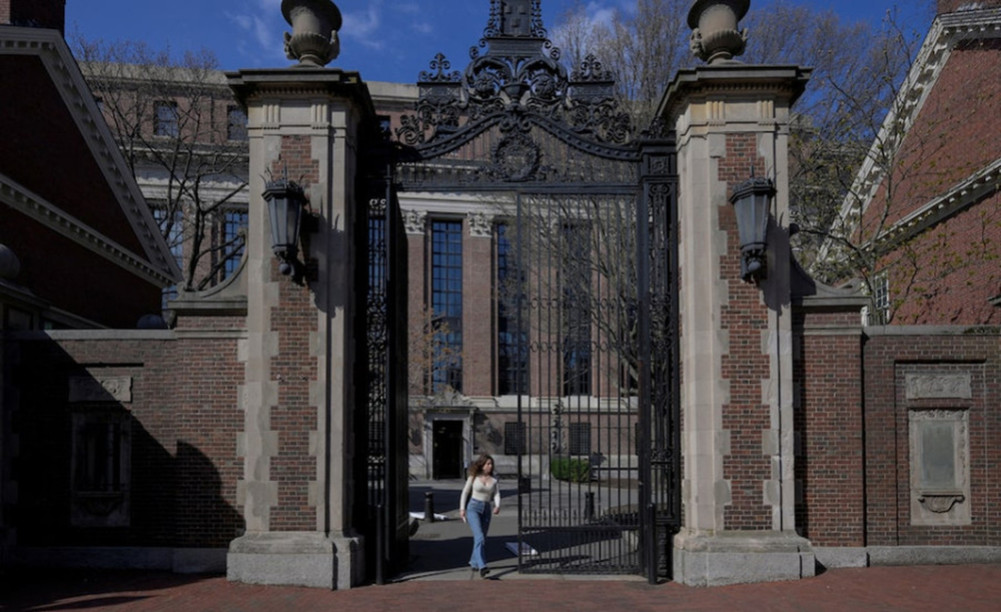
In a case against the Trump administration's efforts to expel international students from Harvard University, a court order has halted the expulsions, but the reputation of academic freedom in America has been seriously affected.
Like President Trump, Indian Prime Minister Narendra Modi's credibility on academic freedom seems problematic. Under the leadership of Prime Minister Modi, academic freedom in India has become a subject of intense debate, especially among scholars, civil society and international observers. Government oversight and political interference increased over Jawaharlal Nehru University, Delhi University and other institutions. Vice-chancellors and heads are often appointed based on ideological leanings or loyalty to the ruling party. There has been pressure to align the
curriculum with Hindu nationalist views, particularly in the subjects of history, culture and political science. Faculty and students who criticize government policies have faced disciplinary action, legal threats, and police action. Dissenting views are labeled as 'anti-national'. Increased surveillance and self-censorship on campuses is reported.
Research and publication on sensitive topics such as freedom in Kashmir, caste violence, religious minorities, or criticism of Hindutva ideology is increasingly prohibited. Researchers face difficulty in accessing archives, data or fieldwork sites, especially when researching politically sensitive topics. There are reports of publishers and universities being pressured to censor or withdraw books.
The appointment of a female Muslim professor in the Sanskrit department at the Banaras Hindu University sparked protests fueled by religious orthodoxy. The administration remained inactive. Ashoka University, a prominent private liberal arts university, has seen prominent scholars such as Pratap Bhanu Mehta and Arvind Subramaniam resign citing concerns about academic freedom and government pressure.
shows that while some private universities retain relative autonomy, space for ideological policing and critical inquiry is shrinking. This trend reflects the broader authoritarian turn in India's democracy.
RSS under Modi is rewriting Indian history. BJP's extreme right-wing ideology is working to change the curriculum of schools. Due to lack of integrity of character and sincerity of purpose, switching political parties is considered a common practice in India. 'Godi Media' and 'WhatsApp University' are distorted institutions of knowledge and expression. No matter how democratically the head of state and head of government are elected, freedom of knowledge is being interfered with in the 'Trump era' and 'Modi era'.
The pursuit of truth and intellectual freedom
Famous astronomer and physicist, Galileo Galilei is a classic example of scientific truth and intellectual honesty. Galileo was sued by religious heretics for challenging biblical orthodoxy when he asserted that the earth revolved around the sun. He was sentenced to house arrest and died in custody.
Perhaps no one has sacrificed more for academic freedom than Socrates. A classic example of the search for truth is the ancient Greek philosopher Socrates' commitment to inquiry. The philosopher Plato, a disciple of Socrates, has seriously mentioned this in 'The Apology'. Socrates devoted his life to questioning commonly held beliefs, exposing contradictions, and challenging powerful figures in the pursuit of truth and knowledge.
His famous quote 'The unexamined life is not worth living' is a guiding principle for educators of every generation. Socrates taught young people to challenge traditional beliefs. It became the cause of his death. Even when threatened with death, he refused to give up his principles. Instead of fleeing or compromising, he accepted the death penalty, claiming that truth and integrity were more valuable than life. His life stands as a supreme example of unwavering dedication to truth, truth.
Although intellectuals from different cultures and eras, Confucius, Buddha and Socrates emphasized the importance of knowledge and conduct. Confucius, Buddha, and Socrates have guided us to question superstitions, expose contradictions, and challenge power. Truth in simple language is the matter which corresponds to the reality. Academic freedom must be understood as the right to seek, publish and teach the truth. The right to academic freedom implies a duty.
Some people talk about 'alternative truths' in the name of post-modernism. But truth is not optional. Hence, ironically, the present time is called the 'Uttar-Satya Yuga'. Feelings, personal beliefs and subjective interpretations are more influential in post-truth times than objective facts. Such 'alternative truths' shape public opinion and political debate. Scholars should be free to challenge prevailing views and authority without fear of punishment. The pursuit of knowledge is not just for utility.
Why academic freedom?
Academic freedom was proclaimed in 1915 by the American Association of University Professors. It mentioned freedom of questioning, research, teaching and expression and publication on any subject. Academic freedom means that students have the right to learn in an academic environment free from external interference.
involves the faculty's right to engage in social and political criticism. Dissent is discouraged without academic freedom in universities. The quality and character of the doctors, engineers, lawyers, journalists and others produced are often compromised by the ruling party for personal gain. Doctors may lack critical thinking about new medical research or public health systems.
engineers can fall behind global standards. Lawyers become servants of power. Instead of challenging unjust laws, not justice, they end up defending the status quo. Civil liberties may be ignored or misunderstood. Teachers, scientists, economists may serve politicians rather than truth or public interest. Without academic freedom, universities can produce technically competent manpower but not intelligent critical thinkers. Manpower is not prepared to serve the public interest in a democratic or ethical manner.
According to the Academic Freedom Index (AFI), the German constitution has strong legal protections for academic freedom. Universities have institutional autonomy. Universities and students can conduct research and teaching without state interference. Sweden has a transparent administration and strong freedom of expression. Universities in Finland are self-governing institutions. The state funds higher education but does not interfere with curriculum or research.
Canada has strong protections for academic expression. The level of university autonomy and academic freedom in the Netherlands is high. There is a balanced relationship between state subsidies and institutional freedom. Universities in New Zealand operate with a high degree of autonomy. Academic staff have a legal right to express unpopular or controversial views.
Norway, Switzerland, Denmark, Austria have respected academic freedom. Right-wing ideologues in the countries mentioned above are criticizing the dysfunctional system, demanding their own agenda. Although UK universities are expected to maintain academic freedom, tensions sometimes arise between freedom and institutional policies, public opinion or political pressures. Countries such as Hungary, Turkey, China, India and Russia have experienced a sharp decline in academic freedom in recent years.
Nepal's challenges
It is said that the university education system in Nepal has expanded the reach of students. But there are many challenges that hinder quality and effectiveness. The number of universities and student enrollment rates have increased significantly. Private universities and affiliated colleges help meet demand and introduce some competition. Many universities suffer from outdated curriculum, weak research culture and lack of qualified faculty.
Politics in Nepal has a great impact on university administration. Student politics and a weak university system have disrupted the academic calendar. State investment in public universities is low. This leads to poor infrastructure and limited research. Tribhuvan University still has a centralized system. Bureaucratic control has limited institutional autonomy. University education often does not match the skills demanded in both Nepal's domestic and foreign labor markets.
Although the university education system has expanded, it is in urgent need of reform focusing on academic quality, governance, research capacity and alignment with national development goals. Nepal's Prime Minister KP Sharma Oli cannot be called the Nepali "mirror" of Trump and Modi. But his influence on Nepal's university education is more political intervention and hegemony than permanent structural reforms.
Academic freedom is the foundation for truth-seeking, research and innovation, responsible citizenship, and the autonomy of academic institutions. Without it, universities are hollow. A democratic society risks becoming less informed, less just and less free. University students who practice academic freedom are not only techno-economic drivers, but transformative forces in national politics.
Regardless of the country, a ruler who politicizes universities destroys the future of his country. University professors, researchers, experts who become puppets of government and political party ideologies are equally dangerous for the future of nations. It is not possible for the average human being to be Socrates and Galileo. But it is possible for academics to become independent of political ideology and promoters of academic freedom.