For the success of a republic, only formal structures and constitutional arrangements are not enough, the practice of republican values and beliefs must be reflected in daily life.
We use Google Cloud Translation Services. Google requires we provide the following disclaimer relating to use of this service:
This service may contain translations powered by Google. Google disclaims all warranties related to the translations, expressed or implied, including any warranties of accuracy, reliability, and any implied warranties of merchantability, fitness for a particular purpose, and noninfringement.
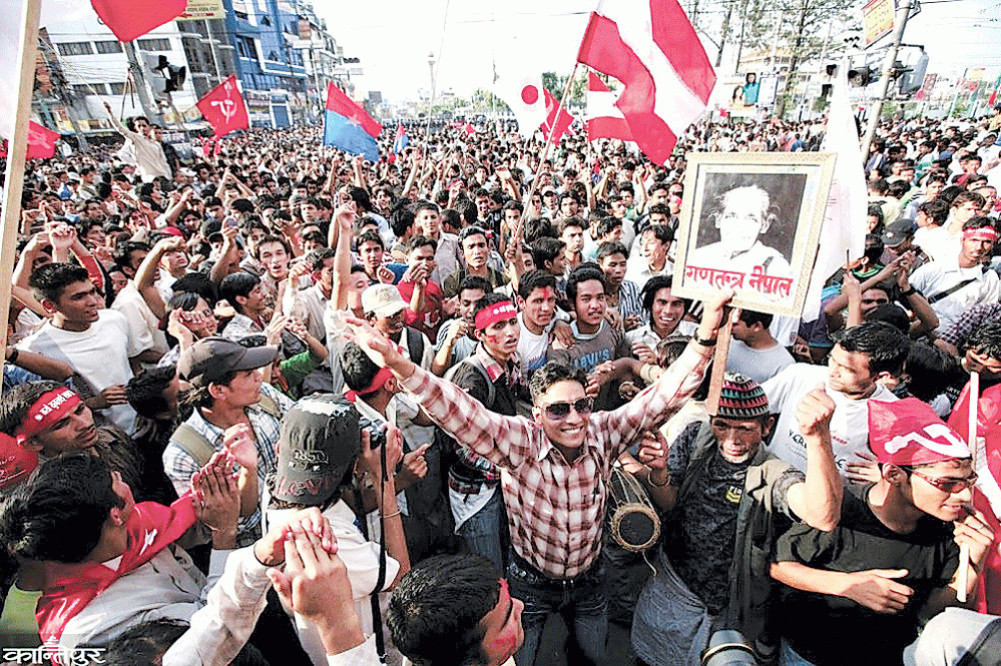
At 11:30 PM on 11th Baisakh, 2063, King Gyanendra restored the dissolved House of Representatives. This declaration was not just a constitutional step but an indicator of an epochal change. A day ago many citizens were in the status of 'terrorists', the next day they became 'citizens'. This change was not only on paper, it was also a revolution of public consciousness.
When the Constituent Assembly announced the Republic on 15th May 2065, there was a stir in the deep traditions and beliefs of Nepali society. The end of the monarchy gave Nepal a new identity and potential. It was not just a manipulation of power but a heightening of social consciousness. The Republic led Nepal to the path of inclusive, egalitarian and responsible governance.
The current political leadership is a generation that grew up reading Mahendramala. Mahendramala's narrative was to extol the beauty of the one-party monarchy while exaggerating the weaknesses of the multi-party system. But the leadership group and political parties established by the republic could not learn from that history. History is harsh - it teaches, but also harshly punishes those who do not learn. Yes, today the republic in Nepal is definitely facing some challenges.
In the absence of a healthy political culture in the political party and the original leadership, the rulers are seen as the kings of Sripech Begar. Due to lack of democratic practice within the party, the leaders have become like lahids. Without long-term thinking, policy making and practice became sloppy. A narrative of 'anything goes' was created to reach and stay in power.
In addition, the internal conflict within the parties and the greed for power led to an attack on the spirit of the republic itself. When leaders gave priority to personal interests, public interest was overshadowed. Personal interests and benefits came to guide the parties rather than policy debates. Full implementation of federalism, inclusiveness and decentralization is yet to come. Abuse of power and corruption at the local level weakened the foundation of the republic.
Proportional election system became a means of producing political slaves, while politics became the power ladder of the family, the spirit of the constitution could not be maintained. Corruption, misrule and lack of accountability eroded public confidence. The people could not realize the expected change from the republic. The opaque behavior of the ruling class and indifference towards the people has widened the trust gap.
The lack of jobs and opportunities has led to growing distaste for politics among the youth. Millions of young people migrated abroad, putting the future of the republic at risk. The apathy of the youth in the country towards politics is increasing the lack of conscious citizens. The tendency to stifle dissent and prohibit criticism has weakened the foundations of democracy. These problems are not the failure of the republic but the weaknesses of its operating system. Despite the decentralization of power, the ideology of 'monarchy' in value and character is still alive.
Some steps must be taken to strengthen the republic. Political will is based on moral capital. It is necessary for the leadership to show full commitment to democratic values. Parties should strengthen internal democracy and develop transparent and accountable leadership. Focusing on long-term national interests above short-term benefits
should be raised. Public access to education, health, justice and public services must be ensured. Corruption control and good governance can restore public confidence. Reorganization and strengthening of public institutions can bring positive changes in people's livelihood.
To keep a republic alive, thinking, debating, and taking responsibility youth are essential. Youth should be involved in politics and policy making. To attract and retain young talent in politics, the latest thinking and opportunities should be created. Parliament, Courts and Commissions should be independent, transparent and effective. These institutions should work in the interest of the people. Power balance and control should be maintained between the executive, legislature and judiciary. No system of governance can succeed without an alert, critical and responsive citizenry. People should be made aware of their rights and duties through civic education. Citizen awareness can be increased by proper use of social media and information technology.
The republic of Nepal was not easy. After 237 years of monarchy, people have got the right to make their own future. However, protection of this right is possible only through constant vigilance and practice. The hope that came with the republic is still unfulfilled. Strong institutions, inclusive governance and citizen participation are still incomplete.
Republic is not just a constitutional structure, it is a continuous exercise of consciousness. History has taught us - 'power does not make a country, consciousness makes it.' Today, when Nepal stands between the legacy of the past, the confusion of the present and the possibilities of the future, it is the responsibility of all of us to keep the republic alive. Mere formal structures and constitutional arrangements are not sufficient for the success of a republic.
The practice of democratic values and beliefs should be reflected in daily life. As the famous political philosopher Abraham Lincoln said, "Government of the people, by the people, for the people" is the essence of a republic. Active participation and responsibility of every citizen is necessary to maintain this essence. The Republic of Nepal should also imbibe this basic spirit in a practical manner.
Indeed, republicanism is a continuous process, a journey, with ups and downs, challenges and opportunities from time to time. Leaders, citizens, and institutions must work together to strengthen the republic. This is the biggest opportunity in Nepal's history, but its success depends on our vigilance. The decisions and actions we take today will determine the shape of Nepal tomorrow. It is our collective duty and historical responsibility to protect and strengthen the Republic.
The Republic of Nepal is not only a historical milestone, it is the beginning of a democratic culture that is constantly evolving. Only the active participation and conscious efforts of every Nepali can keep the original spirit of the republic alive.