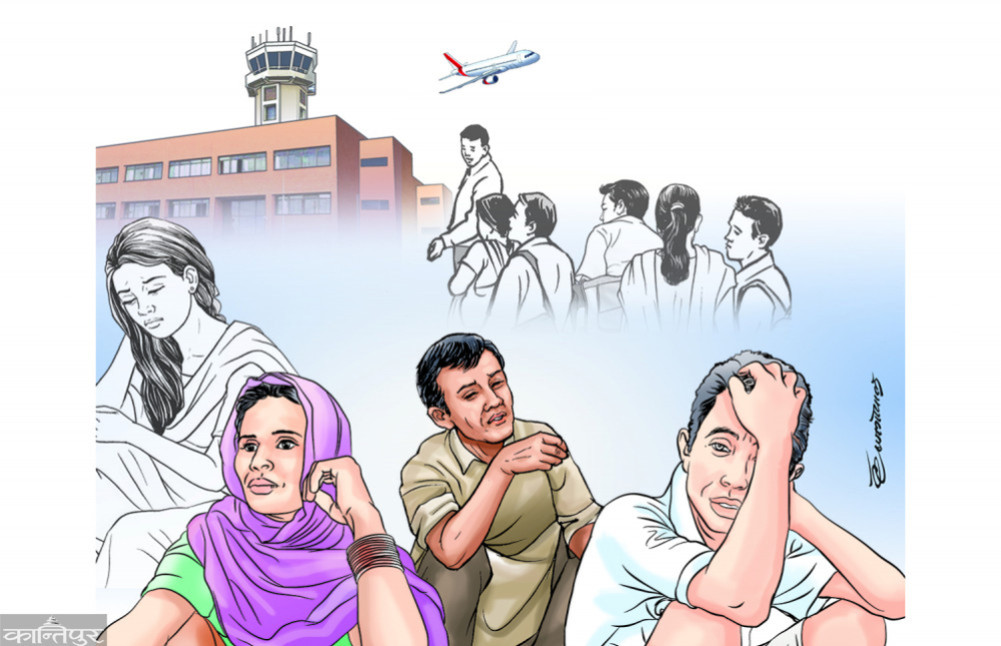
There should be no delay in ruthlessly cutting unproductive spending to build an investment-friendly and expansionary economy. Rather than gossip, we need to develop the economy and free Nepali people from unemployment.
We use Google Cloud Translation Services. Google requires we provide the following disclaimer relating to use of this service:
This service may contain translations powered by Google. Google disclaims all warranties related to the translations, expressed or implied, including any warranties of accuracy, reliability, and any implied warranties of merchantability, fitness for a particular purpose, and noninfringement.
Seyda Oner, an economist at the International Monetary Fund, said that unemployment is "a misfortune for the country" and "a curse for the individual". She noted that the economic recession of 2008, which left about 200 million people unemployed worldwide, was a cursed situation.
As the economy develops and expands, the purchasing power of individuals increases and this increases the demand for goods and services. As production of goods and services increases, unemployment decreases. Unemployment rates rise when the economy contracts. Such contractions will reduce the impact on financially able people, but will directly affect the livelihood of lower and middle class people.
Recently, in the World Bank's report on taxation of South Asian countries, it is mentioned that due to the policy of the central bank, there has been a gradual decline in the demand for loans from the private sector. Due to low revenue collection, the government's ability to spend seems to have decreased. The World Bank's report on employment published last year also mentioned that more resources should be mobilized to increase investment in the productive sector for job creation.
The report suggested that policy initiatives should be taken to promote investment, facilitate the acquisition of land for industrial operations, simplify labor mobilization, and expand export promotion. Although there is a lot of potential for wide expansion of the economy in the Asian countries as a whole, the Asian Development Bank reports that the issue of job creation has become ineffective because the economic and monetary policies do not support job promotion.
Growth and sustainability of the economy is necessary to increase employment. Due to the failure to bring stability to Nepal's economy, there is a risk of falling into the 'lower middle income trap'. Venezuela, a country rich in resources and resources, may become the situation as it grows into the role of a welfare state.
The high-level economic reform suggestion commission to improve Nepal's economy has already submitted its report to the government. The government must be serious about whether to minimize the risks seen in the structure of the economy or to create a positive environment in the overall 'ecosystem' of promoting investment and employment for economic development. Recently, the amendment in various laws is a positive initiative, but it is necessary to focus on building a self-reliant and dynamic economy.
Service sector contributes about 62 percent to Nepal's GDP. While the service sector is being promoted, there has been a delay in transforming it into the development and expansion of agriculture and industry based on its own resources. In the current situation where almost one-third of the total revenue income has to be spent for financial management, it is appropriate to focus on the expansion of the economy even if the debt is increased.
After the earthquake of 2072, the expenditure for reconstruction or the general election of 2079 increased the monetary flow, which gave strong support to the economy. The government can play a promotional role by providing more monetary inflows and incentives to entrepreneurs to invest while developing and expanding the economy. Considering the situation of low revenue collection, although the issue of tax exemption is complicated, attention should be paid to increase domestic production and productivity by modifying the policy introduced to facilitate imports.
During the epidemic of Covid-19, the currency control tool brought to reduce the effect of price increase caused by external factors including fuel increased the interest rate, 10 percent for investing in the stock market and 18 percent for investing in business and 18 percent for investing in the productive sector. This increased the cost of domestic production while facilitating imports. Currently, when investors show reluctance to invest, should it be transferred to the private sector gradually, even if it is through government investment in profitable industrial establishments?
There is no doubt that investment from individual and collective sectors should be promoted for job creation. In the recent situation, when the countries that built the organization raised a question mark on the justification of the World Trade Organization, how relevant would it be for us to continue to follow the laws of these laws? We should be concerned about how to minimize the impact of world liberalization on the country's domestic production and productivity. By clarifying the issue of doing business or production, it would be more relevant to take more responsibility on the issue of 'crony capitalism' being dominant during the formulation of economic and monetary policy.
Challenges in implementation
When government investment is low, the entire responsibility for job creation is in the private sector. In the policy and program recently passed by the Parliament, agriculture and tourism have been promoted for the economic growth of Nepal. Nepal's agriculture has always been consumption-oriented. Third, according to the labor force survey, about 7.2 million people have migrated from agriculture. As the number of Nepalis going to work abroad is increasing, the availability of labor and the issues of fertilizers are becoming more and more important. Concessional loans taken for agricultural production have been used in non-agricultural activities.
Rather than a promotional role in tourism development, higher fares and extra charges are also imposed on foreigners to travel from one place to another. There are more tourists going to other countries than Nepal due to fees charged at all levels and sometimes tourists are cheated. It is necessary for the government to study and remove such fees.
conclusion
The fact that trade and customs are the basis of the current economy of Nepal is harmful for the country's long-term prosperity. For the prosperity of Nepal, attention has not been paid to increase the use of Nepal's unused natural resources and resources. A strategic plan is needed to mobilize unused mines. Even if imports can be discouraged by increasing investment, more jobs can be created.
No country has been built by remittances received from foreign employment and will not be built. Bangladesh, a labor-sending country, has currently made garments its main source of production. A country that receives remittances by sending workers, South Korea has become a country that demands workers. The situation of sending workers to Sri Lanka, Philippines or South American and African countries is not different from that of Nepal. There should be no delay in ruthlessly cutting unproductive spending to build an investment-friendly and expansionary economy. Rather than gossip, we need to develop the economy and free Nepali people from unemployment.
- Basnet is working in the field of labor and employment.