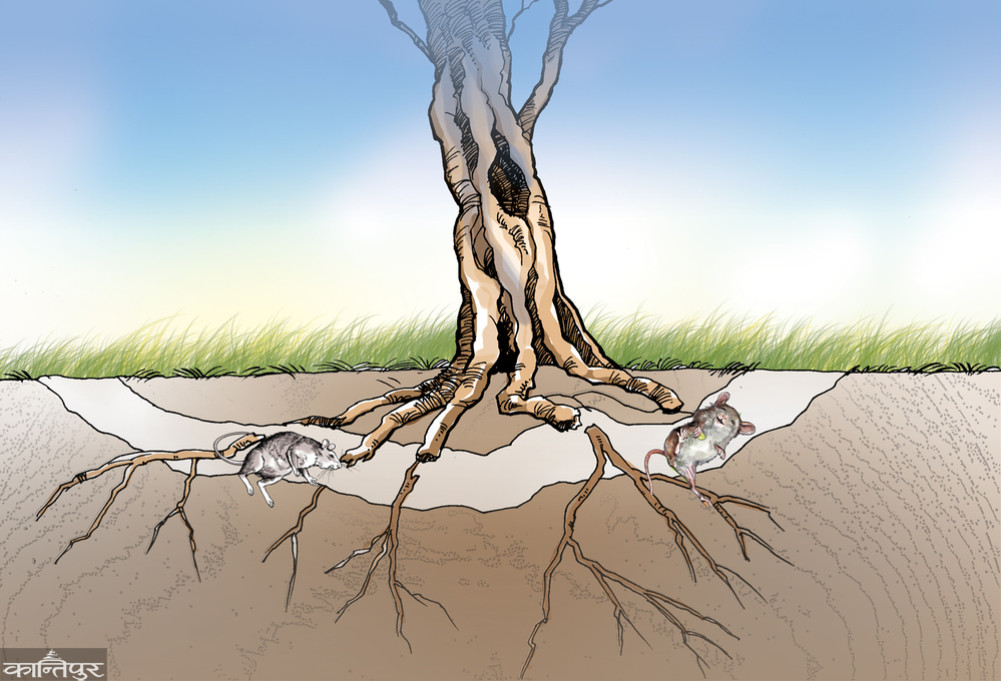
The state is doing everything except the concerns, interests and sorrows of the citizens. They are present in the service of middlemen, big leaders, high administrators, some families and smugglers. How long will it last? Where did the road change? What harm will it bring?
We use Google Cloud Translation Services. Google requires we provide the following disclaimer relating to use of this service:
This service may contain translations powered by Google. Google disclaims all warranties related to the translations, expressed or implied, including any warranties of accuracy, reliability, and any implied warranties of merchantability, fitness for a particular purpose, and noninfringement.
In a democracy, the citizen's right to question is given great importance. It is defined as the beauty of democracy. Giving importance to the question means that the question should work to make the government pro-people, accountable, transparent and responsive. The question is meant to be answered by those in power. But our democracy does not care about citizen's question, not even about citizen's movement.
For a long time, the cooperative victims are on the streets, the meter-based victims, the microfinance victims, and the land victims are on the streets. The government does not listen to any movement, sometimes it seems that the government itself joins the movement. Demonstrates strength. While in the government, they do not care to address the concerns and concerns of the citizens, they become dizzy with the display of power.
Democracy in this sense has not been guaranteed anywhere . Democracy has been made so technical, everything is visible. But democracy has no soul and culture, democracy is not just a paper game. Democracy is becoming increasingly technological. Cinemas have been censored, restricted areas have been increased. All these are works that undermine democracy. Democracy is being shrunk by sitting inside the lion palace while nurturing and growing up.
The volume of disappointment
The state has disappointed the citizens so much that the citizens do not believe that they will be educated in schools, treated in government hospitals, and protected by security agencies. There is no guarantee that Nepal Airlines flights will fly on time. There is no hope of getting service facilities from government offices.
There is no confidence that the projects will be completed in a quality manner on time. Common citizens analyze the coalition of leaders, contractors and employees, they do not believe that the coming budget will do anything for the citizens. It has been a long time since common citizens have understood that the budget is made by colluding with big houses, contractors and middlemen to feed them. Research organizations do research that works, not trust. The court is like the office of the class organization of the party office, where is the state if there is no justice? What is the relationship between the state and citizens? A long analysis is not necessary.
The state has almost lost its legitimacy. Forced to seek foreign employment, those sending remittances to Nepal have no confidence in the state. The path of socialism shown by the constitution is oriented towards becoming a failed state. A state is a coalition of organizations.
These organizations are the trust of the state, which have lost their legitimacy, not earning trust means losing legitimacy. We are not looking for democracy for some miraculous subject, but for better education in schools. The health office should provide health services well. The court should give justice. In this sense, democracy is hollow, it seems like this path is always a web.
It is concluded that aid and grants have no meaning as Nepal is on the front list of corruption to donor agencies. Nepal is not only in the top list of corruption, but globally in the governance index, Nepal is very low. These two researches are of great importance globally. Both studies yielded significant results.
These researches done academically have brought Nepal's image down a lot. Those who will receive it in the future, assistance and grants will be cut and only loans will be available. Debt is also not on our agenda, on their agenda which will help make us poorer. Once credit is lost globally it is very difficult to regain credit.
weak parliament
How right and wrong is the recent teacher movement is a matter of deep debate. But one thing is clear, was it wrong for the teachers to ask for a new law? Education Act 2028, National Parks and Wildlife Act 2029 Many Acts are outdated.
The change of 2046 could not bring many of these laws into rhythm, now we have gone from centralization to federalism, there are three levels of government, three levels of government are constitutional, but the parliament never showed interest in these matters, all laws have to be made new to bring federalism into a framework.
All laws must be enacted at least one year after the first election. It organized federalism, defined the jurisdiction and duties of the three tiers of government, but Parliament was not needed for anything other than forming and forming the government.
Parliament is the heart of a democratic system. But the heart did not work. The teachers should not have come to protest, our parliament was unable to work and had to come to the streets. Big leaders don't go to parliament, for them the position of MP is only the qualification to become minister and prime minister and nothing else.
When the parliament is not the priority of the big leader, the big leader does not seek the role of the parliament and the rest of the parliamentarians cannot show their justification. The weak role of the parliament did not help to undermine the democracy. Not only in terms of legislation, but also in terms of constructive debate, our parliament could not build credibility.
There is no trust in the citizens, it is not sure whether the parliament will make laws for the benefit of the people, the communists used to say - it is a place to sell dog meat by showing the head of a goat. But when looking at the Nepali Parliament, it seems that showing a dog's head means that there is meat in an empty bag. In this way, the relationship between our Parliament and the citizens has been completely cut off. It is clear that the government is in the hands of middlemen.
The middlemen have made the parliament ineffective through the big leaders, the organs of the state have failed. Where is the state and what is it doing? Finding an answer to the question of who is doing it for is not a Mahabharata. The state is doing everything except the concerns, interests and sorrows of the citizens. He is present in the service of middlemen, big leaders, high administrators and some families and smugglers. How long will it last? Where did the road change? What harm will it bring? Is it hard to imagine? But the Prime Minister of the country doesn't think all this .
Conspiracy against UML is over. Another Mahabharata is how to organize policy transparency when Parliament makes laws. Since the law is not made, policy transparency has not gained entry. When will our parliament mature? How?
Participatory democracy
There are two things that our democracy envisions now. First, we practice democracy in terms of federalism, secondly, we organize participatory democracy, these are interconnected. It is the belief that federalism alone makes democracy participatory in the true sense.
One of the main dimensions of participatory democracy is citizen control and participation in the state system. From school or community forest to Singha Durbar, the control and monitoring of citizens is sought to be organized. But under the guise of democracy, the government has been running by keeping the citizens completely out. Citizens' questions and protests are excluded.
In this sense, democracy does not seek citizen proximity, there is a long distance between the state system called democratic and citizens. Citizens are nowhere to be found within the state system. One of the great wishes of participatory democracy is that citizens' agendas should be debated from bottom to top, citizens should present their viewpoints, and the state should take those viewpoints to a wider debate and take the path of addressing them. But our democracy did not open this debate, it tried to keep the society closed.
Society has its own speed, society has its own rules, which cannot be locked down, and even the common sense is lost when it enters the mud. The first condition for organizing participatory democracy is to strengthen federalism. Federalism is constantly being undermined. Forming a good governance commission under the chairmanship of the prime minister means weakening federalism. Prime Minister's If we analyze the
desire, it can be easily guessed that its main objective is to weaken federalism and hollow democracy. Blaming the Prime Minister alone would be the path of the current coalition.
The main forces that make democracy work are the parties. Parties can make democracy accountable and responsive. But since the parties in Nepal are not able to practice democracy within themselves, it has cast a shadow on Nepali democracy. This is the result of parties not being able to develop democratic character and culture. The apolitical character of
parties does not allow democracy to flourish. Within the parties, issues like contracts are on the main agenda, parties are not on the political agenda, parties are not interested in the political agenda, the society has been partisanised. The interests and concerns of the citizens are not the subject of the parties, the citizens are the object of voting for them once in five years, after the objectification of the citizen, the parties did not have to fear the citizen. This is the approach of
teams. The expenses of running the party, the expenses required in the election due to the expensive election system have cut the parties from the yard of the citizens and brought them to the middleman's skull. Not only from the state, but also from the parties, the citizen's agenda has been left out. Today there is no explosion from the civilian level, it seems that it is going on, but it is impossible to predict which day and how it will explode.
Lack of knowledge creation
After federalism came, a great campaign of knowledge creation was necessary in Nepali politics and society. Strengthening federalism by doing and learning through knowledge was supposed to democratize democracy. Nothing is more incongruous than trying to run a new state system out of old knowledge. Old wisdom says that federalism is expensive and not necessary.
How to organize federalism by strengthening the local government and taking the authority to the community level, we did not do any kind of research. The state was not interested in how to create an environment for the province to work on regional autonomy.
We don't see that if knowledge does not advance the state system, the state has not reached the citizens. Every government should be supported by knowledge. The Nepali state has prohibited the production of knowledge and its practical use. What should be done to change the level of dissatisfaction of a citizen? What should be the values of the three levels of government? Proceeding without regard to what our national priorities are will only increase the import of discontent. Democracy will shrink and become hollow.