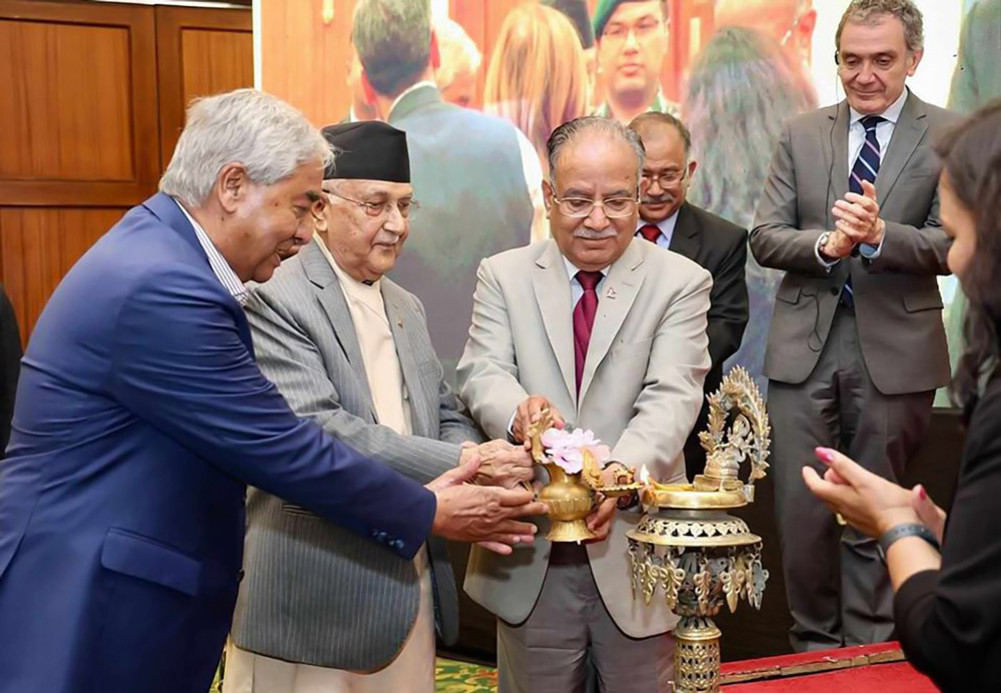
The question arises, these top leaders did not leave power or the society did not leave them? Their throne is safe because of the double standards and norms existing in the society
We use Google Cloud Translation Services. Google requires we provide the following disclaimer relating to use of this service:
This service may contain translations powered by Google. Google disclaims all warranties related to the translations, expressed or implied, including any warranties of accuracy, reliability, and any implied warranties of merchantability, fitness for a particular purpose, and noninfringement.
The 17th Republic Day is just around the corner. Prime Minister KP Sharma Oli, who recently came out of the 'Sagarmatha Dialogue', will probably now get ready to celebrate Republic Day with grandeur. He thinks that there is no crisis in the country.
Therefore, people experiencing 'Patke Loadshedding' will light the lamp with spontaneous enthusiasm on 15th May. But ironically, republican lamps are filled with more discontent and despair than oil.
On top of that, those lights are being targeted by right-wing hundri. On May 15th, the day of the Republic Day, all the royalists have announced a 'United People's Movement' demanding the restoration of the monarchy. That is, the debate of republic versus monarchy has come to the surface again.
The right-wing forces have repeatedly tried unsuccessfully to extinguish the flame of the republic. The May 15 movement is his next attempt. As all the royalist powers came together, they considered it 'decisive'.
However, neither the domestic nor the international environment is favorable for the restoration of the monarchy. The movement of the monarchists has not been able to appeal to the people, except for saying ``Kehi Hand ki? This is just an opportunistic movement. Looking at the past political examples, there is no reason to believe that the people who have repeatedly fought against autocracy will shed blood again to return the monarchy.
But does this mean that the Federal Republic is risk-free? Why has its institutional development not accelerated? These questions need further discussion. This debate will be more relevant on the upcoming Republic Day.
Nepal has become a federal republic since 15th June 2065. In other words, our republic is in its 17 years of adolescence. The republic, which has reached its teenage stage amid many vicissitudes, is not risk-free. The Republic is at risk because of the inaction of the supporters of this system more than the right-wing storm.
Because, the political leadership that considers itself the "Messiah" of the republic has no intention of improving far and wide. They have continuously attacked the democratic method and system by getting caught up in the selfish interests of the government. Law, accountability, transparency, good governance and the implementation of democracy in practice are the cornerstones of a democratic system. However, due to the devaluation of leadership, these foundations are weakening.
The value of democracy has been trampled step by step. However, you are silent. Prime Minister Oli's latest expression is a fresh example of this. He says, 'After 14 months, I will decorate Sher Bahadur Deubaji and give him the Prime Minister in installments.'
Everyone knows that Deuba and Oli made a 'gentleman's agreement' that they would be prime ministers. Perhaps Oli wants to keep showing Deuba the 'prime minister's lollipop' to avoid a power crisis. He knows that as long as Deuba is right, he will not leave the chair if others want him to. That is why he has been showing this 'lollipop' to Deuba from time to time.
He may have talked about giving the Prime Minister in installments as a symbol to reassure Deuba. However, does his statement that 'I will give you the prime minister in installments' from the public platform not respect the constitution? Is the constitution of Nepal made the method of selecting the prime minister like this? Is it possible for one prime minister to give the prime minister by decorating another leader in installments?
Parliament has the power to elect the Prime Minister. According to the constitution, the sovereign parliament elects the prime minister within certain procedures. However, while respecting the rights of the sovereign parliament, Oli says, 'I will give you the prime minister in installments.' Breaking the
method is not a new thing for Oli, but developing a character that does not even question it does not make the republican system flourish. Arbitrary decisions, actions and expressions of leadership are not beyond question. Aren't we establishing the comment that the position of Prime Minister is 'an object to be decorated in installments'? The silence of the "technical heads" counted in the parliament is harmful to the health of the republic.
Tired of expressing commitment to good governance and corruption control, Oli now formed a high-level good governance commission under his own leadership. As a result, many shrugged it off as a classy prank. His commitment to good governance came to the fore in the 'sankhanikhe drama' of appointing the governor. From the exit of Kulman Ghising of the Nepal Electricity Authority to the appointment of the Governor, not only did the Congress-UML coalition government's competence be questioned, it gave more strength to those who questioned the system.
The government has also failed miserably in transparency, which is an essential feature of the republic. Even though there has been widespread criticism that the properties of the Prime Minister and the Council of Ministers have not been made public for ten months, the government's irresponsible and opaque character has been exposed.
After 2046, there has been a continuous demand for the formation of a powerful commission to investigate the wealth of high-ranking people including leaders and employees. The government, which has the responsibility and the opportunity to address the growing frustration and discontent among the people by forming a trustworthy and powerful commission, on the contrary, has not been able to publicize the assets of its own cabinet. The opaque and mysterious lifestyle of the leadership has become a factor in increasing general frustration.
Where is the only opaque government? The latest move by the main opposition leader is yet another example of growing disillusionment with the political leadership. When the news of the Chairman of the Maoist Center Pushpa Kamal Dahal 'Prachanda' collapsed in the toilet in the middle of the night, many sympathized with him. However, when it became public that he had fallen in an expensive resort and tried to hide the incident, then Prachanda, who had a tattoo on his head, went 'viral' on social media. There was a shower of insults and criticism. In particular, this context speaks volumes about the conduct and lifestyle of our political leadership. Speech is a different behavior, of leaders. Even the communists are often criticized as a 'blanket eating ghee' group. Prachanda refreshed it. If you try to make a statement that
leaders should not take a car, go to an expensive resort or use other necessary items, it is wrong. The demand for goods also changes with the change of time and needs.
Some items that were considered luxurious in the past become necessities in the context of time. It is something that belongs to everyone, leader or people. Therefore, Prachandas do not follow the same lifestyle as during the underground period. However, it is necessary to be transparent about the life and lifestyle you live. Giving people and workers the meaning of 'populist marriage' and a simple life and secretly running an expensive resort is a sign of double character. Although the
events and context are intensely focused, symbolically it applies to all. The question has been raised before as the sources of expensive watches, houses or other luxury items used by leaders including the top are not transparent. Prime Minister Oli's watch was discussed a while ago. He hasn't said anything about it yet.
Questions arise about Prachanda's rented house and its source, but there is no answer. Now it is said that Jayveer Deuba, son of Sher Bahadur Deuba, has invested heavily in business. But there is no clear answer. These questions are personal. But if these personal aspects of the leaders who call themselves republicans are not transparent, then the image of the individual will be questioned, and the system will also be connected to it. Therefore, Prachanda calls on his workers to go against the monarchists first and make their lifestyle and behavior compatible with democracy and republic?
Are these few top faces only to blame for raising questions about the democratic system, increasing political pollution and increasing public dissatisfaction? Being at the head of politics, the main responsibility is naturally on him. However, it is not enough to hold all these leaders guilty and become a blanket over all others. As a
, let's not talk about the leaders who have emerged as the second generation or subsequent leadership options. Do they not play a role in increasing the arbitrary role and undue ambition of the top leaders? The role of civil circles? And the role of the media? The question is raised before everyone.
analyst Puranjan Acharya said in an interview, "If the three top leaders leave politics, the current public anger will be 50 percent equal." There is no reason to disagree with Acharya's analysis. A mass political exodus of them would even moderate the widespread anger to a large extent. But, the question arises, have these leaders not left the power or the society has not left the top leader?
Can the top leader remain the top leader if the party or the society does not want it? The top leader enslaved his workers or the workers themselves to become slaves of the top leader? A leader should reach among the citizens who are cursing the leader in the tea shop, and he will be the one who takes the lead to welcome him with a garland. The throne of the top leaders is safe because of the double trend and standards existing in the society.
Deuba is steadfast in Congress. It is not even imagined in the Congress that Deuba will be removed and another leadership will come. Instead, the comment that Deuba is on the right, therefore the party gets the leadership of power, has taken root. All Deuba are engaged in the exercise of making right. Vishwaprakash Sharma, one of the two Chief Ministers who said that the leadership should be handed over, is training to touch the heights at the Everest Base Camp. Another Chief Minister Gagan Thapa is in a similar battle in the political 'base camp'.
The test to touch the height of both is going on. Janardan Sharma, who raised the banner of leadership transformation in Maoists, has now become the 'light' of Prachanda's power aspirants. Recently, many people made similar comments when his picture of him preaching at Deuba Niwas in Budanilkanth was published. UML's internal democracy has reached the abyss, how much will be discussed? In the last meeting, it is clear from the context that Oli did not enter the agenda to release the action of Vinda Pandey and Ushakiran Timsena due to lack of time. The
remained, the matter of the alternative political power that advanced by saying that the flag of the republic will not be raised from these old political parties. The National Independent Party, which has emerged as the fourth force in national politics without assuming full stature, is currently directionless. Ravi Lamichhane, the founder of RSVP, is in custody on charges of fraud, while some of the other leaders have appeared in the parliament, but this party has been entangled in the dust of philanthropic politics. It also has not been able to build a mature foundation that can be trusted to protect the reputation of the republic.
RPP has become monarchist. If it had been able to correct itself from its revivalist position and bring itself to a more moderate path, the RPP could have carved out its place as a traditional force within republican politics. However, he is trying to use this opportunity as an opportunity to fulfill his political ambitions, as the republicans are unpopular and power-oriented and are respecting the federal republic.
In essence, the country is not crisis-free as Oli said. Instead, clouds of conflict and anarchy hang over the Republic's skies. Government, party, leaders, media, all the tissues that have a role in the institutional development of the republic are getting weaker. Therefore, the political leadership should not delay in serious self-examination without turning the discontent and anger against the party system and limited leaders against the system.