Environment Minister Bhupendra Yadav from India, a bordering neighboring country, and Xiao Jie, vice president of the Standing Committee of the National People's Congress from China, participated. Many ministers from other countries have participated. This confirms that our diplomatic initiative is very weak.
We use Google Cloud Translation Services. Google requires we provide the following disclaimer relating to use of this service:
This service may contain translations powered by Google. Google disclaims all warranties related to the translations, expressed or implied, including any warranties of accuracy, reliability, and any implied warranties of merchantability, fitness for a particular purpose, and noninfringement.
The reports of international organizations and the experiences of local people show that Nepal is gradually facing the negative effects of climate change and facing the crisis. The most important issue - Nepal itself is very little responsible for the negative effects and crisis that Nepal is experiencing.
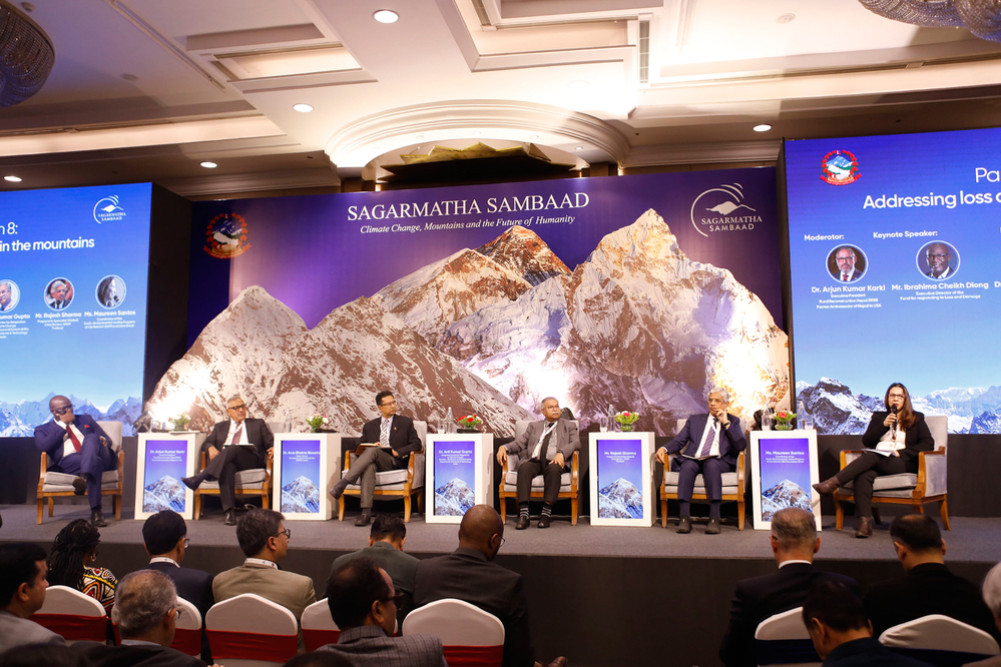
Rather, the development model of the developed nation and the modern lifestyle of its people are more responsible. In this background, Nepal has organized 'Sagarmatha Samvad' from Friday to Sunday focusing on the main concept of 'Climate Change, Mountains and the Future of Humanity' i.e. 'Climate Change, Mountains and Human Future'.
It is relevant to make climate change, which is Nepal's main issue on the international stage, the core concept of the first edition of the Everest Dialogue. 350 people including 175 foreign guests participated in the multi-stakeholder forum 'Sagarmatha Samvad'. In this process, 13 sessions have been conducted on Friday and Saturday.
There is a program to announce 'Sagarmatha Samvad 2025' on Sunday. This has increased the possibility of more debate on the issues of our main concern, gaining international interest and support through foreign guests, and strengthening cooperation with other countries and organizations to minimize the negative effects of climate change.
Preparations for 'Sagarmatha Samvad' started five years ago. When KP Sharma Oli became the Prime Minister for the second time, the date was fixed for Chait 20-22, 2076. But at that time it was postponed due to the epidemic of Covid-19. It is remarkable that the program is being organized even after five years. Singapore hosts the 'Sangrilla Dialogue' with a focus on security issues.
India organizes 'Raisina Dialogue' focusing on various topics like geopolitics, technology, economy, security, climate change. Similarly, there are also popular conferences of different countries like the Davos Conference held in Switzerland and the Boao Conference held in China. Some of these dialogues always focus on the same area, while others focus on different areas every year. Nepal is likely to focus on different topics in the coming days.
However, debating your interests in the style of prestigious dialogue forums of different countries is a positive trend. 'Sagarmatha Samvad' is not a fair where profit is made in cash. Its benefits are linked to long-term and multilateral interests. Being able to bring the international world together to discuss issues of their interest will contribute to the growth of 'soft power'. It helps to enhance diplomatic skills and communicate well. Mainly the case is expanded.
Climate change is an important issue for Nepal. Because, as a negative effect of this, the temperature is increasing. The traditional places of food production are moving to higher altitudes due to the risk of mountain snow melting and glacier bursting. Habitats from animals to insects are also moving higher. This has led to decline in agricultural production and increased food insecurity.
The water source is drying up, the rate and damage of floods and landslides are increasing, the changes such as excessive rain - low rain - no rain are being deeply felt every decade. People's residence, occupation, production, lifestyle, relationship with the environment have all been disrupted.
It is necessary to keep debating the issue of climate change for Nepal and to involve the leaders and experts of other countries in it because they are only responsible for the least but have suffered the most impact. That is why the first edition of Sagarmatha Dialogue is timely. Through such efforts, Nepal can be established as a strong leader in the direction of avoiding the harm of climate change, increasing global and regional partnership and obtaining financial justice from rich countries.
The government had invited 300 foreign guests to participate in the 'Sagarmatha Dialogue'. Also, it was expected that the presence of executive heads from neighboring countries that are in close economic-diplomatic relations with Nepal and are suffering from the effects of climate change. Despite the presence of 175 foreign guests, none of the country's executive heads attended.
Environment Minister Bhupendra Yadav from India, a bordering neighboring country, and Xiao Ji, Vice President of the Standing Committee of the National People's Congress from China, participated. Many ministers from other countries have participated. This confirms that our diplomatic initiative is very weak. Therefore, the expected impact of the dialogue on climate change organized by the 'country of Everest' on the international stage is going to be weak.
Similarly, the government failed to make the 'Sagarmata Samvad' a national festival of debate and discussion. Such references seem to have weakened the preparation of the program. However, being a first program, some weaknesses can be learned and improved. The base camp of Sagarmatha Samvad has been prepared . A strong and effective journey will take us to our destination.