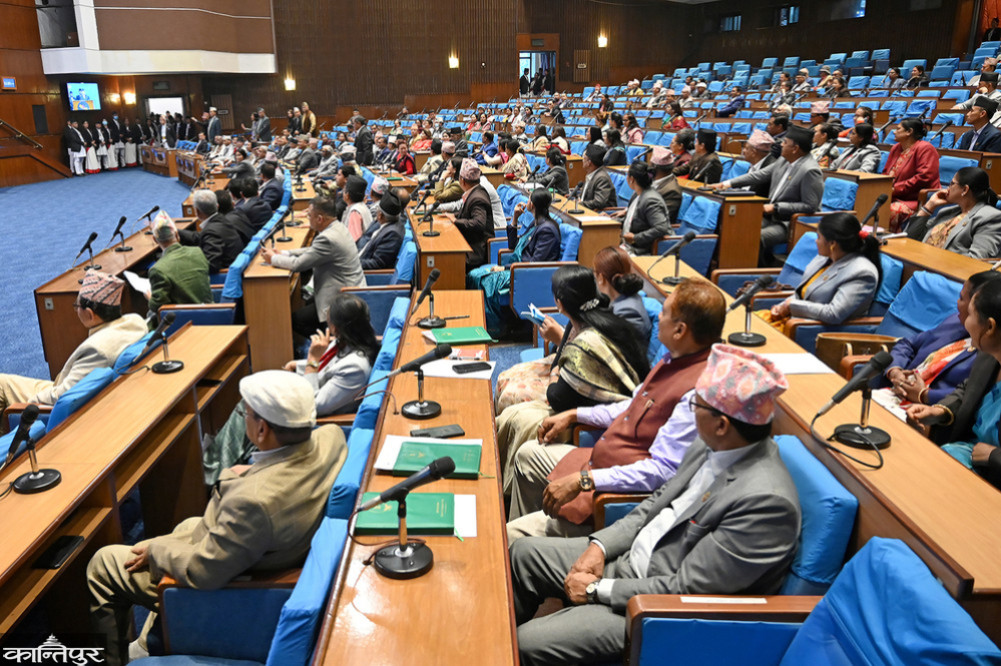
Most MPs' understanding of development is still traditional. Disruption is necessary in the tradition of considering development as roads, bridges and buildings. If the budget is allocated considering the social indicators as the basis of development, the people of the constituency will get proper benefits.
We use Google Cloud Translation Services. Google requires we provide the following disclaimer relating to use of this service:
This service may contain translations powered by Google. Google disclaims all warranties related to the translations, expressed or implied, including any warranties of accuracy, reliability, and any implied warranties of merchantability, fitness for a particular purpose, and noninfringement.
The government is preparing the budget for the next financial year. As always, this year too, discussions and tug-of-war are going on as to how much budget should be allocated to which schemes in the constituencies of which MPs. For that, from the prime minister to ministers and secretaries, there is a rush of people asking for development and budget plans.
When the national economy continues to shrink, it is natural that the size of the budget allocated to the constituencies will also decrease . But what is the priority of which constituencies when allocating the budget? The parliamentarians who demand it and the officials of the Ministry of Finance who allocate it should also understand . In Nepal, there is a trend of planning and allocating budget on access rather than on facts. Some problems have arisen in the identification and implementation of development needs.
MPs are elected by the voters of the constituency. Voters demand more. On the other hand, they have made many promises during the election. People's representatives who have worked in geography and won the election have immense obligations. That's why the parliamentarians are rushing to the corner of the ministry with a long list of plans. In the 'Budget Mela' held in Sindarbar, voters, local people's representatives, state chief ministers, ministers and parliamentarians and federal parliamentarians and ministers are also seen leaving their ministries and running for another ministry with the same voters.
What are the needs of the MPs and public representatives of their constituencies who are demanding the budget ? What is the access to facilities such as education, health, drinking water, toilets, housing etc. in the constituency? Do you know what kind of caste, age group and economic condition people live in the constituency or not? If not, the plan they make and the budget they take cannot do justice to the constituency itself. The National Census 2078 has revealed some new facts about the demographic and social indicators of the constituency. Let us discuss the indicators of some of these constituencies .
Rautahat is a district with poor literacy rate in Nepal. Zone No. 2 and 3 of this district have the weakest literacy. While the average literacy rate of Nepal is 76.3 percent, the literacy of Region No. 2 is 52.4 percent. Where female literacy is only 45.5 percent. Area No. Even in 3, the literacy rate is only 57.8 percent . There is also 45.5 percent female literacy . In Rautahat Constituency No. 2, which is about 25 percent weaker than the national average, it is appropriate to request a budget for educational programs and other related indicators. Why are children not sent to school from villages? The Member of Parliament of that area should look for the details of these things . For example, is the school far from home? Isn't there a bridge in the river where the road goes? Not being able to go to school due to lack of food? Is it because the parents go to work for wages and not give them food on time? Are you not interested in going to school without understanding the language of study? Not getting lunch at school? Toilets, drinking water, classrooms or not? Is it because of the teacher's torture? Are parents making their children work at home rather than studying? Why is the literacy rate weak? When the literacy rate of a constituency is weak, automatically all the indicators of that constituency fall behind . Therefore, if the parliamentarian requests the budget by updating the data of the mentioned subjects, it will be difficult for the Ministry of Finance to meet such demands .
Most of our parliamentarians' understanding of development is still traditional. Disruption is necessary in the tradition of considering development as roads, bridges and buildings. If the budget is allocated considering the social indicators as the basis of development, then the people of the constituency will get proper benefits .
A few days ago I got an opportunity to travel through Arghakhanchi district of Lumbini province. Even in the hilly districts, the roads have reached almost everywhere . But the road network of this district is surprising. Nagbeli roads are visible as far as the eye can see. Many roads in this district made of Samthar hills are black. When the road was built, the residents of this place have been remembering the former minister and MP of this district (suspended) Top Bahadur Rayamazhi. After seeing the roads, I asked an old man while going down Sandhikhark, 'Why do you need so many roads?' The old man said in a sarcastic manner, 'To sit and walk.' Due to external migration, the population growth rate of this district is decreasing annually at the rate of -1.05 percent.
The houses along the black-paved road were found empty in the slums of Arghakhanchi, which looked thin but beautiful. According to a young man who deals in sakhkhar in Chhatredeurali rural municipality of Arghakhanchi, which is on the border of Gulmi, there are no roads here, people need employment programs even if it is small. The need of this district, which is also the constituency of Chief Minister Chetnarayan Acharya, is a program and budget to stop the migration in large numbers.
Even in terms of demographics, there is no homogeneity in the constituencies . The constituency with the highest population is Kathmandu-2. The population here is 268 thousand 169. Then there are Rupandehi-2, Bhaktapur-2, Chitwan-2, Sunsari-2, Lalitpur-3, Bardia-1, Surkhet-2 and Baitadi respectively. The least populated constituency is Manang. Where the population is 5 thousand 658 . Then there are Mustang, Dolpa, Rasuwa and Humla . All these districts have only one constituency. In the population of Nepal, there are more women than men. But in the constituencies of Terai and some urban areas, the male population is more and the sex ratio is above 100 . It has 129.4 and 121.7 percent of Manang and Mustang respectively . The sex ratio of Kathmandu-1 is 114.1 percent. Parsa, Bara, Kathmandu-10, Rasuwa and Sarlahi-4 are the districts with high sex ratio. This means that employment provision is relatively good in these constituencies . The message is that the youth are stuck in the village after finding employment in the village. Based on this data, it is appropriate for MPs of these constituencies to prioritize employment and youth targeted programs in the budget. On the other hand, Pyuthan (81.4), Gulmi 1 (82.8), Palpa-1 (83.3), Arghakhanchi (83.7), Gulmi-2 (83.8) etc. are constituencies with low gender ratio. It is unlikely that there will be a large number of young people in these constituencies working abroad. It is relevant when the parliamentarians of those constituencies demand a program to keep the youth in the village . Although Nepal is culturally a society living in a joint family system, that culture is gradually being fragmented . According to the National Census 2078, about 60 percent of the population lives in a single family. In terms of constituencies, this rate is very high in three districts of Himal. More than three quarters (75.4 percent) of people in Dolakha district live in a single family. In Sindhupalchok and Solukhumbu, 70.9 and 70.4 percent of the population lives in single families.
Parliamentarians should also take into account the diverse characteristics of the population in their constituencies when proposing social security programs. For example, the situation of the dependent population in the constituency, the population of single and widowed women, the situation of child marriage, etc. should also be asked for a plan and budget. The constituencies with the oldest population are Syangja-1, Gorkha-1 and Dhading-1 . Of the total population of these constituencies, 19.2, 19.0 and 18.2 percent respectively are above 60 years of age . While 9.6 percent of the total population in the country is elderly. These constituencies seem to have aged . It seems that the MPs of these areas should give high priority to care programs for senior citizens. The constituency with the highest population of young people is Kathmandu-1. Where the population of 16-24 years age group is 22.7 percent . The majority of this age group is also seen in areas No. 2 and 6 of Kathmandu . Child marriage, which is a form of social evil, is high in Dhanusha district, the capital of Madhesh province. Constituencies 2 and 1 of this district and district Surkhet-1, which is the capital of Karnali province, have high rates of child marriage. Among the married population of these regions, 29.3, 27.5 and 26.4 percent of the population have child marriages.
Census has also analyzed the situation of slum dwellers in the proportion of families living in their own homes. Deravasi population is high in nine constituencies of Kathmandu and Lalitpur-3. 12.8 percent of the total families in Nepal live on rent. But in Kathmandu-1, 62 percent of the families live as tenants. In Kathmandu-6, 60.6 percent of the families live as tenants. In Rautahat-2 of Madhesh Pradesh, the lowest 0.27 percent of families seem to be living on rent.
Regarding drinking water, it seems that tap water facilities have expanded more in the Himalayan region than in the plains. For example, Manang, Taplejung, Solukhumbu, Rasuwa and Darchula, which have only one constituency, have access to drinking water facilities. In which 98.2 and 96.5 percent of families in Manang and Taplejung respectively have access to tap water. 95.2 percent of the population of Gulmi-1 has access to tap water. 94.4 percent of the families of Rupandehi-2 have access to tap water. In Nepal, there are only 2.1 percent of families drinking water from open wells or wells, and 8 to 15 percent of the families in constituencies 1 and 2 of Sindhuli, Dhanusha-1 and 4, all three of Dang, Udaipur-2 and Makwanpur-1 are forced to drink water from wells or wells. This data shows that the parliamentarians of that constituency should lobby for the plan of distributing clean drinking water to their voters . Because the ratio of clean drinking water of the people of these constituencies is very poor compared to the national average .
Cooking fuel is considered as an indicator related to family members' health, economic status and local level development . 51 percent of families in Nepal still cook food from kathdaura . 44.3 percent cook food using LP gas. But in Humla district, 98.5 percent of families cook using firewood, 95.2 percent in Baitadi, and 94.1 percent in Achham-2. It seems appropriate for parliamentarians of these areas to give priority to the firewood replacement program . Kapilvastu-3 and 2 have the highest number of households without toilets. While 4.5 percent of families in Nepal do not have toilet facilities, 32.6 and 23.2 percent of families in these constituencies respectively do not have toilet facilities. The condition of toilet facilities in the constituencies of Madhesh province is very poor.
If we look at the weak 10 constituencies in terms of house structure, all of them are in Madhesh province. According to which 57.03 percent of the houses in Sarlahi-4 are unroofed. 54.75 percent of Parsa-3, 51.67 percent of Mahottari-4 families are living in mud houses. About 100% of residents of Kaski-2, 1 Rupandehi-1 live in concrete houses. In these areas, 98.7, 98.4 and 98.3 percent of families live in concrete houses respectively. One of the reasons
results are reversed in every election is new voters . As the flow of people's migration is increasing, especially towards the urban and federal capitals, if people's ambitions are not addressed, the result will be counterproductive . According to the data, Kathmandu-1 has the highest number of migrants among the 165 constituencies of the country. Where 57.5 percent of the total population has migrated from another district or local level. 52.5 percent of the population in Bhaktapur-2 and 52.4 percent in Kathmandu-6 have migrated from other places.
From some of the representative indicators mentioned above, it is known what the condition of the constituencies is. Parliamentarians should study these indicators in detail and prioritize the needs of their constituencies. A public representative should look at the data and determine what can be improved in five years while starting the post-election work . It is also the responsibility of every parliamentarian to show the voters what has been improved in the target every year. For that, let's make a plan based on the data, let's allocate the budget based on the data. It helps to correct developmental disturbances and imbalances.