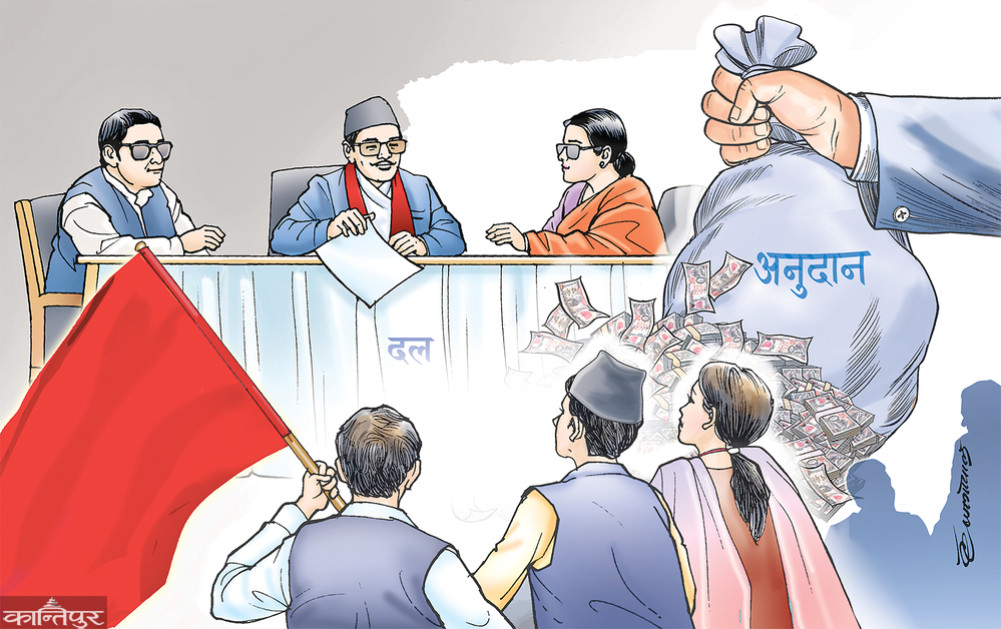
Although it is easy to give subsidies after the first election, there are two types of parties that participate in the subsequent elections - subsidized and non-subsidized. Doesn't this violate the basic ethical basis of elections that the playing field should be equal for every candidate?
We use Google Cloud Translation Services. Google requires we provide the following disclaimer relating to use of this service:
This service may contain translations powered by Google. Google disclaims all warranties related to the translations, expressed or implied, including any warranties of accuracy, reliability, and any implied warranties of merchantability, fitness for a particular purpose, and noninfringement.
Opinions of learned writers have been published from time to time in different media in favor of giving grants to political parties from state funds. It has been reported that the high-level Economic Reforms Suggestion Commission formed under the chairmanship of former Finance Secretary Rameshwar Khanal has included this issue strongly in the report submitted to the government recently.
The democracy we accept is a multi-party parliamentary system. A political party is a social organization formed for the proper participation of individuals in the political system with their collective feelings, thoughts and free will. There is constant competition between various parties for participation in state management. The right to form the government is given to the party that has or is able to achieve a majority in the House. Therefore, political parties and elections are two indispensable elements for democracy.
Financial resources are necessary for the operation of political parties and participation in elections. Which he receives from membership fees, party tax (levy), donations (individuals), industrialists, traders etc. and income from government funds. The party that has more members gets more money from membership fees. Donations from individuals are equally important. Because parties are social institutions, personal donation is also a means of communication between organizations and individuals. When a person or party takes donations from rich businessmen, industrialists, criminals, there is a possibility of making laws for their benefit. That's when political corruption happens.
Chairman Khanal (Kantipur Daily of 2082-01-04) has clarified the need for state subsidy in an objective manner. Candidates wear their wealth to compete in the election. After investing their huge wealth in elections, many engage in unethical activities to get it back. Constituency development program spends wildly. Participates in awarding contracts. They act like asking for shares in an unauthorized manner. In order to prevent this from happening, he has suggested to arrange a subsidy from the state fund. Also, the candidates have proposed not to use their property in the elections and not to collect personal donations. According to him, the main expenditure in the election is for the candidates to convey their identity to the voters.
is done through radio, TV, public meeting or any other means. Election Commission should be the sure way for that. That expenditure should be met from the state fund. The state does not have to bear all the expenses of the candidate, some part of it has to be borne by the affiliated political party. The party is the only organization that collects donations. The party is audited by the Auditor General. Democracy does not go under the control of the rich. According to him, 3 billion 600 million rupees are needed for the amount of state subsidy. That too only if 18 million voters voted. This amount may be lower if fewer voters vote.
The concept of state subsidy seems to have evolved for various reasons. Such as misuse of state resources and means by parties in government, unequal use of resources by various political elements and unaccountable purchase of ballots are the reasons. State grants are provided for party operations and election campaigns. In some countries, subsidies are given only for party operations and in some countries for propaganda. But there are countries where subsidies are given for both works. According to various studies, 70 percent of 180 democratic countries embrace state subsidies. But based on the number of voters, the situation is quite the opposite.
difficulties
A political party is a social institution and its members are not like government employees. A candidate interacts with voters on various religious, cultural, social, gender, economic and personal levels. It is not only financial transactions, but other emotional factors also play a role.
Nepal is a country with about 20 million voters. These voters are divided into 142 castes. They have 124 mother tongues and they follow 10 religions. Around 70-80 million literate voters have gone abroad. Most of the rural voters who live here do not meet Akshar. Everyone knows about their financial situation. The village has a large population of women, senior citizens and school going children. In such a situation, is it easier for the candidate to introduce himself to the voters only through radio, TV and other media? In an underdeveloped country like ours, the candidate tries to prove to the voters that he is a person who supports them in their happiness and sorrow. They try to get votes by feeding poor voters two bags of meat and rice. They also use financial greed, future cooperation, fear and threats. In such a complex situation, getting voter's vote is not easy like America, Europe and other developed countries. We have seen instances of caste discrimination and money transactions while giving tickets to candidates. It is also well known how much influence the factionalism of leaders has on parties.
Another serious question is the grant the party will receive. Which is based on the votes received by the party or seats in the House and the number of candidates. In this, big parties who are financially strong get more subsidy amount. Since it is difficult for a small party to run a party, it is also difficult to raise many candidates to participate in the elections. Although it is easy to give subsidies after the first election, there are two types of parties that participate in the subsequent elections - subsidized and non-subsidized. Doesn't this violate the belief that the playing field should be equal (flat) for each candidate, which is considered the basic moral basis of the election?
In fact, the system of state subsidies requires a candidate to bear financial expenses at various stages before entering the election arena. Aspirants pay party membership fees from their own pockets, which their friends have to pay, because they have to please the members. From rural municipality wards to get party tickets, he reaches the central office by pleasing his supporters, leaders of his faction at various levels, through districts, provinces, where his fate is decided. It doesn't matter how popular the person is in their field. It is our social and cultural legacy, which will be difficult to break, as to who will account for the expenses related to the candidature stage.
options
1. Instead of the financial subsidy received from the state, the goods used for campaigning could be provided to the candidates. If we can provide leaflets, tul, public meeting venue and mics along with other equipment to the candidate, it will reduce the dependency of the candidate on donations considerably.
2. The electoral system we use is first-past-the-post and proportional. Hence, both these electoral systems have shortcomings. In a first-past-the-post electoral system, candidates spend heavily to ensure their victory. It seems to be a drain on money and not appreciated by the majority. In a proportional system, the top leader dominates and the honest, hardworking and poor workers suffer. Therefore, a new joint electoral system should be developed by removing the shortcomings of both these systems and incorporating the good aspects of both. It is necessary to reduce political corruption, to protect the public's faith in democracy, and to make honest workers of normal economic conditions participate in the elections. It is necessary to minimize the influence and direct participation of other influential people including the neo-rich, criminals, contractors and moneylenders, to give a moral and fair form to the democratic system through proportional representation, and to connect democracy with the people and voters through a system of direct first-in-command election. Its process will be as follows:
The candidate's constituencies are also specified in the list submitted to the Election Commission by embracing the proportional system. According to this, candidates are elected on the basis of each constituency, like the system in which the party's candidates get the most votes first, and the parties get representation like the proportional system. That is, representation or representation number is obtained according to the percentage of total votes received by the party. On the basis of the selection of representatives, instead of the serial number of the list, the elected representatives of the party are elected on the basis of the maximum number of votes received by the candidates of that party from their region.