We use Google Cloud Translation Services. Google requires we provide the following disclaimer relating to use of this service:
This service may contain translations powered by Google. Google disclaims all warranties related to the translations, expressed or implied, including any warranties of accuracy, reliability, and any implied warranties of merchantability, fitness for a particular purpose, and noninfringement.
In the parliamentary system, activities such as MPs expressing their opinions in the parliament, listening to others' opinions, disrupting the meeting, and boycotting have their own direct and symbolic meaning. Such activities are also happening regularly in the parliamentary process. Basically he makes the parliament run. They strengthen the relationship between the government, parliament and the people.
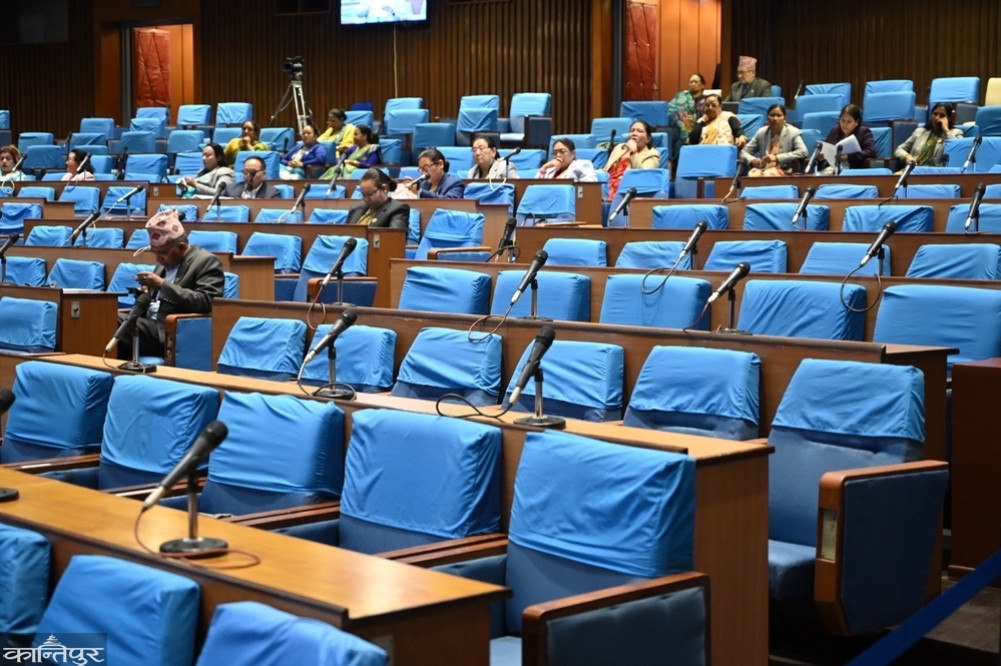
But apart from that, it has been happening to participate in the parliament meeting by appearing and leaving alone. When two or four MPs came or left at any time, it was not a topic to be discussed. We have a tendency to walk out of the meeting en masse so that the chair of the Parliament looks empty. Such cleverness would ensure the allowance of MPs, but it is confirmed that they are avoiding their responsibilities. Finally, the parliamentary dignity itself is devalued. The group questioning the legitimacy of the parliamentary system is gaining strength. Therefore, every MP should respect his responsibility. Party and Speaker of the House and Speaker of the National Assembly should also encourage MPs to participate in the meeting.
After President Ramchandra Poudel presented the government's policy and program on May 19, the discussion has been going on since the 22nd. On the first day of discussion on policies and programs towards the House of Representatives, 52 parliamentarians along with the amendment participated. 208 MPs appeared on Baisakh 24, 210 on Baisakh 25 and 198 on Baisakh 26. All these days had one scene in common - the chairs were empty when the meeting was approaching. Be it emergency time, zero time, special time or special discussion topics like policies and programs and budget, if it is your turn to speak, you tend to speak with interest and then walk away. This is not just a trend that has emerged these days. It is strange that the problems of the democratic period after 2048 persisted even into the democratic republic.
Why MPs are not interested in the meeting? This can be viewed from two angles. First, no matter how many good amendments the parliamentarians put in matters like policies and programs or the budget, no matter how many factual arguments they put forward, their effect is not seen. Government proposals are easily passed because the government usually has a majority in the House. That's why the government does not want to adopt the opinion put forward by its own or opposition MPs. That is why many parliamentarians do not think it is reasonable to speak in the House and listen to the opinions of others in the meeting. Rather than passing what the government has brought, if it can be shown the generosity of including creative suggestions, attendance and participation in the House can increase. It also ultimately enriches the government's proposals.
Second, it is enough to show attendance at the Parliament meeting once. That means the allowance of that day is guaranteed. There is no obligation to stay until the end. That's why he was reluctant to stay. However, this issue is not only related to allowances. It is also associated with the tendency to voice one's opinion but not listen to others. This person's impatience is also the disordered thinking that 'I know myself, why should I listen to others'. An institution like Parliament is also a sovereign forum to express one's views, listen to others and test one's views.
Each MP is sovereign himself. If he decides that he will attend the parliament and fulfill his responsibilities, then it will not be a situation where he will leave the meeting in the middle. Since the parliament session lasts for a long time, it is uncomfortable for the parliamentarians to participate continuously. Like, the meeting on Baisakh 22 lasted for more than 10 hours. During this period, reasons such as fatigue and hunger motivate to leave the meeting. Therefore, it is necessary to discuss the measures to make the Parliament meeting short, efficient and effective according to the time reference.
Even if the top level leaders of the party do not give time for the meeting, the rest of the MPs do not consider it necessary to sit. As the Prime Minister is the executive head, he can not address the Parliament for a long period of time. But if other leaders of his party, the chairman of the ruling partner Congress, the chairman of the main opposition party Maoist Center, etc., would give time to the parliament and actively participate in the meeting, there would not be a situation where the chair of the parliament would have to wait for the parliamentarian.
Making the parliamentary system effective, making its justification more effective is the work of the parliamentary parties. Therefore, they should motivate their MPs to show more presence in Parliament and raise the issue effectively. Political parties have a tendency to not use it effectively as long as there is a parliament and sometimes to give up when it is lost.
2059 After the dissolution of the then House of Representatives on October 18, 2059, the parties had to fight hard with the then King Gyanendra to bring it back. Had to deal with autocracy. Realizing the importance of Parliament at that time, the Parliament meeting was held in Ratnapark. The last time in December 2077 and May 2078, when the parliament was unconstitutionally dissolved, the parties fought on the streets and in the courts. But whenever Parliament is available, the parties do not seem to understand its importance. This trend should be reformed.