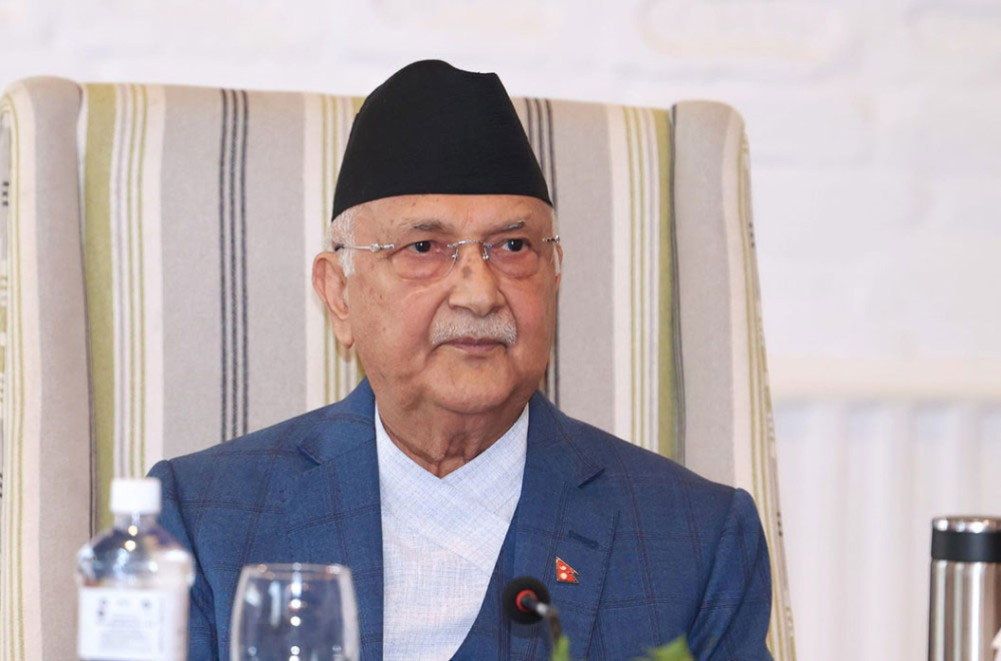
This suggestion may not be acceptable for both types of UML who are competing to 'enslave' Oli and trying to bring the former president to the party. However, if the UML is to reform, the search for a third strand is a must.
We use Google Cloud Translation Services. Google requires we provide the following disclaimer relating to use of this service:
This service may contain translations powered by Google. Google disclaims all warranties related to the translations, expressed or implied, including any warranties of accuracy, reliability, and any implied warranties of merchantability, fitness for a particular purpose, and noninfringement.
Prime Minister and Chairman of CPN-UML KP Sharma Oli is two years younger than Nepal Communist Party. Before he was born, on April 22, 1949 i.e. on 10 Baisakh 2006, Nepal Communist Party was established in Calcutta, India under the leadership of Pushpalal Shrestha. The 74-year-old Oli celebrated the 76th anniversary of the founding of the Communist Party two weeks ago.
Oli was angry while celebrating the birth anniversary of the Communist Party. He was saying, 'We want UML without KP Oli and Nepal without UML. Let's see in Mission 84, Nepal without UML or what Nepal without K?' He added, 'Those who are looking for my alternative, wait 20/25 years now.' When Oli said this, the participating workers applauded.
leaders say one thing today, another tomorrow. Oli is no less in this matter. On the face of it, this expression can be taken lightly. It is impossible not to be interested in the fact that it is said for the political consumption of the immediate action-reaction. However, the expression that the party will not leave power for 20/25 years is undemocratic and arbitrary. This is a matter related to the constitution and values of the party. Therefore, Oli's speech needs more discussion.
Has Oli Mansuwa, who will remain in the party leadership for the rest of his life, been approved by the UML ranks? Or did he say this because he was distracted by the search for alternatives in the party? How much justification is there for Oli's 25-year ambition when the public opinion is growing and does not want to see a top leadership government or party in power for even a minute? And how justified is the attempt to move former president Vidya Bhandari to replace him?
The ongoing debate in UML regarding the issue of leadership has raised many such questions. This analysis will be focused in the light of the above questions relevant to the political future of this party.
Is Oli Nirvikalpa?
Oli feels that he has no choice in the leadership of UML. Therefore, he aspires to remain in leadership for the next 20/25 years. In other words, if it is as he thinks, he will be the leader of UML until he is at least 94 and at most 99 years old. His answer to those who call him sick is, 'Pohor-parar, my health is weak, now it is fine. No need to worry about my health.'
We wish Oli a healthy life and long life. However, his 'good health' will not be a factor in UML's defeat? The reins of power are in his hands. Whether there is a government or not is the same for the people. However, after 'Mission 84', he calls for stability and prosperity and raises the ambition to keep the Akantak Party in power.
Is the provision of electing leadership in UML completed?
In a democracy, parties run on statutes and values. There are regular processes of leadership selection. UML also has a method of electing and renewing the leadership by the convention based on the political program for a certain period. However, ignoring all of them, everyone is silent when the statement that the basic rights of 'sovereign' members are humane comes from the top leader.
Also, Oli is always excited to break the laws and regulations. How he was repeated as the leader of the party in the 10th Congress, how he removed the 70-year limit, that is what the world has seen. His undemocratic practice of dissolving the parliament is widely known as an example of authoritarianism during the republican period. In retrospect, Oli's self-proclaimed leadership for 20/25 years may not seem new. However, it is not natural for UML, which was once called for internal democracy, to sleep like this. Not a single leader/activist raised the question. However, when the question was raised, some of them took action and some of them were expelled from the party.
UML basically has three tiers of leaders/activists. First, the blind devotees of Oli. No matter what he says, no matter what he does, those who say 'I love you ba' to him. Second, those who distanced themselves from him and came to the conclusion that his style of work had harmed the party. This line does not dare to directly oppose Oli, but is trying to create an atmosphere for alternative leadership inside. Probably Oli's 25 years of ruling the party is aimed at this line. Third, the silent row. There is a large section in UML that disagrees with Oli's activities but remains silent because of his terror. These three types of UML trends are the factors that raise Oli's ambitions.
As far as Oli's intention to remain under the leadership grows, the volume of UML's political losses will increase accordingly. And, as it erodes, so will his own surviving political earnings. Oli's main calculation in Nepal's political change is based on the conflict days. In other words, fourteen years of prison life is the main 'certificate' of his politics. He spent a long and painful prison life for political change. He himself repeats the story of that struggle from time to time. However, the history of that struggle cannot become a 'license' to keep Oli in the leadership of the party until his death.
Oli has had more opportunities than what he contributed. How efficient and successful a leader he was, that is the key to his evaluation. Oli, who has been minister/deputy prime minister and four times prime minister, is one of the lucky leaders of UML, who has been able to hold power for a long time. At one time, when the party was under collective leadership, these were in the 'core' team of the main leadership. After the 2070 election, he was elected as the leader of the UML parliamentary party. Soon after, he was elected as the president of UML's ninth national convention held in June 2071. He became the Prime Minister for the first time in October 2072.
It has been more than a decade since the rise of Oli in UML. Meanwhile, he became the prime minister four times. He became the chairman of the 'Powerful CPN', which was made up of two communist parties. He became the prime minister of a strong communist government with a two-thirds majority. And now he has become the Prime Minister for the fourth time with the support of the largest party Congress. During this time, the list of things he could not do was longer than what he could do. Oli received applause when he stood firm against the
blockade, or when he advanced important agreements/understandings with China including transport, or when he released the Chuchhe map with Lipulek from the parliament. He was in adversity when he first became the Prime Minister. The way he coped with the environment of that time, it created trust in him. However, in the following days, due to power frenzy, self-praise and arrogance, the trust in him was lost, the image was blurred. It didn't take long for his nationalism to appear 'fake', when he was having a secret meeting with an intelligence agency official in Baluwatar.
The failed attempts to dissolve the parliament, the party split one after the other, destroyed the faith in the communist leadership including Oli. Against this backdrop, he missed the opportunity to prove himself for the fourth time. Due to the increase of conflict within the party and with fellow travelers, the domestic adversity is increasing, and the external adversity is not less. Especially since the relationship with the neighborhood could not be balanced, the coldness has increased. Many agreements/understandings made with China are neglected, while relations with India are not being improved despite many efforts. From the eyes of the common people, there is no feeling of a government anywhere. Opacity and mismanagement have crippled the government.
No need to give many other examples to measure Oli's failure. The changed 'position' of former President Vidya Bhandari is enough to describe her failure. At one time, Oli became the protector of ambition. Now Oli has come to the conclusion that he is unable to carry the weight of UML. Despite criticism from all sides, Bhandari has started a campaign to oust Oli, demeaning the presidential dignity. She is saying, 'The cooling period is over, I am ready for leadership.'
The UMLs who are sidelined by Oli feel that this option is appropriate to 'address' Oli. According to one UML leader who thinks so, she is suitable for UML leadership for three reasons. First, she can create an atmosphere of unity building among scattered communists. Two, Oli will only leave the chair if he has to. Thirdly, Madan Bhandari's wife is also entitled to inheritance.
However, these options are neither politically nor morally appropriate. No law or constitution prevents former presidents from joining politics. However, this is more of a moral question than a legal or constitutional one. Party leaders do not tire of saying that democracy is an advanced system. An alternative to democracy is called advanced democracy? Shouldn't it be applied in practice? Decisions made based on the interests and whims of limited political factions or individuals do not advance democracy.
Bhandari got the rare opportunity to become president twice. It was a matter of pride for a woman to reach the highest office of the country. However, some of his controversial roles during that time did not give him a place to be proud of. Now he is making another 'blunder' by trying to return to politics. The efforts that are being made to return the person who has taken the parental leadership of the country back to the special party will attack the concept and dignity of the presidential institution. This trend will further weaken the values and methods of democracy.
Another thing, in what sense can she be different from Oli? What is his formula for improving the UML? If he comes to UML, there will be happy news in Oli's persecuted section, but it will not bring back the damaged reputation of this party.
The third strand
UML's current main crisis is the search for leadership to bridge the deep gap in its relationship with the people. UMLs can say that despite the party split in the last election, UML became the second largest party. Even now there is a presence in all the three governments, federal, state and local. If necessary, two to five thousand workers have been mobilized on the road.
Even though the UML line trying to justify it, the fact is that the general public's attraction and trust towards this party is getting fragmented. In the past, when people's issues were raised, thousands of people came down on the streets on the call of this party. Today's demonstrations of the party, which is called to conduct mass mobilization, are ridiculous.
Are the 'people-oriented issues' raised by UML alive or confined to documents? The question is raised. Therefore, there is a need for a third party in UML, which is losing public trust. This suggestion may not be acceptable for the UML, which is competing to 'enslave' Oli and trying to bring the former president into the party. However, if the UML is to improve, the search for a third strand is a must.
From top to bottom, this party has become a victim of unhealthy factionalism. Internal democracy is so weak that the Oli tendency is everywhere. At least in the past, UML had a tendency to debate and constructively criticize political programs. Even today, UMLs use pasted copies of political reports to make pamphlets but do not repeat them. Leaders and factions have become the basis for assigning management responsibilities. At least the third strand can legitimately establish the issue of choosing leadership and changing leadership based on political policies and programs.
Despite being divided dozens of times, communists never stop talking about unity. Now, the attempt to bring former President Bhandari back to politics is also being sought to be justified by the issue of left unity. But why the left unity? Looking at the examples of the past, the mergers were done for the request and management of the parties and some leaders, the consequences of which were not only suffered by these parties but also by the country. Therefore, a third strand is needed to make the issue of left unity and front bandh justifiable and meaningful. Party unity or front bandh will not be sustainable for the old face and ego management of the same leader. The
is the core question, transparency and accountability. Big parties including UML and their leaders/workers are under question in all economic, moral and political aspects. Due to his opaque and unresponsive character, there is extreme frustration among the public. In this background, it would be wiser for the UML to look for a third option from a new direction rather than getting stuck with the options of Oli or Vidya.