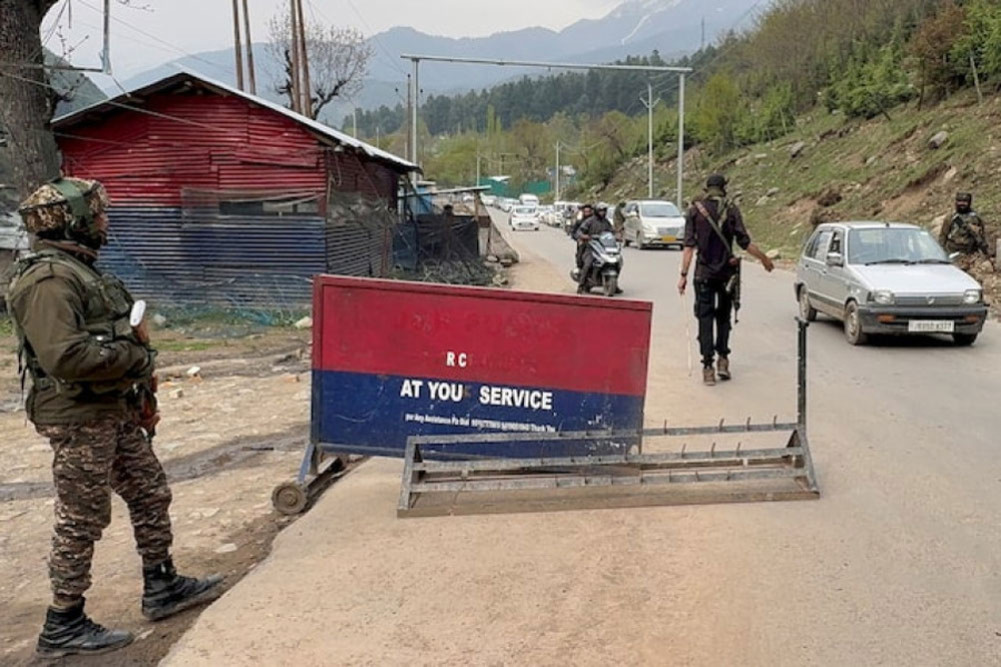
If there is a war situation between India and Pakistan, it will directly affect Nepal, our security strategy should be serious
We use Google Cloud Translation Services. Google requires we provide the following disclaimer relating to use of this service:
This service may contain translations powered by Google. Google disclaims all warranties related to the translations, expressed or implied, including any warranties of accuracy, reliability, and any implied warranties of merchantability, fitness for a particular purpose, and noninfringement.
The terrorist attack in Kashmir's Pahalgam on April 22 that killed 26 people, including a Nepali citizen Sudeep Neupane, has shocked India.
After the incident, Indian Prime Minister Modi cut short his visit to Saudi Arabia and returned. On the day of Swedash's return, an emergency meeting was held with the Foreign Minister and National Security Adviser at the airport.
India has since warned of retaliation. The Union Ministry of Home Affairs is continuously meeting and strategizing with all the Border Security Forces under it High-level security meetings are also being held in Kashmir. Especially in countries bordering India, high vigilance is increasing.
India, which is not comfortable with the current coalition government, sent the head of foreign affairs department of Bharatiya Janata Party, Vijay Chathaiwale, to Nepal after the Pahalgam attack. Prime Minister KP Sharma met with the leaders of the political parties represented in the Parliament and the second level leaders and left a message about the latest security situation in India and that there should be no weakness in the border area of Nepal.
India is very serious this time. Prime Minister Modi has also appointed former RAW chief Alok Joshi to the Security Advisory Board. This shows that India is preparing for a planned retaliation to the Pahalgam attack. Despite the assessment of security challenges in Kashmir's tourist spots and places with no transport facilities, a review is also underway in India on how that day went wrong.
The day after the attack, Lt. Gen. DP Pandey, who recently retired after assuming the command of the Kashmir region, said that security forces cannot be present in every corner and the first source of information is the local citizens, but it is a matter of concern how the information was missed on April 22. His argument is that a tourist spot was chosen for the
attack, and after a long reeking, the place of escape was also decided and Hindus and Muslims were killed for the first time. However, after the April 22 incident, India seems to be very worried about its security situation, while relations with another SAARC country, Pakistan, have once again created a very uncomfortable situation. Which is not good for the security of South Asia.
India is now on high alert to control possible infiltration from all its border areas. The most interest of which is on the border towards Nepal. Due to the open border with Nepal, India's biggest concern is that the Pahalgam attack and any suspects from that group cannot escape. For Nepal, the deployment of Indian security forces is high in the western border crossings which are close to Kashmir.
Status of Bangladesh and Afghanistan
While India is under tension, the political situation in Bangladesh is also posing a risk to the security of South Asia. On August 5, 2024, Andonal of Bangladesh forced Sheikh Hasina to leave the country. After the deportation of Hasina, who is currently under Indian protection, India has strengthened its security arrangements in the border area with Bangladesh. Movement of Hindus in Bangladesh, those demanding a separate Hindu state are also active in Bangladesh. The management of Rohingyas displaced from Myanmar is becoming equally complicated.
The situation in Bangladesh is also increasing concern in the border region of Nepal along with India. India has deployed the Border Security Force (BSF) to protect the borders of Bangladesh and Pakistan, while the SSB is deployed to protect the borders of Nepal and Bhutan. But there is also a risk that those who came to India by fleeing from Bangladesh or infiltrating can also abuse the eastern border with Nepal. In South Asia, tensions between Pakistan and India, internal problems in Bangladesh are both causing the most security risks.
On August 15, 2021, the number of people who left the country was large after the Taliban took power in another SAARC member country, Afghanistan. The Taliban government is still not recognized by the United Nations. Those displaced from Afghanistan entered Nepal using the open border. Even now, the Taliban government has not been able to convince people that there are no security challenges due to them in South Asia. Facts are coming out that the US military is selling weapons left behind in Afghanistan. These incidents show that South Asia and SAARC countries are now in a complicated security situation.
The risk of open borders
The increasing conflict in South Asia and SAARC countries will have an impact on Nepal's border security. When those countries are facing bilateral and internal problems, the security agencies are sensitive that criminal groups should not abuse Nepal's open borders. The Armed Police Force is increasing its presence while the Nepal Police is also on high alert.
However, 24 districts border with India. Since all of them have open borders, more vigilance is needed than in the past so that those who have been displaced and fled from other countries in South Asia can enter Nepal. If there is a war between India and Pakistan, it will directly affect Nepal. In that case we have to be serious about what our security strategy will be.
Border security may not be possible with the single effort of armed police alone. The role of the National Investigation Department, which is the most intelligence agency, is important. RAI should be able to collect information about the possibility of entering Nepal using internal routes other than those monitored by the armed police force.
Because it is found that criminals and terrorists are using the borders of Nepal, India will not only show displeasure, but it can also be dangerous for Nepal's internal security. The Government of India has given freedom of action to the Army and other military forces responsible for military operations. Even if there is a situation of military conflict between India and Pakistan, there is a risk that those displaced from there may choose the path of Nepal because of the open border.
According to the data provided by UNHCR to the Nepal government, 19,600 foreigners from 14 countries are currently living in Nepal after seeking refugee status. including Afghani, Iranian, Iraqi, Myanmar Rohingya, Pakistani, Somali, Ukrainian, South Sudanese and Russian.
All those who come in this way have used the open border and air border of Nepal-India. The use of Nepal as a safe place by the displaced persons is very sensitive for the long-term national security of Nepal. Don't mistake
Russia-Ukraine and Hamas-Israel wars have made the regional security situation very complicated. In the meantime, the security situation in the neighboring countries of Nepal is not so easy. In this situation, it is not enough for the security organization to strengthen the security system of Nepal, the Ministry of Home Affairs has the most important role.
How security officers and chief district officers are selected to be sent to border districts and provinces will determine the security situation there. If the Ministry of Home Affairs pressures Nepal Police or Armed Police Force district chiefs and provincial chiefs to send them who are weak and unable to understand the current situation, all of us may have to suffer the consequences.
In the current situation, there is a need for an agreement on the border with India and officers and chief district officers who can coordinate with the Indian security personnel. – Dhamala is a journalist of Kantipur Television.