An objective answer to the question of who is primarily responsible for political instability, anti-mandate opportunistic alliances, poor delivery, democratic system and the loss of credibility of the state apparatus is now required.
We use Google Cloud Translation Services. Google requires we provide the following disclaimer relating to use of this service:
This service may contain translations powered by Google. Google disclaims all warranties related to the translations, expressed or implied, including any warranties of accuracy, reliability, and any implied warranties of merchantability, fitness for a particular purpose, and noninfringement.
It has been almost a decade since the Constitution was issued by the Constituent Assembly in Nepal. Although this is technically the 'seventh constitution' in terms of constitutional development, it is the 'first constitution' made by the elected representatives of the people.
Because, all previous constitutions were guided by someone's grace, gaze, decree or order. Therefore, according to the principles of constitutionalism, it could not be considered as a constitution. The legal development of democracy should not be based on 'constitution' but on 'constitutionalism'.
In countries around the world whose constitutions have lasted for a long time, they have some common features. They are not made narrow, awkward and rigid.
s are neither ugly nor incomplete. Changed power relations, political and social awareness levels, empirical reality, contemporary era awareness and public expectations are their common characteristics. Objective, scientific and judicious amendment is a special feature of a flexible constitution, which can ensure political stability and democratic continuity. And, it can address the public dissatisfaction that arises over time.
How is our constitution? And how was the journey of its decade-long implementation? It is time to review the experience of a decade since the implementation of the Constitution of Nepal-2072. This was also seen in the sixth plenary meeting of the Eighth Central Committee held on January 21-23.
Since then, President Prachanda has repeatedly expressed such thoughts and feelings. In a recent interview, Prachanda said that the experience and results of the implementation of the constitution should be reviewed and that it is good for democracy to have political course correction through the parliament. Especially, coming from one of the main partners of the constitution making such an idea and expressing the idea that we should move forward based on the constitutional experience makes a lot of sense.
Currently, it is heard that there is "outrage, protest, complaint, dissatisfaction and disappointment" in the public discussion. It is said that the basis of the royalist demonstration, which reached the level of violence, arson, looting and vandalism a few weeks ago, is the expression of this anger. Often popular discontent and impasse are unlikely to be resolved without 'major reforms'. An extraordinary problem calls for an extraordinary solution. And, the intention of that extraordinary solution can be seen in the Maoist chairman's idea of "a decade of constitutional implementation should be reviewed".
The altered balance of power
The balance of power in Nepali politics is slowly changing. In particular, after the formation of the current coalition government of two major parties, Congress and UML, CPN (Maoist Center), which has become a major opposition party, was estimated by some to become weaker in the following days. Some saw this as the sharpest point in Maoist's downward spiral.
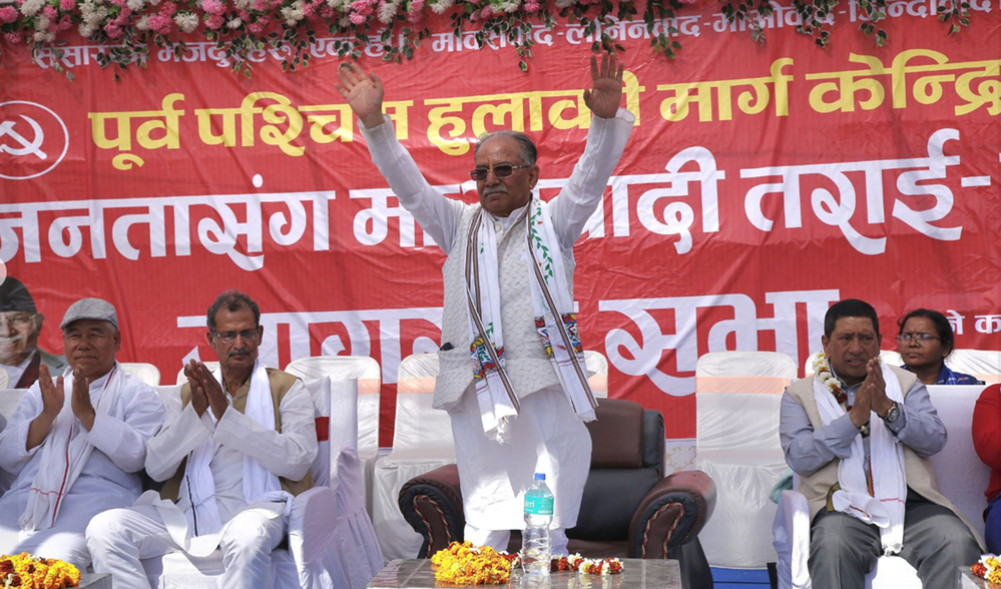
On the basis of that, the mentality of moving forward by killing or ignoring the Maoists was developed in the ruling party. However, looking at the local level by-elections of last November, the recently concluded SWVYU elections, the enthusiastic public participation seen in the Maoists' Terai-Madhesh Awakening campaign and the mass of people who turned up at the Samajwadi Morcha meeting in Kathmandu on March 15, it is confirmed that the Maoists are not as weak as they thought, but are getting stronger. Therefore, it is no longer possible for anyone to ignore Maoist power and move forward.
In the meantime, when the regressive and autocratic element increased the undesirable pressure on the Federal Democratic Republic, the greatest concern and readiness to respond quickly was seen only in the Maoists. The 'monarchist demonstration' was an immature and impatient act of 'psychological warfare' and 'restoration of the monarchy' through the creation of hauguzi against the republic without any objective basis.
It was necessary to give a strong answer, to dispel the fear of 'ghosts' from people's minds and to 'dismiss' them. It was also led by the Maoists through the Samajwadi Front. In this way, it has been confirmed that the concern of the republic is mainly the Maoist center and Prachanda as the leader. This means that the Maoists are not only powerful but also in ideological leadership.
President Prachanda had said in the parliament meeting on February 27 - 'In the history of republics around the world, many histories of monarchy are found written in blood. However, Nepal became an exception to that. This is a testament to our originality and generosity. The history of the republic in Nepal has been written by not only violence against the former royal family, but also by giving the former king a safe place to stay for the time being.
If anyone thinks that this history was forced by revolution, it will be a big mistake. If generosity is seen as a weakness, history can be presented very coldly. If one thinks that the Nepali people who have become sovereign will become Raitis again, there can be no bigger delusion than that. Find your place in democracy, we don't mind.
Democracy belongs to Prachanda as much as it belongs to Gyanendra Shah. However, if the unconstitutional and undemocratic path is chosen without obeying the basic principles of democracy, the revolution will show its power again.'' First - resistance to reactionary, revivalist elements. Second - continuous warning against the incompetence and worthlessness of the Congress-UML government. Third – Finding ways to address growing public discontent, frustration, grievances and anger. To break the story, the Congress-UML also talked about amending the constitution when forming the existing alliance. However, the preamble of the constitutional amendment made by them was completely different and opposite to that of the Maoists. The Congress-UML was motivated by the intention to abolish proportional elections, end inclusiveness or maintain a high rate of 'threshold' for the sake of two-party convenience, seeing inclusiveness and proportional elections as a factor in the rise of small parties and political instability. But as the situation is likely to be unfavorable and counterproductive, those parties are now forced to postpone their intention.
What is confirmed from this illustration is that the ruling party's discussion of the constitutional amendment is not for era reform and to fulfill the national task, but for vested party interests. But the Maoists are debating progress. Because, in a democracy, the number of parties is not an important and decisive issue, the main thing is the representation of political aspirations, ideological currents, social diversity and psychology. In this sense, the attempt to amend the constitution for a 'two-party system' or 'two-party ease' was itself inconsistent, unacceptable, reprehensible and ridiculous.
Whatever the constitution is now, this constitution was not the ideal of the Maoist movement, people's war and the party. Maoists made some compromises while making the constitution. Otherwise, there was a possibility that the second Constituent Assembly might dissolve without making a constitution like the first one. Rather than keeping the country in a big constitutional void for a long time, it was a compulsion created by the balance of power of the Second Constituent Assembly for the Maoists to move forward even if it was by making some 'compromise'.
Therefore, the Maoists agreed to release the constitution by holding '25 points of difference', despite the fact that many questions of government form, electoral system, format of federalism, province demarcation/nomination, financial federalism, inclusiveness and social justice were not addressed in the new constitution according to their principles, ideals and beliefs. Today, it is necessary for everyone to remember the issue of those days.
Somewhere since then, it is reasonable for everyone to frown and think that the instability, failure, public anger and general disappointment is not the result of that 'incomplete revolution'. This will give us a new point of view to review the constitution and move forward, which is also the main objective of Prachanda's idea of 'reviewing the constitution and moving forward'.
Congress-UML can't escape the blame by making Maoists and small parties the cause of instability. The tendency to not have the government form and election system as proposed by the Maoists, to adopt the government form and system as per the wishes of the Congress-UML, and to depict systemic compulsion as a characteristic of the Maoists cannot be accepted.
Political instability, opportunistic alliances against the mandate and power equation, weak delivery and the lost credibility of the democratic system and the state apparatus now require an objective answer to the question of who is the main responsible. Is the existing government of two major parties in accordance with the recognition of multi-party parliamentary democracy, international practice and the mandate of the last general election? Not worth it.
However, looking at what happened and what is happening, from the Maoist point of view, it is necessary to get out of the cheap accusations against each other and seriously review the situation. There can be no doubt that it is a review of a decade since the implementation of the Constitution and a pioneering revision of the Constitution to complete the unfinished tasks of the revolution. This is the basis for strengthening the constitution.
This is the strategic way to expand and broaden democracy. which will sow new hope in the lives of the citizens and address the voices raised against the Federal Democratic Republic. Therefore, let's move forward on the path of reviewing the constitution, leading reforms and creating new hope. Maoist, as a serious and progressive political force will always be ready to fulfill its responsibility.
– Pandey is a central member of the Maoist Centre.