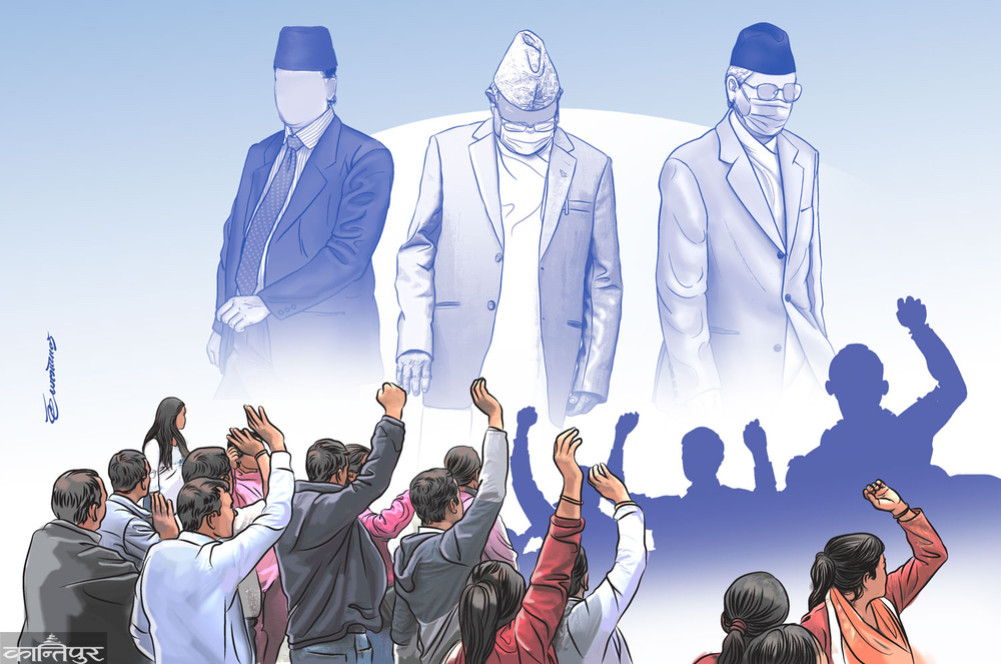
Although the radical change did not transform the society and give competent and good governance, it was successful in shaking the roots of feudalism. Debate and pressure to hold the government accountable is increasing among the people
We use Google Cloud Translation Services. Google requires we provide the following disclaimer relating to use of this service:
This service may contain translations powered by Google. Google disclaims all warranties related to the translations, expressed or implied, including any warranties of accuracy, reliability, and any implied warranties of merchantability, fitness for a particular purpose, and noninfringement.
From 2007 till now, there have been four main changes in Nepal. Even though it has reached a democratic republic through political setbacks, the people are still not confident about its stability. The political leadership has always remained indifferent to the problems of religion, caste, caste, social discrimination, etc. due to the lack of efforts to deconstruct the society.
Until today, it remains in a semi-circular form. When signs of regression affecting national, regional and world politics begin to appear, will not the goal of inclusive democracy in the correct form remain too low? Although numerous people have sacrificed for all the changes, the main leadership class has not embraced the agenda of social transformation.
The political culture of monarchy is built by religion, customs, superstitions and economic interests of a limited class. When such practices are called transformative parties and other sections of society do not try to uproot the roots of feudalism, the problem of feudalism is still there.
Although the 2007 revolution brought an end to the Rana Shahi, Rana Sanskar continued to reign. The 2007 target was met by 2015. The independent system imposed on the foundation of Shahtantra's autocracy raised the civil rites to a high point. By shrinking the social system and politics based on diversity, some upper caste and class rituals were imposed on all castes, castes, regions and 30 years were spent celebrating saying one king, one disguise, one language, one country.
Although the changes of 2046 changed the political structure, the political elite could not create new thinking and culture. The new change could not gain momentum when the king's hauguji, rahansahan were all influenced by the old traditions and when the leaders and workers were engaged in political interests. In the absence of institutional development, politics appeared as a fluid and opportunistic game. Meanwhile King Birendra's dynasty was destroyed. Gyanendra, the brother of Birendra, took advantage of this and became the king.
Birendra himself was also dissatisfied with the work of political party leaders. But the fact that the system has not been reversed has been revealed. Gyanendra repeated the year 2017 and imposed a dictatorial rule. What all the events prove is that the king can never follow the values of democracy. In other countries as well, some monarchies have survived only with the support of the people after the people shook their jaws.
The environment, background etc. of Nepal, the king does not want to stay within the scope of the constitution. The king got the opportunity because of the political party leader's work and selfishness. Not all changes can be brought about by its proponents, and even those so-called change-makers are status quo or dedicated, and are not committed to principles and goals.
2062/63 changes brought together many basic elements of democracy, the current constitution of Nepal is revolutionary in a way. But its implementers, leaders, suffer from split culture and are not convinced of change.
The leaders of the political parties are not free from such a divided mentality, and today the letter and spirit of the constitution is being played with. It seems that some leaders of Congress, the party created by Visveshwar Prasad Koirala, do not understand the essence of change. The attitude towards secularism is the cause of such ignorance.
BP gave an interview in the then English weekly 'Weekly Mirror' that he had a clear opinion about the 2036 referendum and that declaring Nepal a Hindu nation is a fraud. Some of the top leaders of NEK have also said that due to lack of self-awareness and confidence, this issue has come under the pressure of some people.
In becoming a secular state, their religions will be overshadowed or the number of a particular religion will increase, if India has been ruled by BJP for so many years and it is not possible to declare a Hindu nation on the basis of 80 percent Hindus. But at the non-governmental level, in a society that is balanced by encouraging such agendas, it is found that conflicts are increasing in the name of religion.
This subject got a lot of importance when the Constitution of India was being framed. Due to the diversity of the country, the state has concluded that only one religion cannot be accepted. It has no negative impact on Hinduism. It is up to the individual to decide which religion to follow and not to follow, and the majority of people who believe in secularism are probably Hindus. Therefore, doing politics in the name of religion leads to unnecessary debates. The three leaders who created such a situation are those whose political culture is stuck on weak ground.
Within secularism lies the principle of inclusion. Because democracy is a system where all religions, castes, castes, genders and classes get equal opportunities. Today, the number of Dalits in Nepal is said to be around 14 percent. But no party leader seems to be leading for the upliftment of Dalits. The old pattern of upper caste dominance with 30 percent numbers continues.
Maoist leader Pushpa Kamal Dahal was prime minister three times even in the cabinet where Dalits were negligible or zero. There was no question of other parties Congress or UML going ahead of the Maoists. Because even the leaders of those parties do not have the agenda of poverty alleviation, upliftment of Dalits, proper inclusion and empowerment. Even though it is said that the constitution is more and more inclusive, they are very weak in implementation.
Till date, a dynamic ministry does not seem to have been given to a Dalit representative. But this does not mean that it was more inclusive in the previous system. It is ironic that even though there has been a lot of progress, people-oriented agenda, aspects of social justice have not been prioritized in today's republic. As much as we have been in favor of change, we have been weakening our theoretical ground.
Today, parties and people have been confused by regressive air, thinking and sayings. Nepali society should be able to survive even if such regressive winds rise globally. Such negative concepts will be weakened only when the style of running the government and the goals are oriented towards progress in order to reject the comment that the situation has not changed even though the system has changed. Even if any of the current top leaders is the prime minister in turn, there is no difference in principle. The government has become confused like a storm and development plans have become entangled due to wasting time for small interests.
Leaders in the government are busy recruiting, transferring people or doing things like that without knowing what their priorities are. An air of desperation, anger has touched everyone. There is great pressure to improve the situation. But without decisive pressure, there is little chance that the leader will come to his senses. Increasing pressure, getting angry or becoming indifferent towards the government is also a way of purifying democracy.
Today, the President of the United States has reached a place where he has been highly criticized in three months and faces a rebellion. The people have taken to the streets to not want Trump as another dictator. It is public perception of government that gives strength to an established democratic republic. In Nepal, some people are confused about regression. Such trends exist in all societies. Those who seek solutions to the problems seen in today's situation in irrelevant and untimely ways.
Covering (structural) change only means that democracy is not inclusive, fair and people-oriented. Social justice is insufficient without a revolution in political culture. No matter how much the government changes, the political elite must have a strong commitment to social justice. Not only that, but the situation in Nepal has become as it is today.
New Taluism will not continue to apply the provisions of the constitution. The goals of the entire revolution will be incomplete when these major characters are caught in petty selfishness. There is a lack of efforts to overcome the growing disillusionment of the citizens with policy ambiguity, thin governance style, lip assurance towards corruption prevention, status quo foreign policy based on emotion and reaction. Distrust towards the political leadership has increased due to public complaints that there is no difference between the system and the situation.
but the change has happened even though it is half-cut. It should be kept in mind that trying to create a path of regression to overturn the system based on some weaknesses is not possible in today's Nepal. The era of monarchy is over and there is no possibility of restoration of autocratic monarchy like what Nepalese have experienced.
By making the republic more effective, stability and inclusive development are possible. For this, the way of leadership change should be kept open from time to time within the political party, for which the tested leader should give up the attachment that keeps on disappearing. As humans are selfish creatures, the path to such solutions can be difficult. But now there is a hope that only the change of leadership in Nepal will bring about a new tradition.
Congress, UML and Maoists especially if such a provision is made, it will contribute to the country and order. But age alone does not kill a person's energy, passion and desire to do something. A doer can always be an entrepreneur. Advancement and regression depend on thoughts and thinking.
Even some educated young people today are not committed to republicanism and other democratic principles. They think they are right when they walk on the path of counter-revolution. But the battle between democracy and authoritarianism has been going on since ancient times. Like the waves of the ocean, it goes on and on. There are also some who speculate that the system in Nepal will be changed by linking the system with the weakness of the ruler. Advocates of monarchy imagine a golden age in Nepal by throwing away the system brought by the people and returning to the monarchy that has been swept away by history.
Although the change of society was not able to give competent and good governance, it was successful in shaking the roots of feudalism. The debate and pressure to hold the government accountable is increasing among the people. Regressive power is also being assessed. The increased ability to evaluate the people and the debate on democracy today has helped everyone to understand the time and situation and practice being objective.
A leader or a party that cannot understand the spirit of democracy and put politics on the right track will find it difficult to survive. Even if the gradual development of physical infrastructure is accelerated, if the political leader does not have clear thinking, principled practice, strong and effective governance, the people will rise for change. The leadership of which slips from the hands of some current leaders. But such a revolution does not come to revive the monarchy, but to nourish and strengthen the democratic republic.