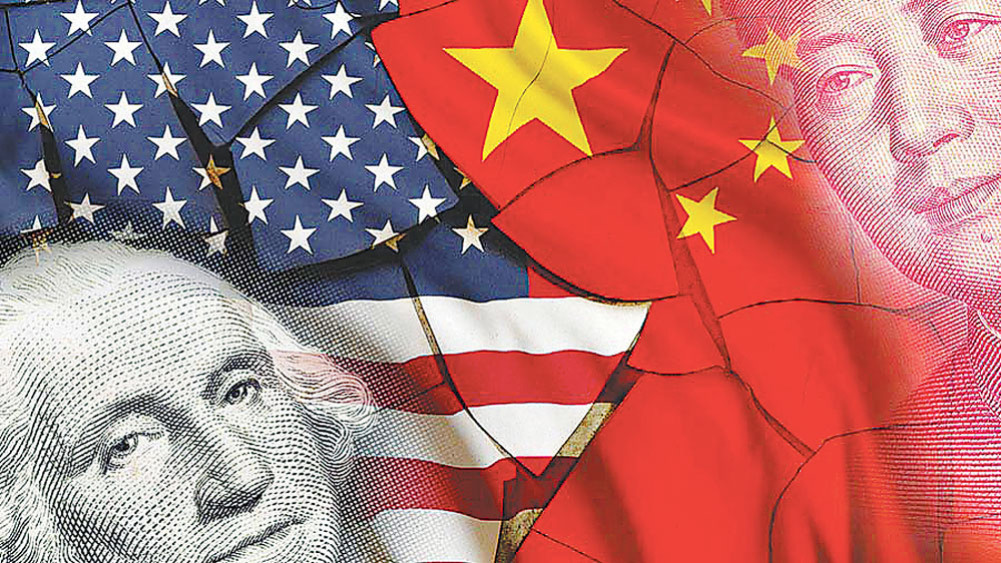
Also, China, which has been subject to Trump's tariff attack before, was not unaware of the possibility of it happening again. After Trump started the war, he seems to have adopted some strategic way to avoid it
We use Google Cloud Translation Services. Google requires we provide the following disclaimer relating to use of this service:
This service may contain translations powered by Google. Google disclaims all warranties related to the translations, expressed or implied, including any warranties of accuracy, reliability, and any implied warranties of merchantability, fitness for a particular purpose, and noninfringement.
The Chinese consider Mao Zedong to be the 'Great Leader'. In the Communist Party Museum in Beijing, glimpses of the Cultural Revolution in China under the leadership of Mao are attractively decorated. But when it comes to prosperous China, the Chinese don't really like to talk about it.
The Chinese do not want to remember the dark side of the Cultural Revolution. They talk about 'Confucian' philosophy, remember the Buddha and discuss the contribution of Deng Xiaoping, the pioneer of economic development.
He also talks about the strong leadership of President Xi Jinping in China, which is growing "day double night four times" on the road to development and prosperity. While talking about development and prosperity, some people question Mao and say, "There is no need to remember the history of past struggles."
However, this time the environment is different. Now nationalism is awakening in China. After US President Donald Trump's decision to impose 'tariffs' (reciprocal customs duties), the Chinese are remembering Mao. A seven-decade-old video clip of Mao released by the Chinese media has now gone viral. Where he is heard saying, "No matter how long this war lasts, we will not give up".
The 'clip' of Mao dates back to 1953, when the Korean peninsula was at war. During the war between North and South Korea, China and Russia stood on the side of North Korea, while the United States was on the side of South Korea. The 'clip' of Mao's speech saying that he would not go to war with America has now gone viral in Chinese media and networks.
In the 1950s, these two countries had a bitter relationship due to the Korean War and the Vietnam War. After almost seven and a half decades, even now there is the same bitterness between these two. The only difference is that at that time the President of the United States was Harry S. Truman, now there is Donald Trump. Then there was a battle for supremacy, now there is a trade war.
After Trump started a trade war again in his second term, China is standing against the US in the same way as Mao stood. President Xi Jinping has said, "China's development today is not with the help of others, but with its own hard work." We are not afraid of any unjust oppression.'
Speaking on April 11 for the first time after the US imposed tariffs, Xi Jinping said, "No one wins in a trade war." Instead, when he goes against the world, he isolates himself.'
However, Trump is indifferent. He has no interest in how the world views America. He is driven to impose his egos on others. On January 20, 2025, assuming the presidency for the second time, Trump announced the "America First" policy and gave a chance to repeat the tariff war. In March he hit back at Canada and Mexico, raising tariffs by 25 percent. There was a dispute with that nation for a few days. Canada retaliated by imposing counter-tariffs. He eventually reconsidered his decision to raise the tariff and postponed it.
After April, he again increased the tariff rate on various countries including China, India, and Southeast Asia. It caused a big wave in the world financial market. The stock market was affected. After big American companies including Apple began to be affected, he again postponed this tariff for 90 days.
Tariffs announced on computers, smart phones, various electronic devices etc. have been removed and the rest have been increased. Trump, who raised 34 percent to 54 on April 2, has since repeatedly increased it to 245 percent in the past three weeks. China has reached 125 percent in response.
Meanwhile, Trump is so unstable that it is difficult to predict what he will decide every new day. He has been doing whatever the fad is. It has been 100 days since Trump became president for the second time. Meanwhile, many of his decisions from domestic to foreign affairs are undemocratic and controversial.
His expressions/presentations are not compatible with the office dignity of the President of a superpower nation. After these actions and decisions of Trump, the world economy is confused as to where it will go next. However, he is confidently saying, "There will be an important agreement with China within a few weeks."
However, China does not seem to be what Trump thinks. While Trump is doing many tricks, on the other hand, President Xi is trying to adopt various strategies against the "tariff-war" in his own way. Meanwhile, China has not changed its 'position'. He has consistently done the same thing that President Xi has been saying.
After every decision of Trump, the spokesperson of the Ministry of Foreign Affairs in Beijing answers it. And the answer is the same. Spokesman Lin Jian said China is not afraid of the US tariff war and is ready to counter it. He said, "Since America started this war, it should take responsibility for it and find a solution through negotiations." Dialogue should be based on mutual interest, respect and equality. Unnecessary threats, pressure and blackmail should be stopped.'
On the one hand, China is keeping the door open for negotiations, and on the other hand, it is drawing a strategy on how to protect itself from American tariff attacks. Moreover, China, which has already suffered from Trump's tariff attack, was not unaware of the fact that it would happen again. After Trump started the war, he seems to have adopted some strategic way to avoid it. Like:
First, after the US increased the tariff rate, China increased the tariff in response. On April 2, China responded by imposing an 84 percent tariff on the U.S. after the U.S. raised it to 54 percent and then again to 104 percent. After that, America increased the tariff by 125%, then by 20% and another time by 100% to 245% while China increased it to 125%. Meanwhile, China has asked its airlines not to buy aircraft or other parts from the American aircraft company Boeing.
Similarly, the export of 'rare earth', a rare metal used to make energy, military materials, smartphones, electronic displays, etc., has been stopped. According to reports, China alone accounts for more than 80 percent of the export of this 'rare earth' in the world market.
Economists believe that the impact of not buying Boeing ships, devices and stopping the export of "rare earth" will be widespread in the American economy. Prices of goods related to planes, vehicles, automobiles etc. will increase and semiconductor companies will be affected. In other words, China has adopted the strategy of 'tit for tat' i.e. resistance after the US increased the tariff rate.
Second, after the US started a trade war, China seemed to want to take its neighbors into confidence without delay. President Xi Jinping, who rarely visits foreign countries, left for a visit to Southeast Asian countries after the US raised tariffs.
Earlier, the full Politburo meeting of the Chinese Communist Party in Beijing on April 8 and 9 decided to reassure the neighborhood of a shared future and to begin efforts for a new peripheral diplomatic exercise. One of the reasons why he chose Vietnam, Malaysia, Cambodia etc. during his visit was the guidance of that meeting. The
was also the second reason, the heavy tariff reference by the US on those countries as well. They have also been hit by US tariffs. In this context, by visiting those countries, Xi tried to give a political message that everyone is on the same front in the trade war.
America, which has been advocating an open market economy, created a tariff panic by trampling even the minimum price of the World Trade Organization, and China has moved forward to advocate a multilateral trade system, supply chain, and an open environment. President Xi attached great importance to the visit to the three ASEAN countries. Talked about regional peace and stability. With all these, China talked about trade partnership, bilateral trade and investment promotion.
They talked about increasing mutual brotherhood and moving forward together in the socialist goal since Vietnam is a communist regime like China. In the midst of all this, China's main concern was to build a front against US tariff terror, to connect its trading partners and to implement its market expansion strategy.
After Xi's visit, Chinese Foreign Minister Wang Yi summed it up with reporters in Beijing and said, "President Xi's visit has given a new height to regional cooperation and coexistence." It is also said that he can take authority as a strategy. By doing this, its products will be cheaper and will be easily consumed in the international market.
Even during the 2018 trade war, China felt relief as the yuan weakened. However, Trump accused China of undermining the yuan in order to sell its huge export industry cheaply to international markets.
Fourth, in terms of the experience of trade war shipments in 2018, the Chinese were already preparing the groundwork for a possible tariff conflict. Therefore, China has also adopted a strategy to develop the domestic demand system. China, which has a large population, has developed a domestic demand system and has taken a strategy to expand its products in the world market other than America.
Most importantly, China seems to have adopted a strategy that can increase its power even this time in the middle of the trade war. China is not unaffected by the trade war. President Xi himself has said that no one will win from this trade war, meaning that China will be affected by it. This will affect China's export economy. However, China, which is still standing strong after 2018, has taken a strategy to take itself further in the world economy this time.
Peking University professor Yao Tang says, 'Trump's tariff panic has ended the post-World War II economic/trade balance situation. We have reached the point of no return. Of course, this trade war will affect both the Chinese and American economies. However, China has no choice but to balance its domestic financial situation and prepare for a full-scale trade war.
This tariff war started by America in particular is the core question, 'Who will be the leader of the world economy?' The defeat of Germany and the decline of Britain in World War II made the United States come to the fore. Moreover, after the collapse of the Soviet Union, the United States has remained a superpower. On the other hand, there is China, which is achieving the height of development and prosperity in four and a half decades. Economically rising China has emerged as a challenge to America's 'superpower'.
Various economic surveys have been predicting that China will become an economic superpower by 2050. And America is not able to digest the rise of China. He wants to prevent China from becoming an economically powerful nation. China is on the path of economic progress. As China's economic development progresses at this pace, it is projected to overtake the US, while the US is falling into trade deficits and right-wing populism.
America, which considers itself the "messiah" of open markets and democracy, is flouting these minimum values. Trump's irresponsible behavior risks isolating him on the world stage. At this time, China's strong economy and technological development, especially the success of the latest 'Deep Cycle', is encouraging and is growing in its ambition to become the world's No. 1 economy. The world economy is swinging in confusion between America's interest in remaining a superpower and stopping China and China's ambition to surpass it.