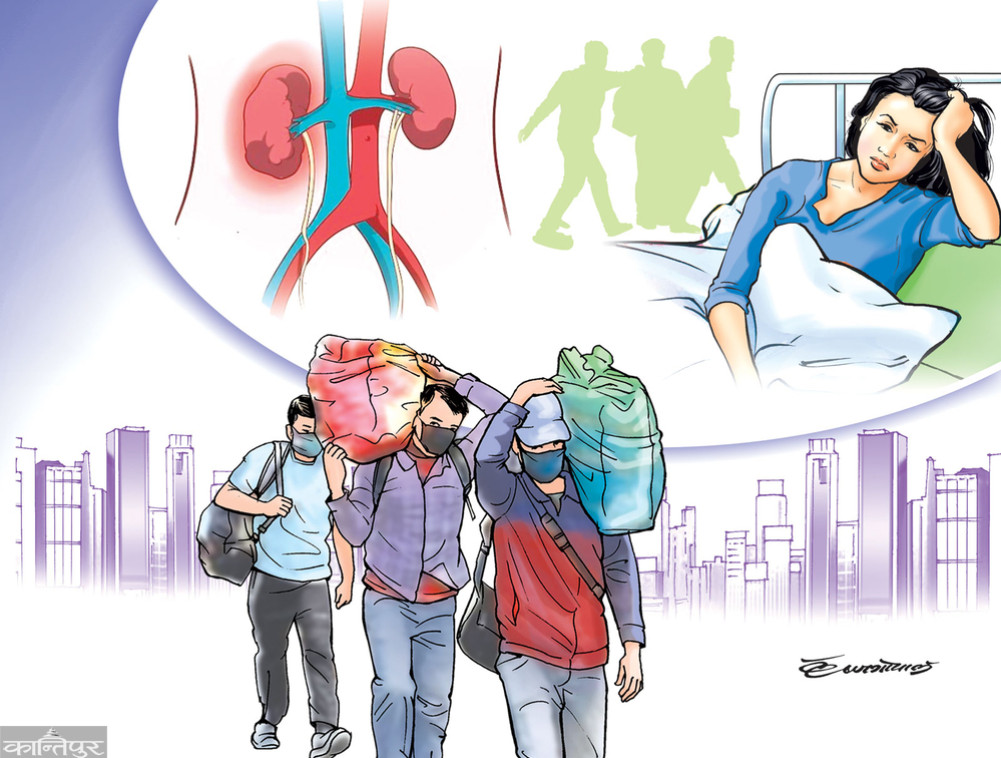
According to a study by the Nepal Development Society, 31 percent of patients undergoing kidney dialysis and transplantation in Nepal are migrant workers under the age of 40, whose kidneys have been damaged due to extreme heat, dehydration and hazardous work conditions.
We use Google Cloud Translation Services. Google requires we provide the following disclaimer relating to use of this service:
This service may contain translations powered by Google. Google disclaims all warranties related to the translations, expressed or implied, including any warranties of accuracy, reliability, and any implied warranties of merchantability, fitness for a particular purpose, and noninfringement.
Currently, Nepali migrant workers who have gone for foreign employment are returning to Nepal not with money in their pockets, but with damaged kidneys. They are returning to the vicious cycle of debt and dependency.
A 28-year-old man from Dhanusha came to Qatar to work in a large construction site, holding his property hostage. In the last two years, he returned home with a lean, thin and weak body due to chronic kidney disease. These are representative characters. There are thousands of such repatriated migrant workers in the corners of Nepal, who are suffering this fate. Until some time ago, they were fulfilling the responsibility of supporting their families, now they are forced to depend on being sick and unable to work.
They are fighting for their lives with chronic kidney disease, which is developing into a silent epidemic as a result of exploitative working conditions in the Gulf nation. This miserable situation of migrant workers who contribute significantly to the nation's economy through remittances is also a reflection of the state's neglect and systemic betrayal of them.
Thousands of Nepalese laborers sweated to build a magnificent stadium in the scorching heat of Qatar. These are the same stadiums, which rocked the world with unique entertainment during the FIFA World Cup. According to official data, more than 2,100 Nepali workers lost their lives in Qatar alone in the previous decade. It has been found that excessive heat and unknown health problems are the main causes of death.
The world has easily forgotten the pitiful and pitiful situation of the workers by keeping them only in the limited range of data, while the Nepal government has not been able to respond to the harsh reality of losing their lives during foreign employment, nor has they been able to raise their voice in a meaningful way. The FIFA World Cup, which is going to be held in Saudi Arabia, is indicating that history will repeat itself once again. The question of how many more Nepali people will be sacrificed as the state fails to take meaningful steps is to be considered.
Nepal's economy is dragging under the guise of remittances earned by hard-earned remittances, including 88 percent of the total labor force migration to Malaysia and the Gulf countries for foreign employment. The price of this lifeline in the form of remittance has become very expensive. In the past decade alone, nearly 10,000 Nepali workers have lost their lives abroad, most of which were easily preventable.
What is even more worrying is that the risk of chronic kidney disease, usually associated with old age, is high among repatriated migrant workers. According to a recent study by the Nepal Development Society, 31 percent of kidney dialysis and transplant patients in Nepal are migrant workers under the age of 40, whose kidneys have been damaged due to extreme heat, dehydration (lack of water) and hazardous working conditions.
Systemic neglect: a death sentence
Migrant workers who have gone to Gulf countries for employment are forced to toil in temperatures of over 50 degrees Celsius without drinking water, food or rest. According to a recent report (2023) by the University of Bournemouth and The Vital Science Project, prolonged exposure to extreme temperatures can lead to heatstroke and a disruption of the blood supply to the kidneys, leading to kidney failure and eventual kidney failure.
Other factors found to be exposure to pesticides include working environments, poor nutrition and limited access to health care. As a result, Nepali migrant workers who have gone to work abroad are now returning to Nepal not with money in their pockets, but with broken kidneys in their bodies, bound in a vicious cycle of debt and dependency.
In order to go for foreign employment, every Nepali worker must pass a health test and be 'fit' to be certified as healthy according to national standards. Only those who have health certificate from the designated official health institution are considered eligible to go for foreign employment. This means that every Nepali migrant worker who goes for foreign employment is a healthy young person in the fertile age group (15-34) of around 20 years old. However, migrant workers who were deemed 'fit' during pre-departure health examinations are returning with chronic kidney disease.
On the other hand, the compensation amount given for the treatment of chronic diseases under the insurance scheme run by the state does not even cover the cost of 'dialysis'. What is even more interesting is that after 6 months of the end of the foreign employment contract period, the insured workers cannot even make any claim. Because of this, many kidney disease workers are unable to receive treatment and are waiting for their death day. Although the National Health Policy, 2076 promises to ensure access to health services for migrant workers, these are limited to paper declarations, while bilateral labor agreements do not contain any binding provisions regarding mandatory safety standards to be arranged by employers.
This crisis has hit migrant workers and their families twice. Migrant workers who have gone to work abroad with hostages of their ancestral lands have been forced to return empty-handed with kidney disease. A 2021 study showed that 92 percent of repatriated migrant workers had kidney problems, most of whom had to rely on dialysis for treatment, and were also forced to live as a burden on their families.
According to the study, it has been found that migrant workers have 76.3 percent more risk of kidney problems than normal Nepalis. Some workers have been pushed into serious crimes, such as the black market of organ trafficking for kidney transplants (National Human Rights Commission, 2022). These workers, who contribute one-third of Nepal's gross domestic product, have been neglected and forced to live a poor life.
Neglected aspect: Health 'screening'
It is widely understood that one of the main reasons migrant workers are at serious risk is poor quality health 'screening'. However, the neglect of the role of the Ministry of Health and Population is more worrying. It is not that the role of the Ministry of Health and Population is not in health 'screening', but that role is only a limited part of the broader health dimension.
The jurisdiction of the expert committee, which consists of doctors nominated by the Ministry of Health and Population, members of the Nepal Health Council and members of the Nepal Health Association, established according to the regulations on foreign employment, is limited to the investigation and examination of cases of fraudulent and fake health reports being issued. Procedures related to health 'screening' do not fall under the jurisdiction of the Expert Committee. This legal loophole has been misused and thousands of migrant workers have been sent to foreign employment without proper health examination. As a result, they are forced to return with deadly diseases.
It is necessary to find a solution to this problem by expanding the jurisdiction of the expert committee and including the monitoring of the committee in the health 'screening' process. It is necessary to maintain the quality, standards and effective regulation of the health 'screening' process. In this regard, it seems necessary to establish close coordination between the Ministry of Health and the Ministry of Labour, Employment and Social Security.
It helps to reduce the risk of preventable health crisis by mandating workers' health examination of international standards before going for foreign employment. The 2034 FIFA World Cup, which is going to be hosted by Saudi Arabia, a major destination for Nepali migrant workers, is inevitable due to the potential risk of such reforms.
Next direction
Nepal should stop treating its migrant workers as slaves. It is necessary to put immediate pressure on the destination country through diplomatic means to improve the work area by providing proper provision of mandatory rest, rest and water as a solution to protect and protect its workers from the state level itself.
The bureaucratic hassles and excessive financial burden that workers have to bear in the process of treatment, insurance and compensation claims in Kathmandu should be reduced. Expanding insurance coverage to include all stages of chronic kidney disease, decentralizing the claim process and making it easy to access at the community level is now an urgent need.
If chronic kidney disease can be diagnosed at an early stage under the health protection plan when returning home, the complications of the disease can be minimized. In addition to ensuring basic requirements such as international standard health tests, which are indispensable from the point of view of health and safety, citizens' trust in the health service system can also be established by arranging for strict regulation and periodic monitoring.
Orientation and public awareness
Questions about fake health certificates and the interrelationship of health 'syndicate' networks are not new. Hence, even the effectiveness of the existing process of pre-deployment health 'screening' comes into doubt. There is ample evidence that health centers are issuing health certificates without proper testing. It is confirmed that this fraudulent practice in foreign employment has spread like an epidemic.
In order to end such fraudulent practices, it is necessary to maintain proper health standards so that the Ministry of Health and Population has full control over the pre-departure health 'screening' process and it should be ensured that unwanted financial benefits are not allowed.
It is also necessary to continuously monitor the health condition of Nepali migrant workers who have returned home. Apart from this, it is also necessary to establish a suitable health monitoring system to record the health status. Without real data about the depth of the problem, meaningful advocacy or policy change is not possible. As the pain of the workers is invisible in the current government records, the government is conveniently ignoring this crisis. A comprehensive health data system helps to uncover such problems and take appropriate action.
Lack of education and public awareness is another big problem. This bulky document has not been effective given that the most vulnerable uneducated and vulnerable workers find it difficult to understand the topics covered in the pre-departure orientation training. Its current form and structure is not tailored to the needs of workers. Orientation training should be conducted in the local language using textual materials with audio visuals so that the workers can really absorb the important information they need.
In addition, vocational training should be prioritized to provide alternatives to work that may cause physical harm to workers. A complete ban on unskilled labor migration could further complicate the risk of clandestine labor trafficking using irregular routes. Therefore, the government should discourage the export of allegedly unskilled labor by creating employment opportunities within the country and take appropriate steps to provide safe and well-paid job training for foreign employment.
Actually this topic is also connected with the respect of human life. Nepalese migrant workers are not only a means of earning foreign currency, they are also someone's father, mother, daughter, son, and relative. They are equally entitled to the protection, respect and protection that citizens get from the state. The existing labor immigration system of the government is such that no matter which country wants to take workers, it feels that it is willing to send its workers without any conditions or security concerns. It is inevitable to change this soon.
Not all workers return sick but the risk is higher for workers from weaker backgrounds and they are also unable to raise their voice. As a result, their suffering is being devalued. Without serious policy changes, this exploitation will continue. Nepal cannot pay the price of losing another generation due to preventable diseases and inhuman working environment. Now is the time to act on behalf of migrant workers.