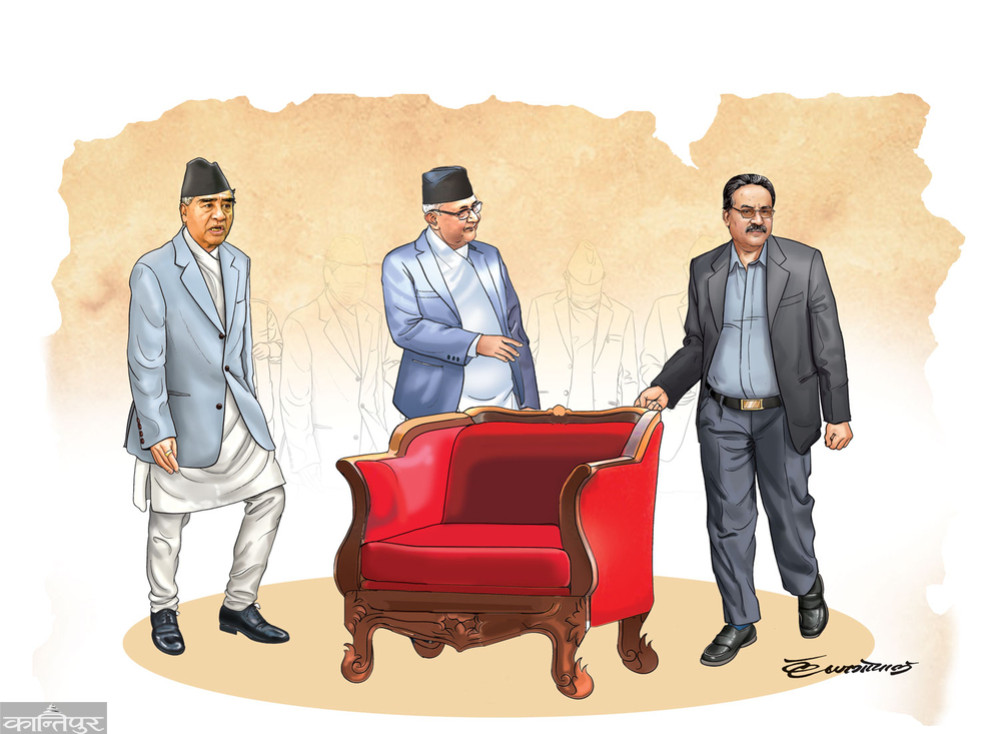
External players are probably also preparing for another upheaval within Nepal. Perhaps even their geopolitical supporters have been impressed by the performance of the three tyrants since 2015.
We use Google Cloud Translation Services. Google requires we provide the following disclaimer relating to use of this service:
This service may contain translations powered by Google. Google disclaims all warranties related to the translations, expressed or implied, including any warranties of accuracy, reliability, and any implied warranties of merchantability, fitness for a particular purpose, and noninfringement.
Vikramabad 2081 is a year of all-round failures to arrive at Nirkyol. Everyone remembers what they had to go through. If we review the New Year's greetings messages given by the three stalwarts of national politics before that, it will become clearer how the public hopes and aspirations were crushed.
The then Prime Minister Pushpa Kamal Dahal promised to lay a strong foundation for the development of the nation through economic reforms in 2081. Probably around 2001, Sarvesarva of the Maoists was still a 'radical' communist and aggressively stated in an interview - 'I hate revisionism.
I seriously hate revisionism. I will never compromise with revisionism. I have fought revisionism time and time again. And, the right policy of the party is based on the process of fighting revisionism.'' Laweda - It is sure that the definition of revisionism has changed in his dictionary since he started wearing Ramnami dupatta on his shoulders. But he could not demonstrate the ability to implement even his own intentions and was deposed within three months of his best wishes.
He has shown greater incompetence as the leader of the opposition than in the leadership of the government. Speaker Dahal has a big hand in making the parliament almost opposition-free. His role in institutionalizing the bad culture of Bhagabanda in governance is no less than the other two tycoons of national politics.
At the beginning of last year, the current Prime Minister Khadga Prasad Sharma Oli expressed his wish that the arrival of the new year 2081 would fill Nepalis with new hope and free them from sadness and disillusionment. Within a few months, he himself became the prime minister. But in his tenure so far, he has completely failed to instill confidence in the future in the general public.
Funny stories told by grandfathers, sermons given by village gurus, practical rituals performed by family priests, jharfuk performed by Dhamijhankri, reprimands given by primary school teachers to children, proverbial verses recited by village elders, rhymes composed on the fly by half-educated saharias, and pariblur, who can speak fluently on any subject, make Sharma Oli better than his peers in the game of politics. Undoubtedly ahead.
An explosive combination of nationalism, xenophobia, national pride, cultural homogeneity and racial superiority made him the ethnic ruler of Khasarya. Due to the protection of supporters, the promotion of workers and the deadly attraction of favoritism to the common people, he has been established as the president of UML, the darling of Maoists and a partner of the Nepali Congress since 2015.
World Hindu Federation's 'Nepal Rishi', senior advisor and acting coordinator of the so-called Rajsatsha Restoration Jana Andolan Committee, Jagman Gurung, at the same time considered Sarvesarva Sharma Oli to be a great scholar who had memorized 'all scriptures, Tantra, Ramayana, Mahabharata, Gita Kanth' and a scholar that no pundit could argue with and no engineer or medical doctor could debate.
Sharma Oli has been formally appointed as the Prime Minister many times because of his talent to sway almost everyone for a while, his extraordinary ability to confuse some supporters forever and his unmatched political acumen to manage his power partners. Now his political maneuvering has become like a dry fuse burning in a wick that has run out of oil.
The longer he remains in government leadership, the hope of the common people is sure to decrease. Perhaps the dedicated workers of UML have started to understand that now and they are looking for a possible alternative to Sharma Oli, who has turned politically upside down, in Bidya Devi Bhandari, the party's former vice-president.
Congress, which has remained the dominant force in democratic politics, regardless of whether it is in power or opposition, should be credited to the 2013 unconstitutional interim election of the cabinet. Appointing the Chief Justice of the Supreme Court, Ohodadar, who had ruled to reduce the sovereign right to extend the mandate of the elected Constituent Assembly, in the name of removing obstacles, was an undertaking to restore the dominance of permanent power in the country's politics. Since then, although Neka has been sitting in the 'driving seat' of the government many times, the control of power has never been lost from the hands of the side drivers.
Since 2014, when the controversial constitution was being promulgated, the official (de jure) prime minister was Sushil Koirala (1939-2016) while the de facto executive chief Sharma Oli was the chief executive. The political guards of the Baluwatar residence also understood that and used to make regular appearances in Balkot to implement their ideas.
By the end of 2015, ethnic Mukhtiar Sharma Oli has almost completely seized power, NE president Sher Bahadur Deuba still has to accept a secondary role in the system of shared governance. He expressed the hope of peace, prosperity and happiness to all Nepalis in the year 2081. A person who accepted to be a secondary force in national politics despite being the president of a party with majority MPs could not have done anything more than express hope.
On the occasion of the new year, at least the heads of the ruling party and the partner parties could include the state of the nation (State of the Nation) or the program of action for the coming year in their speeches. The opposition leader could present an alternative blueprint for future economic policy.
Such sentiments could be considered guidelines for the upcoming budget. But due to the strong strictness of the Brahmin culture, everything in Nepal will be limited to rituals. The pattern of greetings from the same three groups released this year is not much different from last year.
Quoting the words of poet Bhupi Sherchan's poem titled 'New Year', the three political figures seem to be 'emanating from the silent sound of suffering'. Prime Minister Sharma Oli has said that positive thinking, behavior and self-strength are necessary for everyone to achieve the common goal of making the country prosperous and the people happy. Chairman Deuba has pointed out that the time has come to advance the path of economic development and prosperity while maintaining good governance in the country. Maoist Chairman Dahal has called for the prosperity and bright future of the country.
After spending all their accumulated political capital to institutionalize the government malpractice of divisiveness for a decade, there is nothing new left to say to the politicians who are tired, corrupt and exhausted.
Enlightenmentists are not so excited. Disappointment is spreading in Kathmandu. The growing pressure to move to the hills increases the risk that those unable to migrate may be pushed into anti-social activities. Not only in Madhesh province, but almost all cultural Madheshis' helplessness cannot be measured or calculated, but it is not difficult to estimate.
Almost all the politicians who do politics in his name have turned into machines to obey the orders of the Khasaryan rulers. Now it is certain that the riots and arson and traditional disturbances of Birganj by the Enlightenmentists in Kathmandu have given relief to the members of Bhagbanda politics.
It doesn't seem possible to make the general public run more in circles. If the speed and direction of history can't be moved forward, it can turn back without looking stable.
possible scenario
Possible scenarios of political events are difficult to predict. By identifying the symptoms, it is possible to evaluate alternative procedures. If the current situation remains the same, it is almost certain that it will be difficult for Sharma Oli to keep both his seats. On the one hand, the internal power balance of NECA will make it uncomfortable for him to remain as the Prime Minister, on the other hand, the UML workers who are fed up with him may make Bidya Bhandari a contender for the post of party president.
Neka has no strong contender for the post of prime minister other than Deuba, so his government ground of acceptance is very weak. Deuba, who has set a record in the art of showing 'glorious incompetence' every time as Prime Minister, is not a suitable person to lead a weak country in a complex internal situation and complicated geopolitical situation. There was no talk of Deuba himself giving his alternative from NECA, instead he will be ready to pat Sharma Oli on the shoulder. Dahal is eager to crack the
, but his credibility has never been as weak as it is now. It is also understood by all that the Prime Minister's constant thrashing is an open invitation to anarchy. No one has a clear solution. The proposal of bringing Bidyadevi Bhandari to the Parliament through a by-election sponsored by some interest groups and making the former head of state the future head of the executive has not been thrown into the rumor market of Kathmandu. Such propaganda has not spread so far.
Along with the change in the leadership of the government, another parallel rumor is that the parliamentary elections may be held before time. Since the politician Ravi Lamichhane, who shines like a tail-setter in national politics, has been caught in the thick circle of prisons and courts, it seems that the party, which has been the platform of his ambitions, has put a stop to the political campaign named 'Mission-84'.
UML is also preoccupied with more immediate political issues than the upcoming elections. Neka is a party that always goes out to chop firewood while cooking rice, so it does not worry much about the upcoming elections. The discussion of the mid-term elections will break the cloud of danger hanging over the presidency of Deuba, Sharma Oli and Dahal for some time. Even such a scenario is not without problems.
Even the activists of the dominant party may be reluctant to take such a risk without forming a government favorable to them. If that happens, it may be necessary to raise a character of permanent power to hold the reins of politics in the name of removing another obstacle. If that type of constitution is to be amended, some issues that have been postponed since 2015 will come to the surface again.
The concept of a national government is very appealing to authoritarians. Because he gets to run a partisan government by dressing his propositions in the garb of consent. Almost all the governments formed after the 16-point conspiracy of 2015 have governed without opposition. In that sense, Sharma Oli, Dahal and Deuba have run the national government in turn.
It is clear that in order to strengthen their electoral position, NECA and UML want to raise the threshold in the proportional election system in the name of constitutional amendment. However, if the three big parties try to strengthen their supremacy through parliamentary maths by showing the national government and including the smaller parties in the government, then the politics may again turn towards another flow change (course correction). It is self-evident that geopolitical players will then become more active.
Apprehension of upheaval
Maoist Chairman Dahal used to stir up the public circle by throwing his riddles into the political market when he was the elusive leader of the guerrillas. His 'Golmech Sammelan' prelude went to Noida in Uttar Pradesh. He used to accuse the government of that time of staging 'artless plays', now he himself is considered to be an excellent director of such gimmicks.
The internal situation is whatever it is. External players are probably also preparing for another upheaval within Nepal. Perhaps even their geopolitical supporters have been impressed by the performance of the three tyrants since 2015. Now, if the preparations for another round match begin, the efforts to restore India's role in Nepali politics under the pretext of creating a so-called Hindu nation will gain momentum. Perhaps New Delhi's strategists are unable to find a suitable character in Kathmandu for their favorable and fluid situation.
Due to the dominance of ethnic politics in Nepal, such a hero or heroine may have to be chosen from the Khasarya community. Established characters are considered unreliable. Betting on a new face can be risky as well as costly. As in the Gobarpatti slums of India's Ganga plains, if the search for 'strongman' politicians starts in Nepal after the fire of Hindutva politics, even nominal provisions like federalism, inclusiveness and social justice will be at risk.
Since 2013, the Chinese have identified Sharma Oli as the most ambitious, confident, smart and practical and therefore supportable politician of the republic of Nepal. Sharma Oli, who does not hesitate to join hands with any person or any power to protect and promote his interests, is probably still high on the list of Beijing's trusted ones.
The role of leadership in parliamentary politics cannot always remain the same. After the failed attempt to establish a strong communist power under the leadership of Sharma Oli, Dahal did not seem ready to reduce his international acceptance by accepting Beijing's plan to prepare a 'B-Team' for the Maoist center. The Chinese may also be positive about the possibility of 'strongmen' or 'strongwomen'.
Because it carries the slogan of socialism and the flag of liberalism together, Neka became the first choice of most Westerners in the early 1990s. First Europeans and then Americans must have started to prepare UML for marketism to protect their interests after getting tired of the old party's mischief. Having lost both the trust of the Indian government and the trust of the West, Neka is now trying to avoid the geopolitical storm by grasping straws such as Hindutva politics and the possibility of a cultural king.
No matter how the situation develops, the storm of mid-term elections, which will not give any way out, will not only uproot the dead trees from Nepali politics, the damage that will come with it will cause the most damage to the helpless common people. While it's not hard to understand the public's disquiet, there doesn't seem to be much that can be done. A conscious community should not leave the road empty.