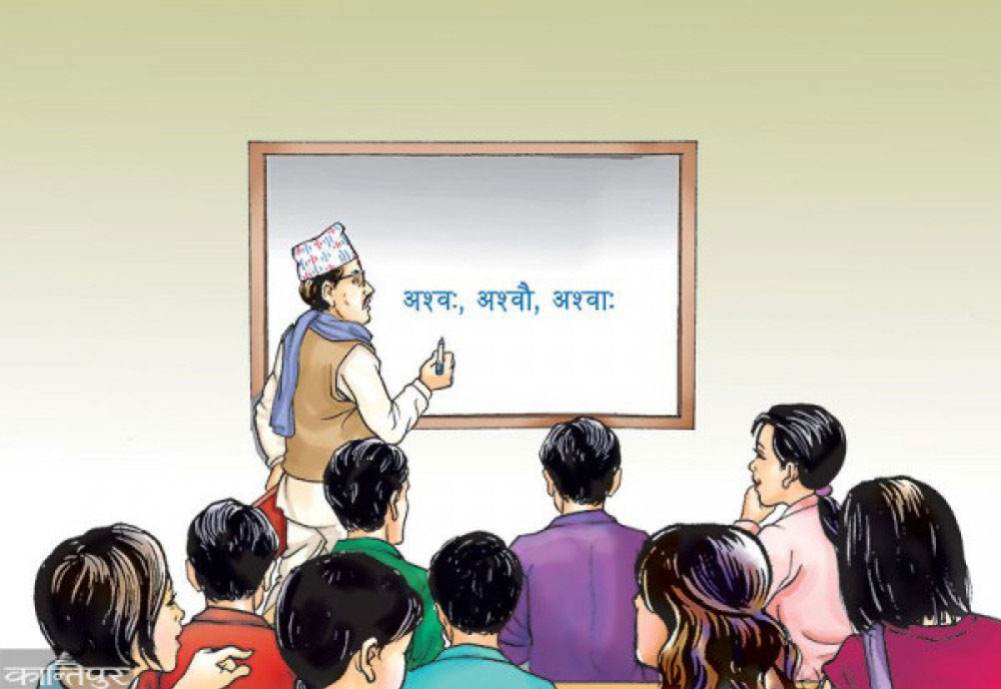
Sanskrit is culture and tradition. This language is the transmitter of Eastern philosophy. It is also a holistic way of life. It teaches not only the art of living but also fearless living.
We use Google Cloud Translation Services. Google requires we provide the following disclaimer relating to use of this service:
This service may contain translations powered by Google. Google disclaims all warranties related to the translations, expressed or implied, including any warranties of accuracy, reliability, and any implied warranties of merchantability, fitness for a particular purpose, and noninfringement.
Sanskrit, the mother of all languages, is known as Devvani, the language of God. It is considered as the oldest and richest language in the world. Also the mother of Nepali language is Sanskrit language. Without the knowledge of Sanskrit, it is difficult to speak and write Nepali language clearly.
While studying in Western countries, we do not even have general knowledge about the Sanskrit language, which is the mother of their mother tongue. Western scholars have studied our Vedas, Puranas and Upanishads. Many Englishmen have turned their attention to the study and research of this language. International religious organizations like ISKCON have been trying to revive this language.
Around 1893, after Swami Vivekananda gave a lecture in America about the glory and saga of Hindu religion and Sanskrit language at the Chicago conference, interest and concern about this language began to grow. The wonderful principles discovered by modern science were conceived in our ancient texts written in Sanskrit. In Sanatan Vedic religion, all rites from conception to funeral are performed in Sanskrit. Four Vedas, Eighteen Puranas, Manu, Yajnavalkya, Parashara, Atri etc. Smritis, Shatdarshan etc. Shastras are unprecedented books of knowledge.
My 15-year-old daughter has a question –
'Mother! Why are we not taught the study of Sanskrit language? Don't I get to know and learn about the mother of my mother tongue?'I get emotional after hearing such questions. The current generations are not able to acquire knowledge regarding such important guidance. Why is there no debate and discussion about preserving Sanskrit in our policies? What is the root of the problem? In gurukuls, Sanskrit schools and colleges, research cannot be done on the basis of priority in different genres of Sanskrit. It is equally important for all three levels of government to be sensitive about this issue.
Today's mid-21st century, the influence of the West has fallen into the artificial intelligence and mechanized age. It is necessary for our society to move towards the path of following, studying and researching the language spoken by our forefathers.
Sanskrit language is still included by many people in their lives. From the time of waking up in the morning till the time of sleeping, they do Vedic work through Sanskrit language. The meaning of religion, karma, knowledge, education, penance and devotion is contained only in Sanskrit education. Sanskrit education can help people to consider themselves civilized and cultured good people.
Sanskrit is culture and tradition. This language is the transmitter of Eastern philosophy. It is also a holistic way of life. It teaches not only the art of living but also fearless living. It is equally fruitful for attaining enlightenment in life and attaining salvation. It is a philosophy of life, it shows the way for man to walk.
We can acquire various important knowledge including various astrology related calculation sequences and human birth chart only by studying and researching Sanskrit education. One who understands the Sanskrit language, his human life can become simple, easy. This language is leading to human life and the good of the world. It is very important to study and teach Sanskrit education in human life in order to make people civilized, dignified, dutiful, honest and virtuous. It is equally important to provide an opportunity to teach the Sanskrit language to today's generation.