It is necessary to review the method and process of financial transfer from the government of Nepal to the state and local levels and from the state to the local level
We use Google Cloud Translation Services. Google requires we provide the following disclaimer relating to use of this service:
This service may contain translations powered by Google. Google disclaims all warranties related to the translations, expressed or implied, including any warranties of accuracy, reliability, and any implied warranties of merchantability, fitness for a particular purpose, and noninfringement.
In sub-section 3 of Article 60 of the Constitution, the Government of Nepal has a provision to distribute financial equalization grants to provinces and local levels on the basis of expenditure needs and revenue capacity. There is no legal term here.
This means that there is a vertical order in the constitution to distribute the equalization subsidy in any way. However, in sub-section 4 of this article, the province must distribute equalization grants to the local level based on the expenditure needs and revenue capacity in accordance with the law. The constitution says to distribute to the provinces only by making laws. However, the government of Nepal has made it mandatory that the equalization subsidy should be distributed to the provinces and local levels anyway. This is the most important thing to understand here. Equalization grant is a constitutional right of state and local level. This is the basic premise that the equalization subsidy cannot be reduced by pulling out different categories. However, since the last two years, a series of reductions in the equalization grants of the state and local levels have started.
After the federal government has kept a lot of revenue rights, it is the intention of the constitution to meet the expenditure needs of the state and local levels on the basis of equalization grants. The principle of grant distribution also says the same. Again, there is a belief that the equalization subsidy should be increased in proportion to the GDP or budget. However, even this belief has not been assimilated. Each year the proportion of equalization grants is decreasing.
Provisions related to the distribution of conditional grants, supplementary grants or special grants for other purposes provided by the Government of Nepal from the Federal Reserve Fund shall be in accordance with the federal laws in Article 60, Clause 6 of the Constitution. This allows the Government of Nepal to distribute conditional, complementary and special grants to the provincial and local levels. However, for this, a law should be made. The constitution does not envisage more than 4 grants. However, the National Natural Resources and Finance Commission understands that the federal government has used more than a dozen channels of grant distribution in the name of various projects. There are also details about this in the parliamentary committee reports.
In the National Natural Resources and Finance Commission Act, 2074, the government of Nepal has mentioned the basis of equalization subsidy to be distributed by the province and local level and by the province to the local level. In the Inter-Governmental Finance Management Act, 2074, the provision of the Constitution has been kept as it is. However, the basis of equalization grant distribution is mentioned in the Act of the Commission. The Inter-Governmental Finance Management Act mentions the basis of conditional, supplementary and special grants to be distributed by the Government of Nepal to the provinces and local levels. In the context of the province, it is also in this law that the province will be governed by the law. Article 251 of the Constitution stipulates that equalization grants and conditional grants distributed by the Government of Nepal at the provincial and local levels shall be based on the recommendations of the National Natural Resources and Finance Commission. However, the constitution states that the basis of subsidy from the state to the local level shall be in accordance with the law of the state. Although the recommendation of the Finance Commission to the province is not mandatory, federal laws such as the Finance Commission Act and the Inter-Governmental Finance Management Act have written the jurisdiction of the province. The federal law cannot compel the state to distribute subsidies to the local level. According to the constitution, this subject should be in the provincial law. However, the province has followed this matter. It has been taken to the implementation level. When I was the vice-chairman of the Planning Commission of Bagmati Province in 2076, this subject was introduced. After discussion among the employees of the provinces, it was also suggested that the provinces are not binding.
The government of Nepal has been distributing conditional, complementary and special grants in addition to equalization grants to the state and local levels. Its implementation took place after the three-level elections in 2074. The first federal budget came in the year 2075/76. The process of distributing all four grants has been started from this budget. For example, the province received a grant of 1 trillion 23 billion rupees based on the budget speech book of the year 2075/76. Of this grant, 40.75 percent was financial equalization grant and 51.75 percent was conditional grant. The remaining 8.10 percent was supplementary and special grants. Out of the total Rs 2 trillion 5 billion grants distributed by the Government of Nepal to the local level, the share of equalization grants was 41.38 percent and conditional grants were 53.74 percent. The rest of the grants were supplementary and special.
When compared to the total budget of the Nepal government, in the year 2075/76, the provinces received 9.39 percent of the subsidy, while the local level received 15.57 percent. Similarly, when discussing the equalization grant, the province received 3.83 percent of the total budget of the government of Nepal, while the local level received 6.44 percent.
Like the first federal budget in the year 2075/76, the state also brought the first full budget in the year 2075/76. The province also started the process of distributing subsidies to the local level by making the law itself, from this budget. In the year 2075/76, the budget of the province was 2 trillion 8 billion rupees. In this budget, the local level subsidy was 11.75 billion rupees. Which is 5.64 percent of the total budget of the province. In the first budget, Bagmati and Gandaki provinces distributed the most equalization grants of 1/1 billion rupees to the local level. Karnali province distributed the least Rs 40 crore.
In the second complete budget of the province in the year 2076/77, the total budget of all the seven provinces was 2 trillion 59 billion 57 crore rupees. In this budget, the grant amount for the local level was 26 billion 4 million rupees. Which is 10.17 percent of the total budget of the province. In the second budget, Bagmati province distributed the highest amount of equalization grants to the provinces at 1.25 billion rupees, while the lowest amount was distributed by Lumbini province at 500 million rupees. In the previous year, Karnali province distributed the least equalization subsidy of Rs 80 crore.
In the year 2076/77, the province received a total grant of 1 trillion 10 billion rupees from the government of Nepal. Which is 7.17 percent of Nepal government's budget. The share received by the province from the Nepal government is 7.17 percent and the share distributed by the province to the local level (10.17 percent).
Although the size of its budget is small, the share of subsidies distributed by the province to the local level is definitely positive.
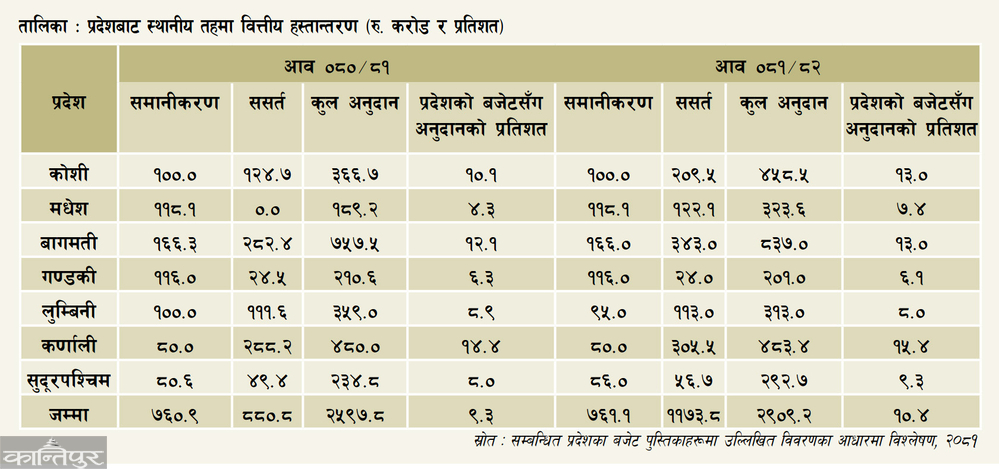
The details of the financial transfer from the state to the local level in the year 2080/81 and the year 2081/82 are in the table. According to which, in the year 2080/81, the province transferred 9.3 percent of the total budget subsidy to the local level, and in the year 2081/82, it has been mentioned in the budget that 10.44 percent will be transferred. In the year 2080/81, the province that distributed the most equalization grants was Bagmati with Rs 1.66 billion, while Karnali Province had the lowest with Rs 80 crore. In the year 2081/82, the subsidy received by the province in the budget of the Government of Nepal is 5.18 percent. However, in terms of percentage, the provinces have included more subsidies than the Nepalese government to transfer to the local level. The table details equalization and conditional grants. However, supplementary and special grants are also included in the statement of total grants. For example, equalization and conditional grants are 67.50 percent of the total grants for the year 2081/82 of Koshi Pradesh. The remaining 32.50 percent have supplementary and special grants.
The percentage of equalization subsidy allocated for the provinces in the year 2081/82 in the budget of the Government of Nepal is 3.23. However, it is 2.73 percent from the province to the local level. The province has not made any concessions in the distribution of grants to the local level. However, the province needs to improve on equalization grants.
In the year 2081/82, the share of supplementary and special subsidies is 11 percent of the total subsidy proposed by the Government of Nepal for the provinces of 96 billion. However, the share of supplementary and special grants is 33.49 percent of the total grants proposed by the province for the local level. Due to this fact, it seems that the province has given a little more emphasis to supplementary and special grants. In principle, complementary and special subsidy distribution is good. However, if these subsidized projects are for profit and pocket money, there is a need to improve. However, the municipalities have also complained that these subsidy projects are coming on the basis of tajbiz. There is a complaint from the provinces and local levels that even in the distribution of supplementary and special grants distributed by the Nepal government to the provinces and local levels, Bhosun dominates. If the situation is the same in the province, there is no choice but to be honest. Overall, there is a need to review the method and process of financial transfer from the Nepal government to the state and local levels and from the state to the local level.

