During the active reign of 2058 to 2063, Gyanendra Shah seized the state and plundered Dhukuti, and distributed financial aid and donations to supporters arbitrarily by making a decision from the cabinet.
We use Google Cloud Translation Services. Google requires we provide the following disclaimer relating to use of this service:
This service may contain translations powered by Google. Google disclaims all warranties related to the translations, expressed or implied, including any warranties of accuracy, reliability, and any implied warranties of merchantability, fitness for a particular purpose, and noninfringement.
Rabindra Mishra and Dhavalashamsher Rana were wearing t-shirts with the slogan 'Let the corrupt be the worm' during the royalist riots that took place on 15th Chait last year in Tinkune, Kathmandu, and were calling the republic a corrupt governance system. On the other hand, Kamal Thapa, the home minister of the autocratic Shahi period, is speaking loudly saying that the republic is a corrupt government.
Monarchists are trying to establish the narrative that the restoration of the monarchy is necessary to end corruption. But if we look only at the short period of the active reign of Gyanendra Shah (2058 Oct 18 to 2063 Baisakh 11), the facts show that there was many times more organized corruption during the Shahi period than now. In addition, the option of restoring the monarchy to control corruption that the royalists are saying is very airy and baseless.
The fact of how corrupt the panchayat was has been made clear by the book titled 'Etihahaso Kalkhand' by Navaraj Subedi, the coordinator of the Raj Sanstha Restoration Movement. Don't even go that far. During his active reign from 2058 to 2063, Gyanendra Shah captured the state and plundered Dhukuti. Gyanendra Shah, the Chairman of the Council of Ministers of the royal regime, distributed financial aid and donations to his supporters in a whimsical manner by making a decision from the Council of Ministers.
The then Finance Minister Dr. Ramsharan Mahat presented to the House of Representatives on 1st May 2063 the 'White Paper 2063 on the current state of the economy' has shown that there was extensive exploitation of the country's treasury during the direct rule of Gyanendra Shah. Financial assistance was provided to the then vice-chairmen of the Council of Ministers, Tulsi Giri and Kirtinidhi Bista, Finance Minister Madhukarshamsher Jabara, and officials nominated in various agencies by deciding an amount of more than 50 lakhs from the Council of Ministers. In Dasain of 2061, 42 lakh rupees were arbitrarily distributed to the royalist activists by approving the budget from the Council of Ministers.
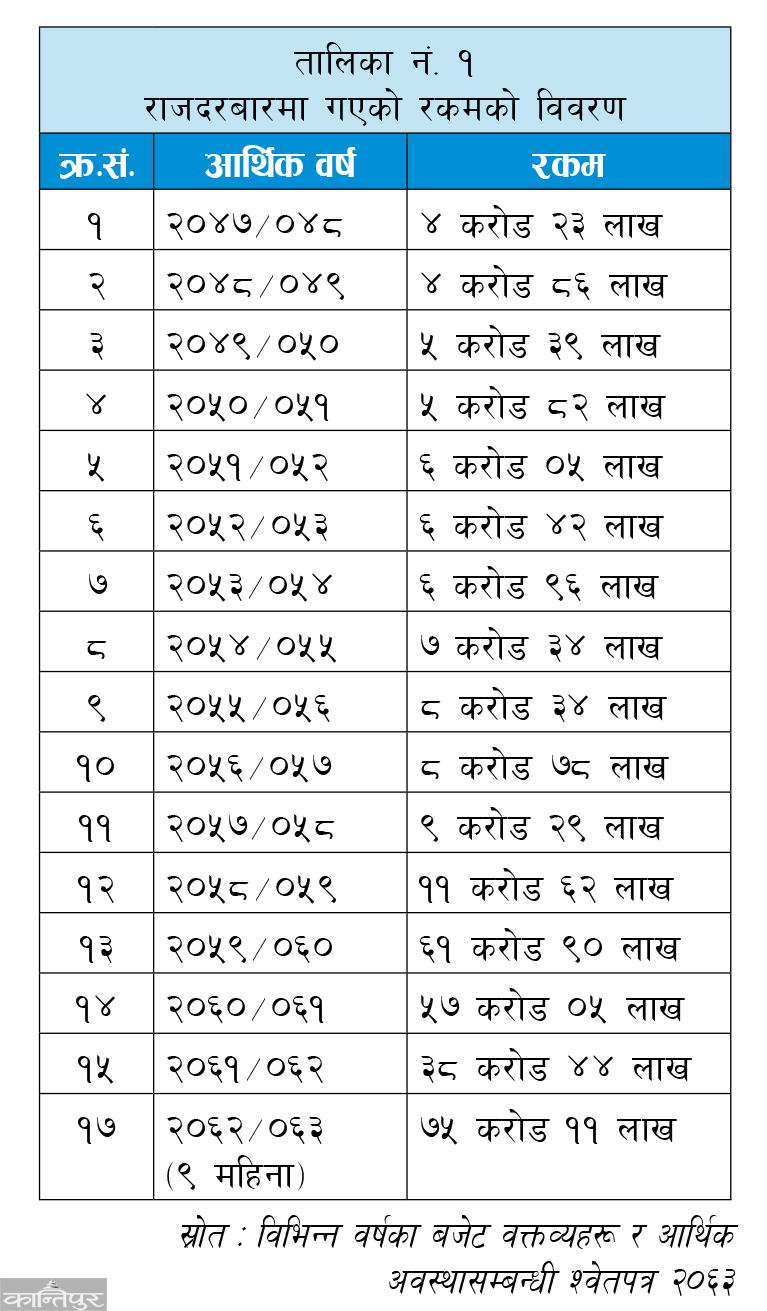
Gyanendra Shah had rapidly increased the financial facilities and budget of the royal palace during his reign. It seems that 116 million 62 million budget went to the royal palace in the financial year 2058/59 before the direct rule of Gyanendra Shah began. But in the financial year 2059/60 when he started his rule, 61.9 million rupees were disbursed to the palace. It seems that in 9 months of the financial year 2062/63, when the royal reign was at its peak, 75 million 11 million rupees went to the palace. Which is table no. 1 illustrates.
Not only this, during the direct rule of Gyanendra Shah, a huge amount of money was spent in an irregular manner only in the name of suraki expenses to feed his supporters. During the Shahi period, there was extensive exploitation of the national treasure in the name of Suraki. It is mentioned in the reports of the then Auditor General that a huge amount of money was spent in the name of Suraki only during the period of three years from the financial year 2058/59 to 2060/61. Which is table no. 2 illustrates.
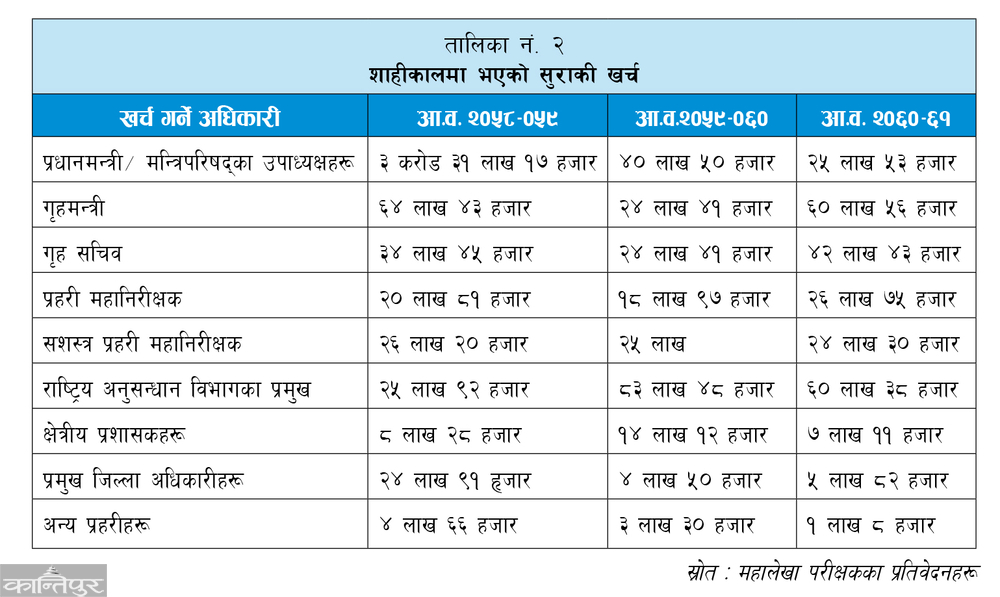
According to the white paper, during the 15-month reign of Gyanendra, the unreimbursed expenses of the Home Minister and the Home Secretary under the heading of suraki operations reached nearly one crore. What is more interesting is that the then Home Minister Kamal Thapa, who spoke loudly about the increase in corruption during the republican regime, made a 'Lucknow loot' on the state treasury by spending 500,000 rupees per day from January 12, 2062 to Baisakh 5, 2063. Suraki had misused more than 15 million in the city election that was not held during the Shahi period.
These are just a few examples. During the reign of Gyanendra Shah, the state was captured and the public property and treasury were exploited. Corruption at that time was basically in two forms. First, the palace and its members mobilized all state agencies and misused the national treasury and treasury. During the three years of Gyanendra's active reign, expensive cars worth more than 380 million were brought into Nepal under customs exemption for the palace.
In the same period, more than 300 million rupees were spent on Gyanendra's Africa and Paras Shah's Europe tour. At that time, there was no transparency in the expenditure of the amount that went to the palace. Under the guise of the then constitutional provision that no question will be raised in any court regarding any work done by Shri 5, he misused the state machinery and looted the Dhukuti.
Second, under the guise of the king, his supporters and parties supporting his autocracy committed corruption. Leaders and workers of Rashtriya Prajatantra Party, who supported the regime of Gyanendra Shah, had widely misused the state funds. The royal government spent 3.17 billion rupees in non-budgetary budget only in nine months of the financial year 2062/63. At that time those who supported Gyanendra's autocratic rule were also financially rewarded. They were free to exploit the state treasury and abuse the economy. Supporting Gyanendra's autocratic rule was like getting a 'license' for corruption and exploitation of state funds.
These days, royalists are speaking loudly against corruption. In the Nepali society where 'institutional memory' is very weak, their speech may be making some people think yes. But during the direct rule of Gyanendra, if we look at the plunder done by him and his supporters on the state treasury, their hypocritical character can be clearly seen.
They have criticized the democratic government as corrupt but are silent about the economic crimes committed under the rule of Gyanendra Shah. This does not mean that corruption is less or reduced in the republic. But now the corruption committed by any functionary of the state apparatus can be publicly questioned. But during the Shahi period, there was a rule that the king and other members of the court could not even question the corruption and exploitation of state funds. Therefore, many scandals that happened at that time could not be made public.
One of the reasons for the second mass movement was the exploitation and looting of the state treasury during the reign of Gyanendra Shah. However, even after the establishment of the Republic, it is ironic that the necessary structural, policy and legal reforms for corruption control could not be made. When corruption cannot be controlled and the names of high-level leaders and their family members are slandered in such cases, the republic is being questioned. But the cure for the corruption that has increased during the republican regime can never be the restoration of the monarchy. A regime that legitimizes the seizure of state funds for the benefit of one family was and will be hundreds of times more corrupt than the current regime.
Institutional, legal and policy reforms are necessary to control corruption. It needs to start with the establishment of a powerful Assets Investigation Commission to investigate cases of corruption. The Commission should be tasked with conducting an independent and impartial investigation into the assets of all those who came to power after 2047. In which not only democratic and republican but also Gyanendra's reign should be assigned the responsibility of investigation and recommending action. Those found guilty by the said commission should be dealt with ruthlessly.

