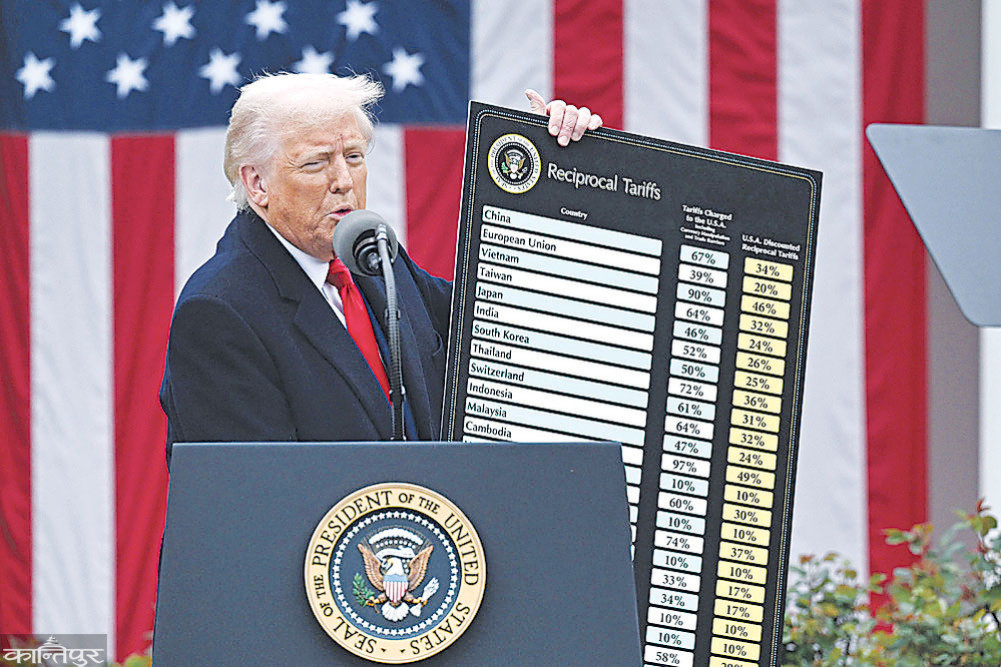
Nepal can take advantage of the high US customs tariff with the surrounding neighboring countries and take initiatives to open industrial trade immediately.
We use Google Cloud Translation Services. Google requires we provide the following disclaimer relating to use of this service:
This service may contain translations powered by Google. Google disclaims all warranties related to the translations, expressed or implied, including any warranties of accuracy, reliability, and any implied warranties of merchantability, fitness for a particular purpose, and noninfringement.
There is no doubt that US President Donald Trump's new announcement to change the tariff rates is likely to cause a lot of upheaval in the global economy. At first glance, such increased rates seem to increase inflation in the United States.
When inflation is high, US banks tend to raise their interest rates in response. As interest rates rise in the US, investors around the world are more likely to deposit dollars there or buy US bonds or treasury bills, increasing the demand for the US currency. As the demand increases, the price of the commodity increases, and then the US currency becomes stronger compared to other currencies in the world.
On the other hand, when the currency is devalued, the prices of goods in all the concerned countries will rise and inflation will increase. In response to this, all interest rates, including deposits, increase in those countries. When the interest rate increases, there is a negative impact on the stock market of a country like Nepal, and the sale of real estate is reduced. The overall economy becomes unstable.
Financial crises are a regular occurrence. Such incidents have happened before. Therefore, an incident from fifty years ago is also helpful in understanding the effects of the current crisis. In 1973 (October 2030), the OPEC countries announced a petroleum embargo against countries that supported Israel in the Yom Kippur war. Then the price of goods in the US rose and the US inflation rate immediately went from 4 percent to 12 percent. On the other hand, along with inflation, US interest rates also increased for the next six years. With the problem in the American market, it began to affect the world.
In Nepal, interest rates were continuously increased in 2031 and 2032. According to the data of Rashtra Bank, the interest rate on savings was increased from four to five percent in April 2031. It was increased from 5 percent to 8 percent in the year 2032. In 2032, the interest rate on fixed deposits was also increased from 9.5 percent to 10.5 percent to 15 to 16 percent. The minimum interest rate of various loans has been increased to 18 percent.
It was also a completely new situation from the perspective of Nepal. Rastra Bank started the monetary policy of determining the interest rate only on 15th August 2023. That too after the shocking revaluation with the Indian currency (from 100 Indian Rupees to Rs. 160 Nepali on 24th June 2023 to 100 Indian Rupees to Rs. 101 Nepali at once) at a time when BOP was unbalanced. The National Bank was gradually developing the ability to set the reference interest rate within the country by evaluating the international situation.
Because of this, the country's interest rates could not be adjusted according to the needs for a long time. The Bank's policy rate, which stood at six percent in 2024, fell to that level only in 2058. In between it went up to fifteen percent. This high interest rate troubled the country for a long time.
also weakened the country's industrial competitiveness. The US had a decade of high interest rates, high inflation and weak economic growth. Almost the same situation happened to us. High interest rates persisted, with average inflation rates of 6.2 percent in the 1960s, 7.9 percent in the 70s, 10.7 percent in the 80s, and 9.6 percent in the 90s. Although there were a few years in between, there was no economic growth until the 1990s. The effects became so 'persistent' for various reasons.
Therefore, during the Panchayat period, the revaluation of the Nepalese currency with the Indian currency on the one hand and the high bank interest rates on the other hand put the country's economy and industrialization on hold. In the case of industrialization, this effect lasted until the mid-forties. Only the liberalization of the forties mitigated its effects to some extent.
What will happen now? Like during the petroleum crisis, if the interest rate in Nepal increases significantly within the next two years, it is likely to have a very bad impact on the capital market, which is now developed in Nepal, a major difference from the thirties. Apart from that, the overall economic activities are hampered by high interest rates. This negative impact will also affect the industries that are opening now, including the hydropower industry. The impact of global inflation on government revenue is uncertain.
This is because the economy is based on imports. In fiscal year 2030/31, 76 million rupees were raised, compared to 1 billion (an increase of 33 percent) in 2031/32. Dr. who just came to handle the Ministry of Finance. This gave false relief to Bhesh Bahadur Thapa as the revenue growth slowed down to 10 per cent the very next year as it was not based on sustainability. Since our country is still an import-based economy, revenue in Nepalese currency may increase initially, which is likely to provide relief to the government. Even if revenue increases at customs points, revenue from other economic activities may decrease. The total effect will be determined by the sum of these two. A negative impact on
revenue will create a very risky situation in the next few years. The main reason for this is the increasing government debt and government liabilities. Total Government Debt Vs. In 2074, it was 7 trillion rupees, now it has reached 27 trillion. In this, the share of domestic debt has increased from forty percent to around fifty percent. Until a few years ago, the share of domestic debt was 20 percent. On the other hand, spending on social security has also increased. Failure to pay revenue not only reduces the ability to start development projects, but also weakens the ability to pay debts and meet mandatory social security obligations. Both of these will cause more instability in the country and it will be more difficult for the government to function. When listening to
, all these situations sound bland. But there is a way out of this.
First, the way to improve the business environment. As many have pointed out, Nepal can take advantage of the high US tariff rates with the neighboring countries and take initiatives to open industrial trade immediately. Judging by the way Trump's new tariffs are set, this arbitrage-based industrialization may not last long. What is said about how the US administration determined how much tariff a country imposes on the US in such a short period of time is that it was calculated by dividing a country's total trade surplus with the US by its total trade.
means Americans have worked on the principle that America should have trade surplus with every country. As soon as a country benefits from trade, it will be taxed more. But in any case, the option of simplifying the process of opening industries without expecting much will not harm Nepal.
Second, withdrawal from setting monetary policy (mainly periodic deposit rates) with long-term effects. If the experience of the thirties has taught us anything, it is that such regulations can have a very long tail. However, interest rates have risen as quickly as they have fallen in the past decade. But due to the increase in bad loans of banks, this time it is necessary to be careful about the long-term effect of the rates of periodic deposits.
Third and foremost, both sources of economic growth are now in trouble. The private sector is looking for an environment of 'confidence' to invest and is not looking to invest despite having investable funds in banks. The government's ability to mobilize domestic resources has been constrained by its inability to raise revenue and the growing size of total government debt (and, by extension, the share of domestic debt). There has not been much success in raising resources from the external sector.
The inefficiency of the overall system is also to blame for this. It is not new that projects started with loans and grants are not completed on time. But it is clear that the negative impact of finding sources of economic growth will cause problems. In this perspective, old policy "prescriptions" such as "increasing government investment in areas with high returns" and "encouraging the private sector to invest" are more relevant now.