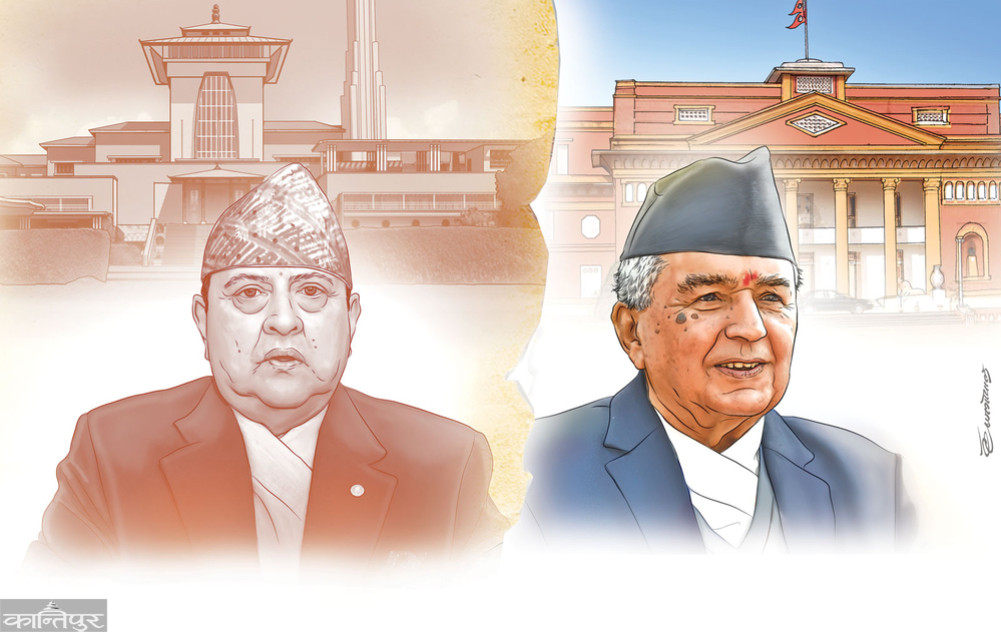
A person who is ready to become someone's slave, how can he make the country and society sovereign and prosperous? He who is the owner of the country and is ready to become a citizen, how will he increase the prestige of the country?
We use Google Cloud Translation Services. Google requires we provide the following disclaimer relating to use of this service:
This service may contain translations powered by Google. Google disclaims all warranties related to the translations, expressed or implied, including any warranties of accuracy, reliability, and any implied warranties of merchantability, fitness for a particular purpose, and noninfringement.
I have met President Ramchandra Poudel five times so far. Once as Congress leader and then as President. The first meeting with him at Sheetal Niwas was unexpected. I reached after he wanted to meet some writer, columnist at Sheetal Niwas.
It was my turn to speak, and I said at the beginning - President, I am not coming to address anything special. Please excuse me if you were too polite when speaking.'' He smiled and said - 'Address is just a formality.' Especially, love and respect. I also come from a simple family. I did politics, climbed my own mountain of sorrows and joys and arrived here. I know that this position is temporary and I will return to that, where the common people are. I am an ordinary person and if I am addressed with the respect, respect and love that belongs to an ordinary person, it is enough for me.'
My fifth meeting with him was last March 14th. A quiet and simple meeting. In the meeting, we were some friends of the 'Nagarik Pratham' campaign, who wanted to tell him about the problems of politics in the country. We had politics, politics, good governance, livelihood, state crafting, nation building, civic supremacy, prosperity and self-respect. In fact, it was a meeting, a meeting of ordinary citizens with first citizens. But there was neither any additional address, nor any dedication and devotion. It was a faithful and intimate encounter. You don't even have to learn to speak, you don't even have to stand and bend. Making the
meeting easier, he said - 'I am a constitutional president. I have my limits and I want to play my part by respecting those limits.'' As a mature and mature person should be, was what he said. Neither smoldering ego, nor lust for extra power and strength. His behavior was completely democratic and parental.
When Sheetal was returning from Niwas, the town was buzzing with the chanting of the royalists' demonstration on Chait 15. At that moment, some questions came to my mind. Like, if I had met the king that day instead of the president, what would that meeting have been like? Maybe I should have learned to say boxes and say in conversation - Mousuf, Sarkar, Jo Nigah, Jo Adesh etc. That is, I should have addressed the king in such a way that the words would tell me my position and limits in the conversation. At that moment, more questions came to my mind, what does it mean to be the president of the country? And what does it mean to be a king? I think the theoretical and political implications of these questions are very deep.
Start of questions
What is the difference between being a king or a president in a country? This debate starts with the perspective of country, state, politics, government and citizen, from its ideology, meaning, definition and sign. Like, the royalist 'school of thought' says - 'This country was built by the king. After all, to say a country is to say a king. The country and the king are inseparable.' But the republican 'school of thought' says - 'There are citizens, therefore there is a country. The country is the citizen and he is the owner of the country. These are two different views that come to politics, which then make everything different. And, one approach leads to the palace of the king and the other leads to the courtyard of the president. Royalists like
think that the king is born as the ruler of this country. be happy And, he is a citizen of this country, Phagat Raiti. Just as the king is the master of the land, soil, mountains and hills, so is he the master of the raitis. King is God, others are devotees. The king is merciful, the others beggars. He is a servant, another is a servant. The king is Mousuf, the other subjects. Royalists believe that a king came first to this country. fought a war Washed the feet and legs with the blood of the enemy and built the country. Therefore, the king is the creator of the country. That's why Roja Khet Raja's. Rozza Bari, Khark, Forest and Gardens Rajaka. Tar, Bensi, Valley and Charicharan Rajaka. Our beautiful daughters and strong sons belong to the king. The palaces of the king standing in the streets and squares of the city. The royalists sing the praises of the king and say - the king who preserves history. The king is the guardian of the citizens. They think that the Raitis should look towards the palace and take svasti. Bhakti should be sung. Box should be tapped. Cheers should be made. Because the body, mind and wealth of the people belong to the king. Kingdom of the king. Government of the king. Our honor is the King's. Our pride belongs to the king. Our blood, sweat, labor all belong to the king. People have no private dreams, no self-esteem, no self-esteem. All these belong to the king. To be a king is to be everything and to be a raiti is to devote oneself completely to the king.
The rulers explained the history in such a way that, it was said - this country was built by the kings. That's what they said in school. That's what they said in college. That's what the military said. That's what the police said. The minister and the boss said the same. That's what the songs and stories said. Young people started to believe that this country was built by kings. One day the real servant of the king announced – “The king has the right to rule by birth. The king's sovereignty is supreme. Therefore, the king is above the constitution. Because the king is God. The king is Moussuf. The king is Shri 5. And you innocent people living in the land of that all-pervading, all-powerful king are Phagat Raiti or Praja. To be a subject is to take refuge at the feet of the king.' Thus the king took hold of the scepter and it began to fall on the backs of the subjects. It happened that, to strike is the religion of the king, to endure is the action of the people. It became the duty of the people not to question and always smile. Insult him, jail him or slander him, it is the faith of the people to worship Khwamit. The king whips, the people endure. The king turned on all fours and punished the citizens, the people endured. The people could neither weep nor laugh. The subjects had a circle of loyalty and morality determined by the court. The people were imprisoned within its borders. It was the duty of the people to cheer the king and offer the price.
This was an ideology created by the Rajavadi school. Who said - 'There is a king, therefore there is a country.' Can anyone accept this ideology even in today's modern and democratic era, which considers the citizens as fagat raiti or subjects? Of course, anyone who accepts this is a royalist. He who denies it and dreams of civil liberty and supremacy is a republican. I think, the difference between the king and the president starts from this ideological point.
The Light of Consciousness
Let us now enter into the consciousness of a few people and see the light contained within it. With the flow of time, the common people began to dream of freedom. He questioned his heart and shouted loudly – 'I am neither a Raiti nor a Praja. I am a sovereign citizen. I own the country. I am the master of the state.' Thus the fire of freedom and liberation was ignited in the common people. And, a new school of democracy was opened. Who challenged the traditional belief of state, politics and government dominance and said - 'The owner of this country is not the king. The citizen is the owner of the country, state and politics. Therefore, not in the king, but in the citizens, the political power and sovereignty is vested. The citizen said even more loudly - 'I am, therefore the country exists. I am, therefore the kingdom is. I am, therefore there is politics, party and government. Therefore, who chooses his ruler (servant), that is my sovereign right.' That is, the citizen is the owner of the country. Citizens own history, present and future. The citizen is supreme and no one is above the citizen.
In this way, a new consciousness was awakened in Nepali politics. Civic consciousness. Consciousness of freedom. Consciousness of universality. The movement took place in the light of this consciousness. The crown of sovereign supremacy and sovereignty was taken away from the hands of the king. That is, a federal democratic republic came to Nepal. The dynasty tradition, which considered itself the master of the country's political power and sovereignty, fell from the pinnacle of power and came to stand in the line of citizens. Its symbolic meaning is that the citizens refused to be subjects or subjects and declared themselves supreme, sovereign and independent. The president is an example of that. The highest expression of that is the President.
Let's think about the length of the road we walked from Raiti through Praja to citizens? What will be the price of the blood and sweat that we shed to become a citizen? How much will the sacrifices and sacrifices made by our ancestors and ourselves be worth? Will we be Raiti again? Are we going back to where we started the change? This is not our way and it will never enhance our civic dignity. Because being a citizen means being three things. The first is to be independent. The second is to be sovereign. The third is to have self-respect. The king-seekers who now appear in the crowd have neither a sense of freedom nor a sense of their sovereignty. Neither do they know the power and dignity of being a citizen, nor the power. Those who are monarchists have bonds that bind themselves within them. Let's think, a person who is ready to become someone's slave, how can he make the country and society sovereign and prosperous? He who is the owner of the country and is ready to become a citizen, how will he increase the prestige of the country? A man bound to slavery, how is he a citizen?
question comes the same, do we accept the fake thing that this country was built by the previous kings? Do we believe that only one king will protect this country? Is the king our sustainer, lord and incarnation of Vishnu? Are we willing to surrender our freedom to someone? Are we ready to give our sovereign rights and self-respect hostage to anyone? Are we going to go back to where our ancestors fought and broke the handcuffs of Raiti? Of course there will be a crisis in our politics. But democracy itself will eradicate its evils. But the road will not turn. Otherwise, how can one reach heaven by walking towards hell?
address to the former king
While leaving Sheetal's residence, I once asked the president - 'What does it mean for a common man to be president?' His answer was - 'Being president means acceptance of civil equality and supremacy. The President is a symbol of freedom, sovereignty and self-respect of every citizen. This is not me Ramchandra Paudel. This is an institution.' I thought to myself, if I had asked this question to the king, what would have been the answer? Could the king say that he is no more special than I am a citizen? History says that the pride and arrogance of one's own lineage, one's caste, one's own religion is the character of the monarchy. Because they think that to be king is to be the best. That's why the royalists think - 'Monarchy is a symbol of supremacy'. But the president? The president himself defines that position and says - "The president is a symbol of civic power, self-respect and freedom."
While parting ways after yesterday's meeting, the President said - 'I have told the parties, don't seek any special favors from me. I can't even think of anything other than the limits given by the constitution. After all, I will be staying here for a few days. Till that time I wish to live in such a way as to establish the dignity of this institution and the spirit of civic supremacy. So that citizens can see the difference between the king and the president by looking at this institution. When I leave here, my soil and my path will be the same. That will be my home. That will be the night and day I spend. I am not a king and I will never be a president. It's all temporary and that's the beauty of being temporary.'
After listening to the president, I thought, this is the difference between a king and a president. The king is the permanent power. Who considers himself the owner of sovereignty and state power. The President is such a lofty position, which wants to protect the sovereignty and state power vested in the citizens.
When I was thinking about the freedom and self-respect of a common man, at the same time I thought, Purvaraja Gyanendra is walking on a path that should not be walked. He is walking in such a frenzy of self-loathing, which never leads him to his destination. On the contrary, it destroys the civil consciousness and self-respect that may be awakened in him. So I would kindly say to him, sir, realize the freedom and self-respect of being a citizen and take a break from dreaming of becoming a king. Take care of age and focus on pilgrimage. The joy of being a sovereign citizen is limitless sir, enjoy it. And those who want to sit on your right and left and bake the bread of politics, leave them out of your yard. Whatever is happening in the country, the seeds of democracy are growing despite the thousand weaknesses. You sit in the Attalika of Nirmal Niwas and experience its infinite beauty. Janigari sir, be a saint and let us citizens also sleep with the saint.
With utmost respect to you as a former president, I say again, sir, enjoy the life of a common man. Have you ventured into the old streets of Kathmandu and eaten Yomari and Lakhamari? Have you brought your elderly mother around in Chardham? Have you watched a play with your family at Shilpi or Mandala theater in Kathmandu? Sir, have you stood in the open square and talked to the wind, played the flute? Have you hummed alone in the middle of the night? Or, have you gathered your children together and told them a village food story? There are many things to be enjoyed in life, sir. Leaving all that, why do you join the ulama of selfish monarchists? Don't you already see them riding on your shoulders to power? Why the fascination again? And, for that, why still trample on the freedom and sovereignty of Nepali citizens? We citizens rejoice in this Lord, come, you too enjoy being a sovereign citizen. It is a wonderful joy.