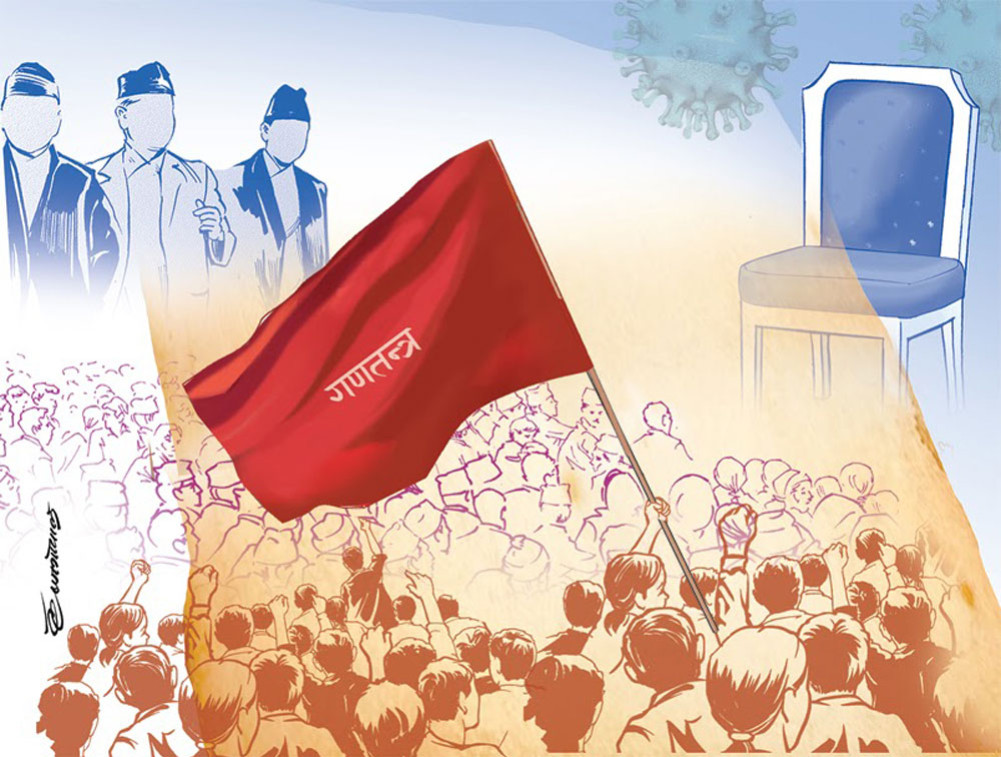
After the republic, the parties presented themselves as rulers rather than representatives of the people, as if they had replaced the king. Spent most of the time in power play. He forgot the true promise made in 062/63. This has created frustration and anger among the people.
We use Google Cloud Translation Services. Google requires we provide the following disclaimer relating to use of this service:
This service may contain translations powered by Google. Google disclaims all warranties related to the translations, expressed or implied, including any warranties of accuracy, reliability, and any implied warranties of merchantability, fitness for a particular purpose, and noninfringement.
After seeing the crowd gathered at the airport after the message of February 7, the former king Gyanendra and Rajawadi thought that, 'Nepalese people do not like the change, the republic, so this crowd will establish the monarchy.'
The monarchy that has reached its grave caused this level of chaos due to the manipulation and conspiracy of domestic and foreign reactionary and backward elements. But due to the three-cornered incident, the door to restoring the monarchy has been closed forever. The Republic has gained more power. If the parties learn even a little bit from this incident, the foundations of the republic will not only be strengthened, but it will be transformed into a 'democracy' that provides services and facilities to the people.
There are weaknesses in the governance of the parties. However, this is not the only reason why the royalists have risen. The photo of Yogi Adityanath, the Chief Minister of Uttar Pradesh, India, has been placed in the procession, which has made it clear that, under the guise of power, Gyanendra is motivated to conspire against the republic.
The Nepali people and parties did not want to jail the king and his followers as the culprits of the people's movement who imposed autocracy by taking away civil rights and as recommended by the Rayamazhi Commission or to end the tragedy like the autocratic dictators of the world. Instead, as a former head of state, he has been providing honor and service facilities along with his palace. Freedom of expression from traveling in the country and abroad.
South African leader Nelson Mandela said to those who imprisoned him for 27 years, "Forgive but not forget". In order to establish lasting peace, Mandela said that he would forgive the whites without revenge but would never forget the injustices and atrocities they had committed.
Perhaps the parties adopted this belief regarding the king of Nepal. Not only Gyanendra, the Rayamazhi Commission also did not take revenge on the people who were found guilty of the people's movement. However, Gyanendra took advantage of this liberality of the parties and continued to conspire against the republic.
Gyanendra is shocked, Nepali forgot all my misdeeds. However, the common Nepalese have not forgotten and will not forget the monarchy and the extreme despotic and anti-people actions done by Gyanendra. Even the new generation who didn't see the king's actions got to see the three-cornered Tandava with their own eyes.
King's misrule
The royalists have spread the illusion that under the rule of the king, the country was Ram Rajya or heaven and after the republic, the parties made hell. The reality is different. Taking advantage of the closed society with illiterate and religious society, poverty, lack, and backwardness, did not the monarchy simply rule over the people by declaring itself as the incarnation of Vishnu?
Darbaria Bhardar, Chamche, Hukke, Dhoke and a handful of elites and the bourgeoisie, landlords and their leading feudalism is not the monarchy? Isn't the monarchy an institution that declares excellence based on birth, descent and generation rather than on the basis of merit, ability and popularity, divides the Nepalese society based on race, caste, religion, gender, geography and pushes Nepal back centuries by extreme exploitation, oppression and discrimination?
The monarchy exploited the country by creating a unified and centralized state with one language, one dress, one religion, and the dominance of a single caste. The freedom, equality, fraternity, development, prosperity, science and technology developed in the 15th and 16th centuries in the western countries could not be included in the monarchy period.
The king's brother-in-law continued to complain about the taxes paid by the people. On the contrary, the people were treated as slaves, subjects, slaves, murder, violence, rape, exploitation and other things happened during the monarchy. Words cannot be found to explain the despotism and misrule during Gyanendra's reign since the Darbar massacre. Due to the controversial, defiant and anti-public actions of the king, crown prince and members of the royal family, the monarchy, which has proved unsuccessful in history, is not possible to return.
The impact of geopolitics
Nepal's politics has been affected by the conflicting interests and geopolitical maneuvers of two neighbors. It is not hidden that the western countries have a deeper interest. India has always wanted political power of its own to maintain its influence in Nepal.
After using the monarchy and Congress in that role for a long time, with the fall of the monarchy, India continued to look for that power in Nepal. Due to the inability to trust the current parties and leaders of Nepal, it has also been analyzed that India is trying to re-establish the monarchy as a permanent and strong power and increase the controlled instability.
A republic with federalism, secularism, inclusiveness and democracy is the goal of Nepal and Nepali people. However, India's staunch Hindu party BJP and Narendra Modi, who did not like these issues, envisioned a Hindu nation in Nepal. Rejecting the constitution watered by the blood and sweat of the common Nepalese and imposing an inhumane blockade on Nepal is closely linked to the present alliance.
Even though the then Prime Minister KP Sharma Oli's nationalist stance and the struggle of the Nepali people were forced to open the embargo, India was still planning to return the Hindu nation to Nepal through some means. Purvaraja was considered the most reliable means of this.
KP Sharma Oli, who has been protesting against India's micromanaging style and conspiracy since the time of issuing the constitution, is the link of India's conspiracy to protest this way and increase chaos. The Nepali people must strongly resist the alliance of the royalists with India.
reform pressure
The indicators of the republic are ahead of the development indicators of the monarchy in all respects. The country is gradually moving forward in the direction of development and prosperity. However, it is true that the good governance and service delivery as expected by the common people has not been achieved.
It is also true that the style of the leaders is more like the king of yesterday than the people-friendly or republican, exploitative feudalism and moving away from the people. The newly emerged parties also abused the party and the leader in the name of the old ones but did not show any way of development and exit. In this way, it seems that the monarchists are trying to take advantage of the dissatisfaction caused by the politics of the parties, which is clouded by the power interests and mutual bitterness.
In the period after the promulgation of the Constitution of 2072, the parties have to show managerial skills to institutionalize and sustain the change, to bring about changes in the living standards of the people. However, the parties do not seem to have learned from the history of autocracy raising its head if the change is not institutionalized by linking it with the people's living standards. Due to the unhealthy and narrow competition of the parties, manipulation of domestic and foreign elements and instability, the parties have not been able to fulfill the people's expectations. Now, the maneuvers of the royalists have alerted the parties to take immediate concrete steps to bring about changes in the standard of living of the people as envisioned by the constitution.
Before the mass movement of 062/63, the parties had promised to be self-critical of their shortcomings. However, after the republic, the parties presented themselves as rulers rather than representatives of the people, as if they had replaced the king. Spent most of the time in power play. He forgot the true promise made in 062/63. This has created frustration and anger among the people. Therefore, the veil of ego and power selfishness in the eyes of the leaders should be opened immediately. Work must respond to the challenge of monarchism.