Taking advantage of the weak and unstable government, the big corrupt people seem to be flourishing in the illegal business of transferring the money of corruption out of the country, investing there or purifying it and re-entering Nepal.
We use Google Cloud Translation Services. Google requires we provide the following disclaimer relating to use of this service:
This service may contain translations powered by Google. Google disclaims all warranties related to the translations, expressed or implied, including any warranties of accuracy, reliability, and any implied warranties of merchantability, fitness for a particular purpose, and noninfringement.
The bribes during the purchase of two widebody aircraft by Nepal Airlines Corporation were transacted outside Nepal. According to a news published in Kantipur Daily on December 18, 41 lakh 40 thousand US dollars of the bribe was managed in countries including Singapore and Dubai.
According to another news, a company named AAR Corp. was found guilty of bribing the government officials of both countries to get a contract for the sale of ships in Nepal and South Africa. The American court also decided to fine the company 55 million dollars.
Similarly, it was found during the investigation of the authority that the suspended managing director of Nepal Telecom, Sunil Paudel, received bribes for information technology procurement outside the country and deposited the amount of such bribes in Singapore's United Overseas Bank. The authority filed a case against Paudel in a special court with the accusation that Paudel had used hundi to launder assets worth 237.5 million rupees. In this regard, the special court has also ordered to provide detailed information about the amount.
If we analyze only the above-mentioned incident that has been made public recently, the recent corruption-related activities are not limited only within the borders of Nepal. In Nepal, the money earned through corruption has started to be managed in countries such as Switzerland and Singapore, which are among the least corrupt countries in the world. In other words, corruption has crossed the borders of the country.
The authority also seems to be aware of this. The Chief Commissioner of the Authority, Prem Kumar Rai, said in October 2080 in the Constitutional Affairs Committee of the House of Representatives that large-scale corruption transactions have started taking place in Singapore, Dubai, Hong Kong and other countries. He also said that it is difficult to get the necessary evidence because there is no agreement to exchange information with such countries while investigating corruption.
The facts being published at different times have shown that money is being illegally transported from Nepal to foreign countries. People and organizations accustomed to the virtual world seem to be making foreign dollar cards through illegal means, sending money abroad through hundi or currency smuggling.
According to a report by Finsin, between 14 July 2014 and 19 January 2016 only 40 million 176 thousand 504 US dollars were illegally exchanged in various countries including Nepal. In this way, various facts of illegal virtual transactions to send foreign money from Nepal were made public.
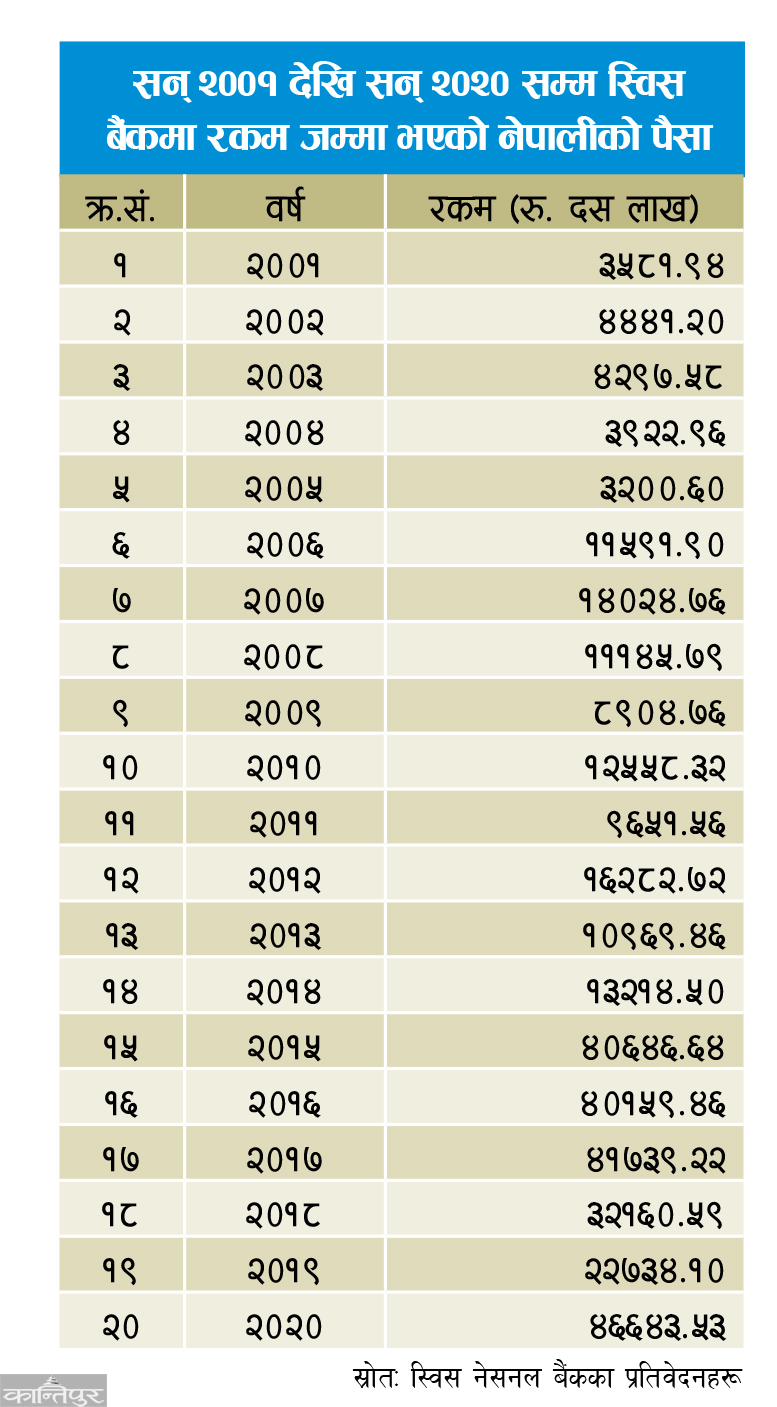
The fact that Nepalis illegally deposited large sums of money in Swiss banks has also been made public. According to the data of the Swiss National Bank, 1 billion 46 million rupees were collected in 1996, 1 billion 86 million rupees in 1997, 2 billion 18 million rupees in 1998, 1 billion 84 million rupees in 1999 and 2 billion 34 million rupees in 2000.
Just looking at Nepali's savings in the Swiss Bank and studying the various events that are being published from time to time, the cases of financial irregularities and corruption transactions are not in the country but outside the country. Corruption 'deals' have started outside Nepal. Another example of corruption crossing borders is the Panama Papers. In the year 2072, the facts about the illegal wealth hidden by various people around the world were published in the public Panama papers. The fact that the International Investigative Journalist Group made public revealed the fact that there are 5 billion 40 million rupees of Nepalese in Swiss banks. Similarly, a few years ago, in collaboration with international investigative journalists, the Center for Investigative Journalism disclosed the fact that more than 52 billion was accumulated in the Swiss National Bank of Nepal alone.
According to the Act 2021 prohibiting Nepalese from investing abroad, no Nepalese citizen can invest abroad and deposit money in foreign banks. But some business houses of Nepal have invested in countries that are considered favorable for tax evasion.
Investigative Journalism Center A study published in 2075 revealed the fact that Nepal's assets are being transferred abroad through informal means, and by setting up companies there and through those companies, bringing money to Nepal and laundering assets by calling them direct foreign investments.
The fact that various high-ranking people of Nepal are also involved in such activities is being publicized at different times. Due to a decision of the then Deputy Governor of Nepal Rastra Bank, Shivraj Shrestha, one billion and 92 million rupees left the country suspiciously. The board of directors of the bank investigated this and suspended Shrestha on 18 October 2076. After this, a committee was formed to investigate Shrestha. The said committee recommended that the government of Nepal should take action against Shrestha for being involved in suspicious activities of money laundering. But the cabinet meeting held on 3rd January 2076 gave immunity to Shrestha and reinstated him. The
fact says that the cases of unethical transactions, economic crimes and corruption transactions between the government, private sector, multinational companies, non-governmental organizations and other entities in Nepal have started to happen outside the country. This is having a negative impact on the overall economic sector of Nepal. There is no situation where the existing corruption control law of Nepal can control the cross-border corruption related transactions. There are some reasons behind this.
First, globalization has created opportunities for transnational corruption due to the rapid expansion of investment, trade and technology transfers between countries, and information technology. Nepal's anti-corruption laws have not made clear institutional arrangements to control cross-border corruption transactions. Likewise, the necessary institutional and legal agreements for the exchange of information have not been reached with the countries where such transactions are taking place and where such transactions may take place. As a result, it becomes easy to hide assets illegally, and large corruption transactions take place outside the country.
Second, is the use of digital technology. Due to the rapid development of digital information technology, money transfer has also become very easy. By misusing such information technology, black money earned illegally within the country has become rampant. Basically, the corrupt use the means of online banking, money transfer services, cryptocurrency, hundi, currency smuggling etc. to illegally transfer money out of the country. Trafficking is being done through information technology due to weak laws and institutional systems.
Third, there is a lack of effective implementation of existing laws. In terms of corruption control in Nepal, the existing legal and institutional structure, international cooperation and information exchange system are also weak. Because of this, the corruption in Nepal has become an international transaction, dealing abroad and dealing money there.
Fourth, is the lack of political will. The most important issue for corruption control is strong political will. But Nepal's political parties are not sensitive about corruption control. Parties are indifferent to corruption control. As a result, sufficient political and diplomatic initiatives have not been taken for the agreement and consensus that should be established between the countries to control corruption related activities across borders. There is also a problem in matters such as information exchange. It is further aggravated by political instability. Taking advantage of the weak and unstable government, it seems that big corrupt people are flourishing in the illegal business of transferring the money of corruption out of the country, investing there or purifying it and bringing it back into Nepal.
What can be done now?
Something needs to be done to bring the cross-border transactions and transactions of corruption under the ambit of action. First, effective implementation of the 2004 United Nations Convention against Corruption is essential. Article 4 of the Convention deals with international cooperation. Article 46 (1) states that States Parties shall provide mutual legal assistance to each other as liberally as possible in investigations, prosecutions and judicial proceedings related to the offenses set forth in the Convention. It is necessary for the government of Nepal to enter into necessary bilateral agreements with various other countries regarding the provision of mutual legal assistance and exchange of information with such countries. Effective implementation of the Convention and joint and organized fight in global cooperation will make it easier to bring back the hidden assets acquired through cross-border corrupt activities and transactions.
Second, the public procurement process should be made more transparent, accountable and responsive. Strong legal and institutional arrangements should be made to make the procurement process transparent, especially for large-scale public procurement schemes such as airplanes, health supplies or other procurement processes. All the details of such purchases, the officials involved in the purchase process and the members of the purchase committee, should be digitized and made transparent so that the general public and knowledgeable people can easily get information about the entire process including the purchase. This means that citizens themselves can play the role of watchmen.
Third, cross-border cooperation needs to be made more effective and stronger. International cooperation and coordination is essential to make cross-border corruption control effective. Various organizations like Interpol, United Nations should make the mutual cooperation system more strong and effective and bring the cross-border corrupt activities within the legal scope.
Fourth, the empowerment of civil society and effective citizen involvement should be ensured. It is necessary to make the role of citizens effective and strong for the control of corruption not only within the country but also across borders. Citizens can make an important contribution to corruption control by providing information, complaints and monitoring.
Finally, to break the international network of corruption, the integrated efforts of all parties, effective legal system and strong institutional structure are necessary. For this, it is necessary for the government to make a common and organized effort of civil society, the private sector and international organizations to amend and construct domestic laws, effective implementation of laws, necessary for the effective implementation of the International Convention against Corruption 2004.

