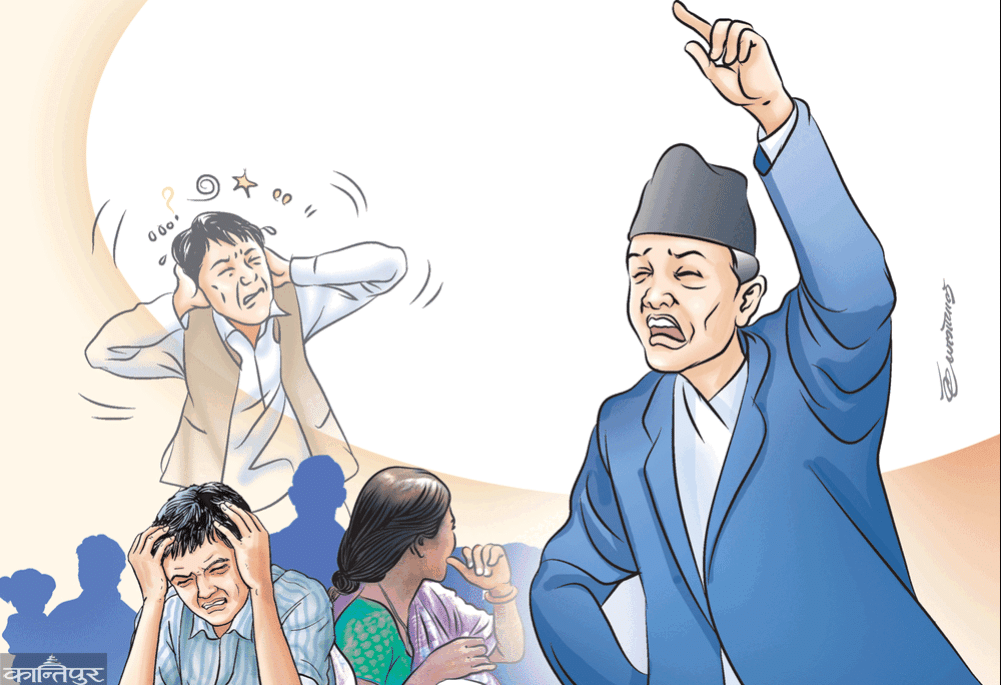
As strong as this current system is, it is seen that it lacks 'life and air'. There is also a possibility that the federal republic will be in danger due to lack of life.
We use Google Cloud Translation Services. Google requires we provide the following disclaimer relating to use of this service:
This service may contain translations powered by Google. Google disclaims all warranties related to the translations, expressed or implied, including any warranties of accuracy, reliability, and any implied warranties of merchantability, fitness for a particular purpose, and noninfringement.
"Social networks" which are in high trend now are becoming "indispensable" for any society. From India to America, from China to Britain, from Africa to Australia (big or small), people of all countries are expressing the naked truth of their society and country on social media. If we study the thoughts, good thoughts and bad thoughts expressed in various networks around the world, then the 'unprocessed mood' of the people around the world will be revealed.
Almost all the expressions of people pouring out on the networks are the strong waves and seething waves of dissatisfaction with their government and environment. Be it politics or economics, people today seem to be angry with both their times and their rulers. Their eyes are not worried about the future, but angry about the present. This outrage is not unnatural. It is a product of the chaotic environment that pervades the society in which we live.
When King Gyanendra, who was removed from the throne of Nepal, returned to Kathmandu from his visit to Pokhara a few days ago, the crowd of people seen at Tribhuvan Airport to 'welcome' him was not natural. His alleged supporters used social media to rally that crowd in favor of Gyanendra Shah. This does not mean that there were no spontaneous participants in that crowd. However, that number was not that impressive. Supporters of Gyanendra worked very hard to direct people to their side through social media. Their hard work was successful.
After walking the path of the Federal Republic of Nepal, the political leaders could not decide the destination. Those who understood the problem were not in a position to make decisions. In those places, there were leaders who said that they would not reach America by riding a bullock cart. However, Nepalese people reached the federal republic by riding bullock carts. However, the heroes of the republic could not easily manage the republic in time. Nepalis were not the only ones interested in making the constitution of Nepal. Many rich countries of the world were interested in the physical "development" of a country like Nepal, which is rich in terms of nature. The neighborhood did not matter. Anyway, the constitution of republic Nepal was made. A directly elected parliament was established. To strengthen it, 'proportional election' was added.
However, the "sovereign" capacity of the Constitution of Federal Republic of Nepal could not be established for the sake of the people, which was made after such a long time. This constitution became the text of a 'special class'. People's wishes and expectations could not be met. The Federal Parliament was also established only as a mechanism to form the federal government. The self-centered and apolitical behavior of the party leaders was not compatible with the federal republican constitution.
Federal Parliament elections were held twice after the promulgation of the Constitution. In the manifestos prepared for these elections, all parties big, small and medium mentioned their programs and 'promises' in beautiful words. However, the people did not believe in those promises. As a result, no party could get a majority.
Even before the epochal change, the situation of the country was very difficult for the people. However, the leaders of the 'historical' party never tried to understand their role and responsibility. Equations between Congress, UML and Maoist parties have been made and changed many times. Regional and small parties could not defend their existence in this game of big party equation. Based on their compatibility, they became the leaders of the three big parties. Various types of inter-caste 'coalitions' were formed. None of the party leaders wanted to operate on this chaotic situation. It was not unusual for leaders of
parties to take the path to power. However, it was not unusual for alliances formed with the purpose of climbing the ladder of power 'anyway' to be ineffective in terms of the paramount development of Nepal and the Nepalese people. Because of the personal interests of those in power rather than the broad political interests of the country, the work for the welfare of the people could not be done according to the purpose of the federal republican constitution. The people were overwhelmed by the incompetence and inaction of the governments formed during this period. There was no force in the case that the opponents of the federal republic used the growing dissatisfaction of the people with the government to 'return' the Hindu religion, the Hindu nation and the Hindu king.
Their slogan of making King Gyanendra, who was deposed by the people, the 'savior' of the Hindu nation of Nepal, was reduced to the status of a high-level joke. The face of Yogi Adityanath, the Chief Minister of India's Uttar Pradesh government, shown at the demonstration in favor of the Hindu King, did not attract the Nepalese people. No matter how hard the royalists tried to gather a 'crowd' to welcome Gyanendra, the crowd gathered was not qualitative. Such a crowd remains as a tamasa. Nothing can be more than that. After the
demonstration, Gyanendra Shah himself entered into active politics. He made senior citizen Navraj Subedi, one of the 'warlords' of the panchayat system, the commander of his restoration campaign. This shows the extent of Gyanendra Shah's political ability and knowledge. Gyanendra is not the problem of today's Nepal. Former dictators are nowhere to be found on the economic, social and strategic map of the changing world. People of the species who earn pulses and rice by singing the praises of Gyanendra are slowly disappearing. Their exodus is a natural and gradual process.
The most striking thing here is the same. The established political leadership in Nepal tries to do the politics of convenience. The leaders of the political parties who considered themselves to be the agents of the epochal changes of 2062-63 wrote the constitution, but did not want to follow its spirit. They did not make any attempt to bring about structural changes in the regime. They did not look for a way to remove the dominance of the Bhunifutta class, who were called 'Tathabhatha', from the country's governance system. Knowingly or unknowingly, whether they are women or tribals, political parties have created a strategy to win only the rich, wealthy and 'Kul-Gharan' candidates from all regions. The purpose of federalism narrowed as the
parties fell under the siege of the Bhunifutta class nurtured by Gyanendra and his predecessors. The provincial government and central institutions of the federal republic did not try to make the culturally strong and prosperous castes and tribes autonomous, whether they are from the mountains or from Madhesh. What development and what development? None of the parties were ready to go down to the people's level and identify their hopes. The leaders of the political parties did not want to face the truth that the federal structure cannot be strengthened unless the state and local governments are strengthened. The government has been formed at the provincial and local levels. However, how to establish coordination between financial resources and practical aspects for the operation of that government? Never thought about it.
Job opportunities in the country have not been opened. Tanneris are migrating abroad. No party leader is serious about finding opportunities in the country as an alternative to foreign employment. The anger towards the unimaginative leadership that wants to run the country with the money earned from foreign employment is not at all unnatural.
Now there is no coordination between the three levels of government. Even after two decades of transformation, whether at the central level or at the provincial level or at the local level, the leaders of the political parties have not even drawn a blueprint for the management and development of the country's resources and the delivery of essential services to the people. The right to be exercised by the provincial and local governments has not been able to come out of the boundaries of the Singha Darbar.
Undoubtedly, the current system is stronger than the system that prevailed in the country 40 years ago. People are also able to claim their 'rights'. They can abuse the leader by name. Could the king have been called that way yesterday? Of course it couldn't. However, no matter how strong this current system is, it is seen that it lacks 'life and air'. There is also a possibility that the Federal Republic will be in danger due to lack of life.
should be regarded as unfortunate – no political party leaders seem to want to get to the nitty-gritty. Now, both the state and the people have started to distrust each other. This situation is increasing. In this situation, it is necessary for all parties to work together to make the federal government system effective. Like now, the country will not be moved by ducks or chickens.
People have looked for patriotism in political parties. Patriotism is not the worship of Madhesh, hills and mountains, forests and rivers. This is the satisfaction that comes after fulfilling the aspirations of the people. Until the politics is brought to that level, what is the point of gossiping?