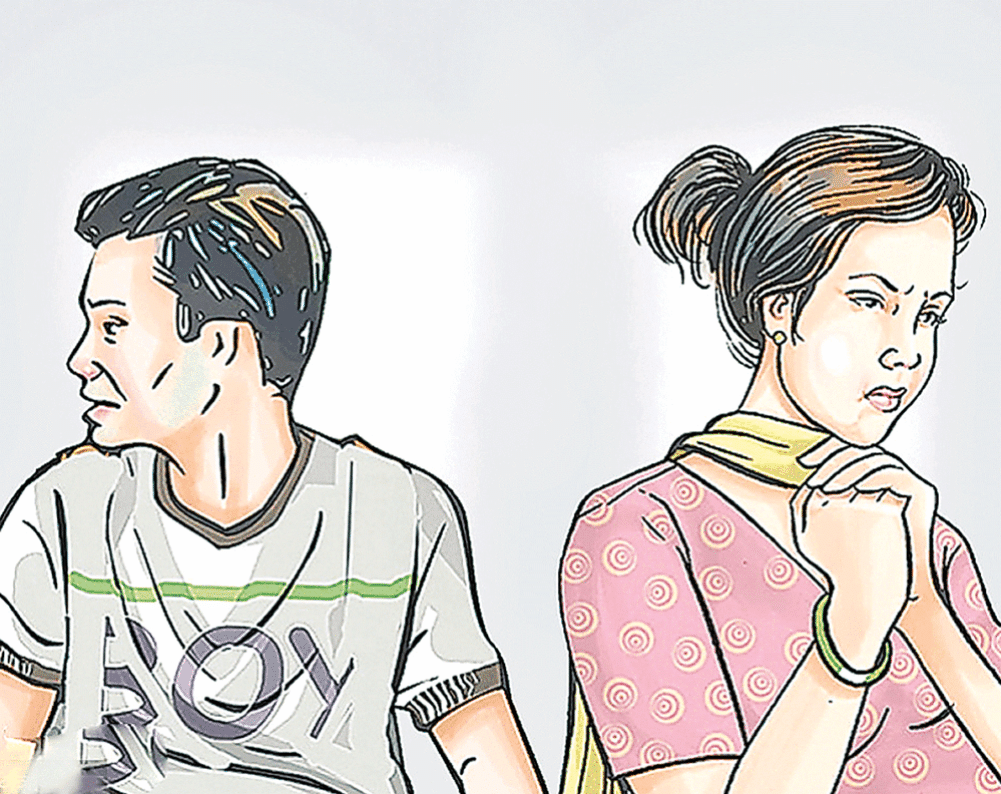
After the divorce of the parents, their children have not only lost the love, affection, upbringing, education and support of both, but also they are affected by economic, social and family problems.
We use Google Cloud Translation Services. Google requires we provide the following disclaimer relating to use of this service:
This service may contain translations powered by Google. Google disclaims all warranties related to the translations, expressed or implied, including any warranties of accuracy, reliability, and any implied warranties of merchantability, fitness for a particular purpose, and noninfringement.
In today's changing times, it has become common for husbands and wives to get divorced when there is a conflict in the marital relationship that was created to maintain social order. If there is no mutual love, respect, trust and harmony between husband and wife, the relationship is not healthy and cannot last long. It is the right of every person to end such a relationship and lead a happy life if there is discord and discord between husband and wife.
Our laws have also made it possible for husband and wife to get divorce easily if they want. According to which divorce seems to be on the rise recently. But due to divorce, their children have to face a lot of pressure, stress and difficult situation. After the divorce of the parents, their children cannot easily get upbringing, education, health and security, and they are also affected by economic, social and psychological effects.
According to the data of the National Identity Card and Registration Department, 48 thousand 981 cases of divorce were registered in the previous financial year. In the annual report of the Supreme Court, it is mentioned that divorce cases are 11.43 percent of the cases registered in the courts across the country.
Divorce cases in Nepal have increased by almost 5 times in a period of 10 years. According to the report, in 2068/69, there were 7 thousand 704 divorce cases in all three levels of courts, while in 2078/79, they reached 37 thousand 434. It seems that most of the cases of divorce are due to abuse, beating, and mental stress on women by their husbands and families. Discriminatory social order, desire for economic social freedom and other compelling circumstances are equally responsible for the rise in divorce.
According to the Civil Code, both husband and wife can divorce at any time. If divorce is to be done on the sole desire of the husband, there must be four conditions. If the wife lives separately for more than three years without taking permission, if she is not fed or kicked out of the house, if there is physical or mental suffering, and if it is determined that she has had sex with another man, the husband can divorce her.
There is a law that allows a wife to divorce in six cases. If the husband lives apart for more than 3 years, does not give him food or throws him out of the house, if he causes physical or mental suffering, if he remarries, if he has sex with another woman, if he forces his wife, the wife can get a divorce. Divorce laws are somewhat lenient for women. Section 82 (c) of the Civil Code does not automatically divorce the first wife when the husband remarries. However, it is mentioned that if a married woman marries a second time without divorce, the relationship between husband and wife is considered to be automatically terminated.
Divorce has a negative impact on children's psychology, education, health and access to various facilities. According to sociologists and legal experts, some children run away from home, fall into drug addiction, labor exploitation after parental discord. After the divorce of the parents, their children have not only lost the love, affection, nurturing, education and support of both, but they are also affected by economic, social and family problems.
The statistics also show that his children have lost the right to live with both parents due to family disintegration. According to the 2078 census, 78 percent of the total children in the country are living with both parents. It is mentioned in the data that 17 percent lived only with their mother. About 5 percent of children do not live with both parents. In the 2068 census, the number of children living with both parents was 87.07 percent. 10 years ago, the number of children who were not able to live with both parents was only 2.45 percent.
According to sub-section 5 of section 115 of the Civil Code 2074, if the husband and wife are separated, if there are any minors, their upbringing, education and treatment arrangements shall be according to the agreement of the husband and wife, and if there is no such agreement, the custody of the mother for minors who have not completed 5 years of age, the custody of the father for minors who have completed 10 years of age, and the custody of the minor who has completed 10 years of age. There is a system that can. According to Section 118, even if the marital relationship between the husband and wife ends, the legal rights and obligations of the parents towards the children born from him will continue.
Because of divorce, some of the children's rights provided by the Children's Act 2075 have been taken away. According to a study by the United Nations agency UNICEF, 80 percent of the brain has developed when children are 3 years old. If both parents do not spend enough time with the child at this age, it has been pointed out that mental and practical problems will occur in children.
Both parents should be responsible for protecting children from the effects of divorce. It is important for parents to pay attention to solving their problems so that the child's physical and mental health, all-round development, family and social relations and daily lifestyle are not affected.